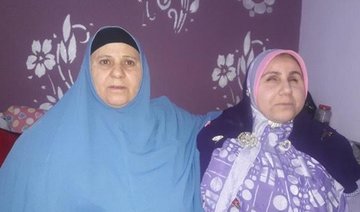
CAIRO: 42 Egyptian women were honored by Egyptian President Abdel Fattah El-Sisi as part of nationwide celebrations on Wednesday marking Mother’s Day.
Speaking on the occasion, Sisi praised “the greatness of Egyptian women,” in a ceremony held at a Cairo hotel.
Public figures, ministers, and Egypt’s first lady attended the event.
Maya Morsi, Chairwoman of the National Council for Women (NCW), said Egyptian women are Egypt’s third line of defense, after the army and the police, according to Al-Masry el-Youm newspaper.
Morsi said Egypt has a clear policy and approach to empowering women across all fields, referring to legislation and unprecedented laws recently issued to protect the rights of Egyptian women.
Meanwhile, Egyptian female celebrities filled social media with heartwarming messages as they expressed their gratitude towards mothers and motherhood.
Egyptian actress Donia Samir Ghanem sent her wishes to her mother Dalal Abdel Aziz in the form of a picture she has posted on her official Twitter account.
Egyptian singer Angham chose to celebrate the occasion her own way, by sharing a video of her newly released song that celebrate mother's love. “Mother, my backbone, my support, in your shadow I live .. no matter what I do to you is never enough.” said the song's lyrics.
Meanwhile, singer Carmen Soliman, who was just blessed with a baby, posted on Instagram her latest song on how motherhood has changed her life, while asking fans to share the song with their beloved mothers.
The Arab world marks Mother’s day on March 21 of every year.

President El-Sisi honors 42 Egyptian women on Mother's Day
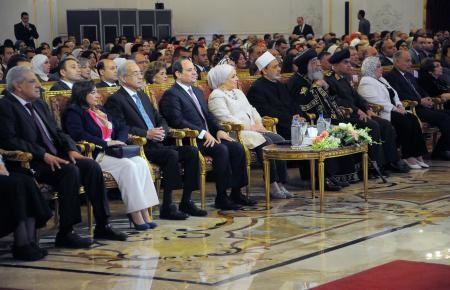
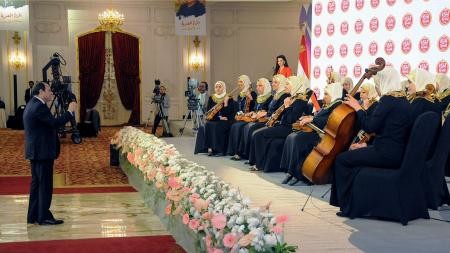
Afghan barbers under pressure as morality police take on short beards
KABUL: Barbers in Afghanistan risk detention for trimming men’s beards too short, they told AFP, as the Taliban authorities enforce their strict interpretation of Islamic law with increasing zeal.
Last month, the Ministry for the Propagation of Virtue and Prevention of Vice said it was now “obligatory” to grow beards longer than a fist, doubling down on an earlier order.
Minister Khalid Hanafi said it was the government’s “responsibility to guide the nation to have an appearance according to sharia,” or Islamic law.
Officials tasked with promoting virtue “are obliged to implement the Islamic system,” he said.
With ministry officials patrolling city streets to ensure the rule is followed, the men interviewed by AFP all spoke on condition of anonymity due to security concerns.
In the southeastern province of Ghazni, a 30-year-old barber said he was detained for three nights after officials found out that one of his employees had given a client a Western-style haircut.
“First, I was held in a cold hall. Later, after I insisted on being released, they transferred me to a cold (shipping) container,” he said.
He was eventually released without charge and continues to work, but usually hides with his clients when the patrols pass by.
“The thing is that no one can argue or question” the ministry officials, the barber said.
“Everyone fears them.”
He added that in some cases where both a barber and clients were detained, “the clients have been let out, but they kept the barber” in custody.
Last year, three barbers in Kunar province were jailed for three to five months for breaching the ministry’s rules, according to a UN report.
‘Personal space’
Alongside the uptick in enforcement, the religious affairs ministry has also issued stricter orders.
In an eight-page guide to imams issued in November, prayer leaders were told to describe shaving beards as a “major sin” in their sermons.
The religious affairs ministry’s arguments against trimming state that by shaving their beards, men were “trying to look like women.”
The orders have also reached universities — where only men study because women have been banned.
A 22-year-old Kabul University student said lecturers “have warned us... that if we don’t have a proper Islamic appearance, which includes beards and head covering, they will deduct our marks.”
In the capital Kabul, a 25-year-old barber lamented that “there are a lot of restrictions” which go against his young clients’ preference for closer shaves.
“Barbers are private businesses, beards and heads are something personal, they should be able to cut the way they want,” he said.
Hanafi, the virtue propagation minister, has dismissed such arguments, saying last month that telling men “to grow a beard according to sharia” cannot be considered “invading the personal space.”
Business slump
In Afghanistan, the majority are practicing Muslims, but before the Taliban authorities returned to power in 2021, residents of major cities could choose their own appearance.
In areas where Taliban fighters were battling US-backed forces, men would grow beards either out of fear or by choice.
As fewer and fewer men opt for a close shave, the 25-year-old Kabul barber said he was already losing business.
Many civil servants, for example, “used to sort their hair a couple of times a week, but now, most of them have grown beards, they don’t show up even in a month,” he said.
A 50-year-old barber in Kabul said morality patrols “visit and check every day.”
In one incident this month, the barber said that an officer came into the shop and asked: “Why did you cut the hair like this?“
“After trying to explain that he is a child, he told us: ‘No, do Islamic hair, not English hair’.”