Blue-chips lift Saudi Arabia’s stock market, UAE’s Aldar and Emaar climb

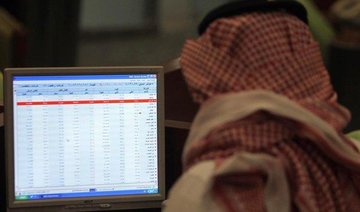
Saudi Arabia’s stock market rose on Wednesday, lifted by its expected inclusion in the secondary FTSE emerging market index. (Reuters)
Updated 06 February 2019
Follow

Blue-chips lift Saudi Arabia’s stock market, UAE’s Aldar and Emaar climb

RIYADH: Saudi Arabia’s stock market rose on Wednesday, lifted by its expected inclusion in the secondary FTSE emerging market index, while United Arab Emirates’ markets were boosted by its top two property companies.
The Saudi index gained 0.5 percent to close at 7,762 points, backed by leading stocks that investors expect to attract foreign funds if the FTSE upgrade is confirmed at the end of this month.
Al Rajhi Bank rose 1 percent, with the stock going ex-dividend on Monday. National Commercial Bank added 0.9 percent and miner Ma’aden gained 2.6 percent while retail play Jarir rose by 3.2 percent.
Saudi Electricity Co, however, fell by 4.2 percent after reporting a 5.5 billion riyal ($1.5 billion) loss for the fourth quarter. The company said shifting to IFRS accounting standards had affected its results, but gave no details.
The loss was bigger than forecasts from SICO Bahrain and NCB Capital of 878 million riyals and 1.58 billion riyals respectively.
“The Saudi market may stall around current levels for some time, facing technical resistance at 7,800 points and waiting for positive news that can move it up again, like the FTSE inclusion decision,” said Muhammad Faisal Potrik, head of research at Riyad Capital.
The index peaked this month at 7,839 points.
The Abu Dhabi index rose 0.9 percent, with Aldar Properties adding 2.8 percent after the company said it had signed a joint venture agreement with Dubai’s Emaar Properties to develop local and international projects worth as much as 30 billion dirhams ($8.2 billion).
Emaar rose 2.2 percent, lifting the Dubai index by 0.8 percent.
Neither company provided details of the venture’s likely impact on earnings, but the deal could help to cut costs and aid Aldar’s overseas expansion.
The Qatar index was down 1.2 percent, dragged lower by Qatar Gas Transport’s 6 percent drop as it went ex-dividend. The Al Rayan Qatar exchange-traded fund listed on Wednesday with initial assets exceeding $120 million. Focused on sharia-compliant stocks, it is Qatar’s second locally listed ETF. Amwal’s QE Index ETF, with assets of $40 million, also listed this month.
Egypt’s index closed 0.2 percent higher as real estate firm SODIC soared 10 percent to 24.11 Egyptian pounds. CI Capital raised its target price for the stock to 32 pounds.

SAUDI ARABIA
* The index rose 0.5 percent to 7,762 points.

DUBAI
* The index added 0.8 percent to 3,207 points.

ABU DHABI
* The index rose 0.9 percent to 4,567 points.

QATAR
* The index fell 1.2 percent to 8,873 points.

EGYPT
* The index rose 0.2 percent to 17,147 points.

KUWAIT
* The index fell 0.3 percent to 6,687 points.

BAHRAIN
* The index lost 0.3 percent to 1,336 points.

OMAN
* The index rose 0.3 percent to 4,796 points.

European gas prices soar almost 50% as Iran conflict halts Qatar LNG output

Updated 02 March 2026
Follow

European gas prices soar almost 50% as Iran conflict halts Qatar LNG output

  • Analysts warn prolonged disruption could push prices higher
  • Some shipments of oil, LNG through Strait of Hormuz suspended
  • Benchmark Asian LNG price up almost 39 percent

LONDON: ​Benchmark Dutch and British wholesale gas prices soared by almost 50 percent on Monday, after major liquefied natural gas exporter Qatar Energy said it had halted production due to attacks in the Middle East.

Qatar, soon to cement its role as the world’s second largest LNG exporter after the US, plays a major role in balancing both Asian and European markets’ demand of LNG.

Most tanker owners, oil majors and ‌trading houses ‌have suspended crude oil, fuel and liquefied natural ​gas shipments ‌via ⁠the ​Strait of ⁠Hormuz, trade sources said, after Tehran warned ships against moving through the waterway.

Europe has increased imports of LNG over the past few years as it seeks to phase out Russian gas following Russia’s invasion of Ukraine.

Around 20 percent of the world’s LNG transits through the Strait of Hormuz and a prolonged suspension or full closure would increase global competition for other ⁠sources of the gas, driving up prices internationally.

“Disruptions to ‌LNG flows would reignite competition between ‌Asia and Europe for available cargoes,” said ​Massimo Di Odoardo, vice president, gas ‌and LNG research at Wood Mackenzie.

The Dutch front-month contract at the ‌TTF hub, seen as a benchmark price for Europe, was up €14.56 at €46.52 per megawatt hour, or around $15.92/mmBtu, by 12:55 p.m. GMT, ICE data showed.

Prices were already some 25 percent higher earlier in the day but extended gains ‌after QatarEnergy’s production halt.

Benchmark Asian LNG prices jumped almost 39 percent on Monday morning with the S&P Global ⁠Energy Japan-Korea-Marker, widely used ⁠as an Asian LNG benchmark, at $15.068 per million British thermal units, Platts data showed.

“If LNG/gas markets start to price in an extended period of losses to Qatari LNG supply, TTF could potentially spike to 80-100 euros/MWh ($28-35/mmBtu),” Warren Patterson, head of commodities strategy at ING, said. The British April contract was up 40.83 pence at 119.40 pence per therm, ICE data showed.

Europe is also relying on LNG imports to help fill its gas storage sites which have been depleted over the winter and are currently around 30 percent full, the latest data from Gas Infrastructure ​Europe showed. In the European carbon ​market, the benchmark contract was down €1.10 at €69.17 a tonne