In Somalia, women defy strict rules to play football

1 / 7
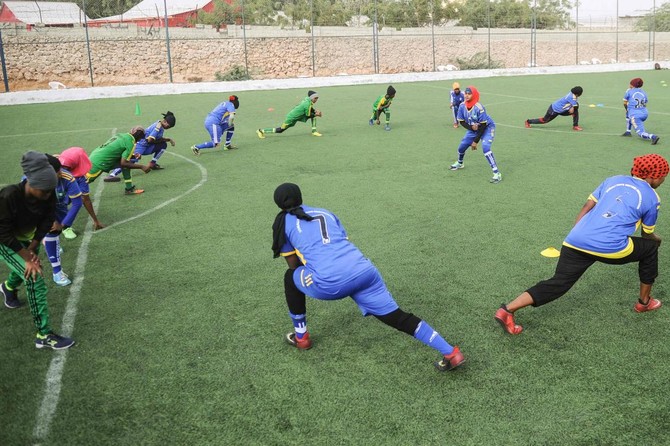
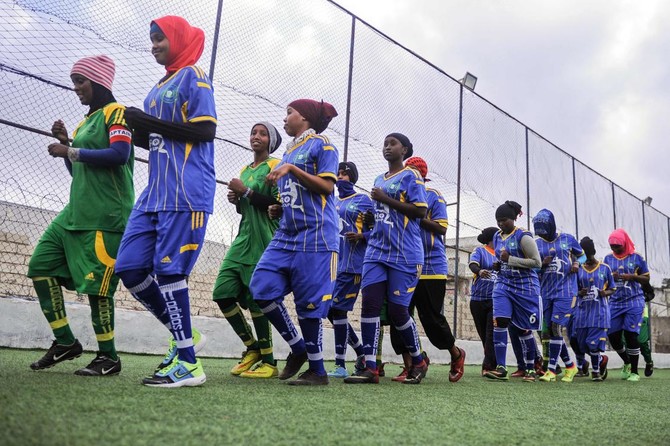
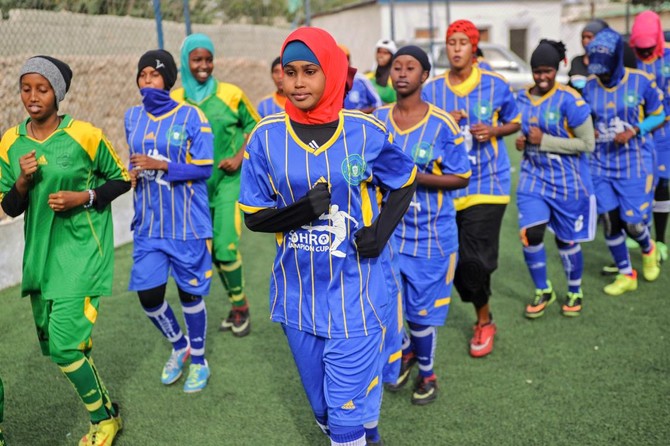
Somali football players of Golden Girls Football Center, Somalia’s first female soccer club, attend their training session at Toyo stadium in Mogadishu, on March 5, 2018. (AFP/Mohamed Abdiwahab)
2 / 7
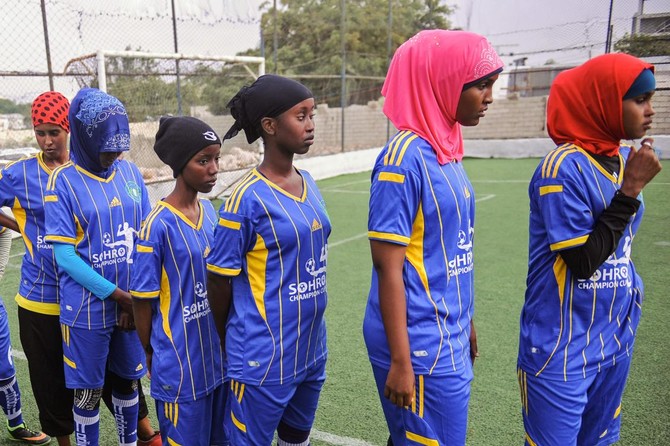
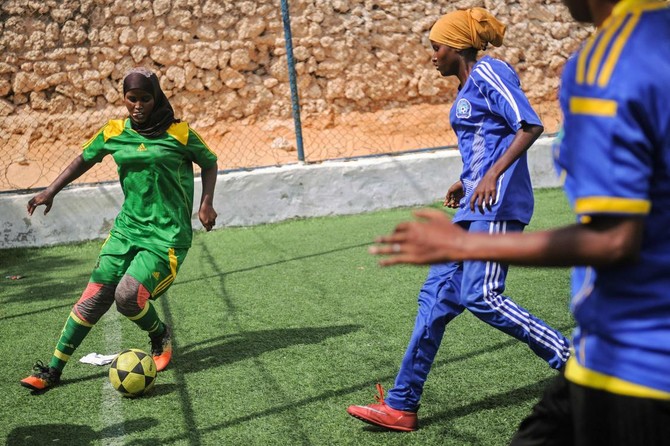
Somali football players of Golden Girls Football Center, Somalia’s first female soccer club, attend their training session at Toyo stadium in Mogadishu, on March 5, 2018. The sight of young women playing football is highly unusual in Somalia, due to societal pressures as well as fear of Al-Shabab. The Golden Girls Football Center which was founded by local NGO in 2017 and currently has about 60 players, has aim to provide opportunities for Somali women to play football hoping to encourage them, in the future, to be national women’s football team players. (AFP/Mohamed Abdiwahab)
3 / 7
Somali football players of Golden Girls Football Centre, Somalia's first female soccer club, attend their training session at Toyo stadium in Mogadishu, on March 5, 2018. The sight of young women playing football is highly unusual in Somalia, due to societal pressures as well as fear of Al-Shabaab. The Golden Girls Football Centre which was founded by local NGO in 2017 and currently has about 60 players, has aim to provide opportunities for Somali women to play football hoping to encourage them, in the future, to be national women’s football team players. (AFP/Mohamed Abdiwahab)
4 / 7
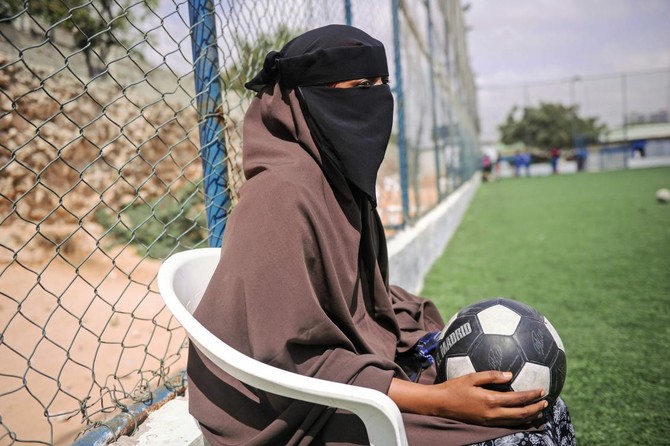
Aisha Alli, 25, a Somali football player of Golden Girls Football Center, Somalia’s first female soccer club, watches a match during a training session at Toyo stadium in Mogadishu, on March 5, 2018. The sight of young women playing football is highly unusual in Somalia, due to societal pressures as well as fear of Al-Shabab. The Golden Girls Football Center which was founded by local NGO in 2017 and currently has about 60 players, has aim to provide opportunities for Somali women to play football hoping to encourage them, in the future, to be national women’s football team players. (AFP/Mohamed Abdiwahab)
5 / 7
Somali football players of Golden Girls Football Center, Somalia’s first female soccer club, attend their training session at Toyo stadium in Mogadishu, on March 5, 2018. The sight of young women playing football is highly unusual in Somalia, due to societal pressures as well as fear of Al-Shabab. The Golden Girls Football Center which was founded by local NGO in 2017 and currently has about 60 players, has aim to provide opportunities for Somali women to play football hoping to encourage them, in the future, to be national women’s football team players. (AFP/Mohamed Abdiwahab)
6 / 7
Somali football players of Golden Girls Football Center, Somalia’s first female soccer club, attend their training session at Toyo stadium in Mogadishu, on March 5, 2018. The sight of young women playing football is highly unusual in Somalia, due to societal pressures as well as fear of Al-Shabab. (AFP/Mohamed Abdiwahab)
7 / 7
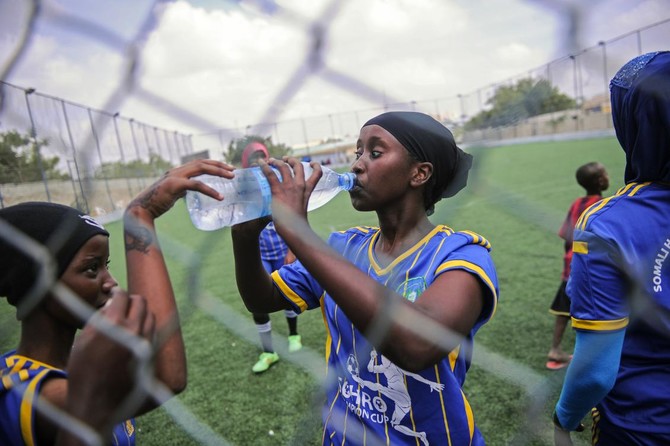
Somali football players of Golden Girls Football Center, Somalia’s first female soccer club, drink water during their training session at Toyo stadium in Mogadishu, on March 5, 2018. The sight of young women playing football is highly unusual in Somalia, due to societal pressures as well as fear of Al-Shabab. The Golden Girls Football Center which was founded by local NGO in 2017 and currently has about 60 players, has aim to provide opportunities for Somali women to play football hoping to encourage them, in the future, to be national women’s football team players. (AFP/Mohamed Abdiwahab)
Updated 21 March 2018
Follow

In Somalia, women defy strict rules to play football

MOGADISHU: Shortly after sunrise, a group of young women arrives at a football pitch in Mogadishu, where they shrug off their hijabs — some changing underneath the billowing veil — to reveal their team kit.
Young Somali men stand nearby, some disapproving but all watching closely, as the women jog up and down, dribble a worn-out ball between colorful cones and do sit-ups, less than 200 meters (656 feet) from a heavily guarded security checkpoint.
The sight of young women playing football is highly unusual in Somalia, due to societal pressures as well as fear of Al-Shabab.
The Al-Qaeda linked Islamist group launches regular attacks in Mogadishu and considers forms of entertainment, such as football, to be evil, worse still if women are involved.
“It is obvious that we are scared despite the fact that we put on heavy clothes over our shorts and T-shirts (until) we get to the pitch. It is very difficult to walk normally with sports clothes — we never wear sports clothing in society,” said Hibaq Abdukadir, 20, one of the footballers.
She is among 60 girls, who have signed up to train at the Golden Girls Center in Mogadishu, Somalia’s first female soccer club.
Mohamed Abukar Ali, the 28-year-old co-founder of the center, said he was inspired to create the club after he realized that Somalia had no female footballers.
“We are... trying to make these girls the first Somali female football professionals,” he said.
However this is not an easy task.
“When the girls have to attend training sessions, we have to organize to pick them up and bring them here and back home after the session because they are girls and we think about their security,” said Ali.
“There are so many challenges, from security to lack of resources... but that will not deter our ambition to establish female football clubs in this country,” he said. “We believe it is the right time and we should have the courage to think differently.”
Many of the girls who have joined the club said they had always wanted to try playing football but never had the opportunity.
“I have been playing football for seven months, but my family has only known about it for two months,” said Sohad Mohamed, 19.
“I used to dodge my mother about where I was going because she would not allow me to play football, but at least my mum is okay with it now, even though the rest of my family is not happy.”
In Somalia, it is taboo for women to appear in public dressed in shorts, trousers or T-shirts, with Islamic scholars saying sports clothing is not appropriate Islamic dress for women.
The players wear tights underneath their baggy shorts, and cover their hair, but still face criticism for their dress.
“I come to watch them train but frankly speaking, I would not be happy to see my sister doing it, this is not good in society’s eyes because they look naked,” said Yusuf Abdirahman, who lives near the football field.
Mohamed Yahye, another onlooker, is happy to see women playing football but is also concerned about how they are dressed.
“I think there is nothing wrong with women playing football, the only thing they should change is the dress code, they need to wear something that is not slim-fitting. But as long as their body is not seen, they are in line with the Islamic dress codes,” he said.
However the Golden Girls are not fazed.
“My ambition is so high that I aim for the same progress as those female footballers who play for Barcelona,” said Abdukadir.


How Saudi football scored in the runup to 2026 FIFA World Cup

Updated 03 January 2026
Follow

How Saudi football scored in the runup to 2026 FIFA World Cup

  • Saudi Pro League asserted global dominance with star-studded lineups and record-breaking performances from Asia’s elite top-tier clubs
  • Domestic leagues reached new heights, yet the national team faces mounting pressure ahead of a high-stakes global tournament

DUBAI: FIFA President Gianni Infantino seemed full of optimism on Dec. 21 when he said Saudi Arabia had become a major hub on the global football stage and that the Saudi Pro League was on track to become one of the top three in the world.

With players like Cristiano Ronaldo and Karim Benzema and a nation crazy about the great game, this endorsement perhaps comes as little surprise.

Infantino also predicted a successful World Cup in 2034 when the tournament will be hosted by Saudi Arabia. With infrastructure being built and upgraded, the Expo 2030 venue under construction, and reforms underway, the World Cup seems destined to be a success.

At the 2026 World Cup, Saudi Arabia will face Uruguay, European champions Spain, and Cape Verde in their three Group H matches, taking place in Miami, Atlanta, and Houston respectively. (Reuters/File)

The FIFA boss also praised the progress made not only at the senior national team level and across youth categories, but also in the women’s game, thanks to the backing of football authorities in recent years.

While this paints a positive picture of the game in the Kingdom, it follows the national team’s 1-0 loss to Jordan in the semi-finals of the 2025 Arab Cup. Many supporters will need far more convincing of the team’s prospects going into the New Year.

Although the return of Herve Renard as coach of the Green Falcons following Roberto Mancini’s disappointing stint has resulted in a second consecutive World Cup qualification (and seventh overall), failure to win the Arab Cup in Qatar and some less than inspiring performances means the jury is still out on the Frenchman.

At the 2026 World Cup, Saudi Arabia will face Uruguay, European champions Spain, and Cape Verde in their three Group H matches, taking place in Miami, Atlanta, and Houston respectively.

Saudi fans sharing Infantino’s positive outlook will hope Renard’s men can emulate the historic win over Argentina on that memorable night at Lusail Stadium in 2022. But that is far easier said than done, and many remain unconvinced.

Cristiano Ronaldo celebrates after scoring a goal during the Saudi Pro League. (AFP/File)

For a start, just as Poland and Mexico were alerted to Saudi Arabia’s potential following that humbling of Lionel Messi and co in Qatar, their opponents in the US will likewise be on their guard this time around.

Worryingly for Saudi fans, the team has rarely, if at all, hit the same highs since Saleh Al-Shehri’s equalizer and Salem Al-Dawsari’s stunning strike brought about arguably the most famous win in the Green Falcons’ history.

The 2023 AFC Asian Cup, played in early 2024 and only months after Mancini’s arrival, saw Saudi Arabia eliminated by South Korea on penalties in the round of 16.

World Cup qualification was eventually secured but not before the team needed to negotiate a fourth round group that included Iraq and Indonesia in October.

The semi-final exit at the Arab Cups prompted rumors — immediately denied by the Saudi Arabian Football Federation — that Renard’s job was under threat. Still, it was hardly a ringing endorsement of the way things had turned out on his second stint as national team coach. 

Al-Ahli's Roberto Firmino lifts the trophy as he celebrates with teammates after winning the Asian Champions League. (Reuters/File)

Outspoken Saudi-based football pundit Battal Algoos has been scathing in his criticism of Renard and his employers, and in particular of the excuses for the Arab Cup disappointment.

“It seems to be a contagion that has affected the Saudi camp,” he said on the football show “Filmarma” on Al Arabiya.

“Everyone justifies (their position) through others’ failures. We brought you to win a championship, not to say ‘those before me didn’t win championships, I’m no worse than them’.

“It seems to be contagious, from (SAFF President) Yasser Al-Misehal to Renard. Or their thinking is one and the same.”

Paul Williams, Australian journalist and founder and presenter of “The Asian Game” podcast, was at Lusail Stadium the day Saudi Arabia beat the eventual world champions, but believes urgent fixes are needed by Renard this time round.

New Murabba Stadium. (Supplied)

“There are a multitude of areas that Saudi Arabia need to improve,” he told Arab News. “The obvious is in the final third, where there are still issues finding a reliable avenue to goal, an issue that blighted most of their qualification campaign.

“But they also haven’t yet found a capable replacement in midfield for Salman Al-Faraj, and the entire narrative around Saudi football has changed since before 2022.

“There has always been pressure and expectation from the fans, but that is even more intense now and it feels like that sits heavily on the squad, who are yet to prove they are capable of delivering under that burden of expectation.”

The team’s main concern remains, as it was four years ago in Qatar, its lack of fire power up front and an over-reliance on Al-Dawsari for goals and inspiration. In that sense, at least the 34-year-old talisman can still be relied on.

Al-Ittihad's Karim Benzema celebrates. (Reuters/File)

The Al-Hilal and Saudi Arabia captain provided one of the highlights of 2025 when he was named AFC Player of the Year at the awards ceremony in Riyadh. Al-Dawsari is the only Saudi to have won the Asian award twice.

On an individual level, he enjoyed a stellar 2024-25 season with his club, although Al-Hilal lost out on the Saudi Pro League title to a Benzema-inspired Al-Ittihad.

Al-Dawsari and Al-Hilal came back strongly in the summer to reach the quarter-finals of the 2025 FIFA Club World Cup in the US, along the way drawing 1-1 with Real Madrid in the group stage and brilliantly beating Manchester City 4-3 in the round of 16.

Domestically, however, it is their local rivals that have stolen all the headlines, with their lead at the top of the SPL delighting millions of fans around the world and perhaps in the process reinforcing Infantino’s estimation of the league.

Al-Nassr, now managed by former Al-Hilal boss Jorge Jesus and inspired by the relentlessly enduring Ronaldo, look near invincible at the top of the table, having won all nine matches during this campaign.

The coronation that their fans and the Portuguese legend’s army of global followers had envisioned since he landed in Riyadh three years ago is looking increasingly likely to happen in May. Their end of year report card is glowing 9 out of 10.

Cristiano Ronaldo scores a goal in the Saudi Pro League. (Reuters/File)

Al-Hilal, the self-styled Real Madrid of Asia, can never be counted out however, and the title race in 2026 could be one of the most exciting and close in recent years.

Reigning champions Al-Ittihad, on the other hand, have put up a dismal defense of their title resulting in the sacking of Laurent Blanc, who was succeeded by Sergio Conceicao. Their card will read “must do better.”

Al-Ahli provided further evidence of the SPL’s continental dominance by claiming the 2025 AFC Champions League Elite after beating Japan’s Kawasaki Frontale 2-0 in Jeddah last May. 

Elsewhere, Aramco-owned Al-Qadsiah and newly promoted NEOM provide intriguing plot lines as they sit in fifth and eighth respectively, while Al-Taawoun continue to punch above their weight in third.

One of the standout personalities of the season has been US investor Ben Harburg who — through Harburg Group — acquired 100 percent of Al-Kholood in July, making it the first Saudi club wholly owned by a foreign entity. The purchase opens up new possibilities for the SPL.

Al-Hilal's Salem Al-Dawsari poses with the trophy and the President of the Asian Football Confederation Salman bin Ibrahim Al Khalifa after winning the AFC Player of the Year. (Reuters/File)

There is little debate now that the SPL is the most powerful and entertaining in Asia and could in future years, if Infantino is right, become one of the world’s best. The national team’s standing however, until the 2026 World Cup at least, remains up in the air.