Trump administration says Moscow poses a threat by aiding Saudi Arabia’s opponents

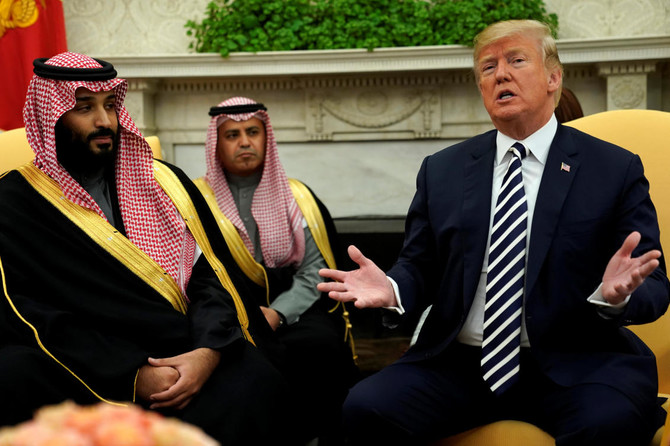
U.S. President Donald Trump welcomes Saudi Arabia's Crown Prince Mohammed bin Salman in the Oval Office at the White House in Washington, U.S. March 20, 2018. REUTERS/Jonathan Ernst
Updated 21 March 2018
Follow

Trump administration says Moscow poses a threat by aiding Saudi Arabia’s opponents

WASHINGTON: Donald Trump and Crown Prince Mohammed bin Salman discussed ways of putting pressure on Russia in opposition to what the US sees as its destabilizing role in the Middle East.
Ahead of talks between the two leaders, in Washington on Tuesday, a senior US administration official said Russia posed a threat to Saudi Arabia’s secuy by aiding Riyadh’s opponents, particularly in Yemen and Syria, and by backing Iran.
“Ultimately, the discussions will center on how can we find joint ways to make Russia pay a price for its activities in Syria and its support for Iran’s missile proliferation into Yemen — all of which risks deepening this crisis and leading to major regional catastrophe,” the official said.
The official, who made the remarks in a briefing to journalists, cited “reckless missile attacks against Saudi Arabia and the Emirates” and attacks on shipping in the Red Sea, as examples of Tehran targeting Riyadh, then being protected from US punitive economic sanctions by Russian vetoes at the UN Security Council.
Trump spoke to Russian President Vladimir Putin on Tuesday, to congratulate him on his re-election to another six year term of office.
He said the two leaders would “probably be meeting in the not-too-distant future to discuss the arms race, which is getting out of control”. They also needed to talk about Syria, Ukraine and North Korea, Trump said.
Russian-Saudi ties have remained strong, including the first visit by a Saudi leader when King Salman visited Moscow in October.
As a result of that trip, Riyadh agreed to purchase an advanced anti-aircraft missile system from Russia, and made deals on oil production.
Washington has made little secret of the fact that it sees Russia as playing the role of both arsonist and fire fighter in its dealings with Saudi Arabia — aiding Tehran and its proxies to shoot increasingly advanced missiles at Riyadh, and then selling defense systems to counter the threat.
“The Russians are helpful on one hand but, behind the scenes, have ratcheted up the prices and ultimately posed greater threats to the Kingdom in ways that are subtly deigned to undermine the US-Saudi relationship,” the administration official said.
The official said the US president would also remind the Saudi crown prince that Russia had pledged to supply Iran with advanced tanks and attack aircraft, when prohibitions against conventional weapon supplies to Iran, put in place as part of the nuclear program deal, come to an end.
Saudi Arabia, its regional allies and the US have taken an increasingly hawkish stance toward Iran, which they see as a growing threat in the region, with an overbearing influence in Baghdad, Sanaa, Beirut and Damascus.
Russian political and military backing has been central in allowing Iran, Syria and Iranian-backed groups in Lebanon and Iraq to form such a powerful bloc. Ranged against them are the US and its Middle Eastern allies, including Saudi Arabia.
Last month, Russia drew condemnation from the US and its allies after it vetoed a UN Security Council resolution that would have pressured Iran over the transfer of weapons to Houthi militias in Yemen.
The decision by the Trump administration to directly address Moscow’s role in talks with Saudi Arabia touches on a difficult subject for the White House.
A special investigation is currently under way into Russian interference in the US election, including efforts by Moscow to promote Trump’s candidacy and block Hillary Clinton’s election.
The probe has infuriated Trump, who insists there has been no collusion between his campaign and Russia.
Special counsel Robert Mueller, a former FBI director who is heading the investigation, has so far secured a guilty plea for giving false testimony to federal agents from Trump’s former national security adviser, Michael Flynn. He has also filed charges against Paul Manafort, Mr.Trump’s former campaign manager, and his deputy Richard Gates, and indicted 13 Russians.
The investigation, which has transfixed Washington and hamstrung the US president during his first year in office, appears to be edging ever closer to Trump himself.


Tarique Rahman takes oath as Bangladesh’s PM after landslide election win

Updated 5 sec ago
Follow

Tarique Rahman takes oath as Bangladesh’s PM after landslide election win

  • 49 members of new cabinet, including ministers and state ministers, have also been sworn in
  • Experts say restoring law and order will be the new government’s main immediate task

DHAKA: Bangladesh Nationalist Party Chairman Tarique Rahman took the oath as prime minister on Tuesday, days after his party secured more than a two-thirds majority in the first vote since a student-led uprising expelled former Premier Sheikh Hasina.

The son of former Prime Minister Khaleda Zia and former President Ziaur Rahman — the BNP’s founder — Rahman returned to Bangladesh in late December after nearly two decades of self-imposed exile.

He led his party to a landslide victory last week, winning an absolute majority with 209 seats in the 300-seat parliament, followed by the Jamaat-e-Islami party, which won 68 seats.

The swearing-in ceremony was held publicly for the first time, under the open sky at the south plaza of the national parliament building.

Rahman’s administration takes over from an interim government led by Nobel laureate Muhammad Yunus who during the 18 months after Hasina’s ouster in August 2024, prepared the country for reform and the next election.

One of the most immediate tasks expected of the new leadership of the country of 170 million is the restoration of law and order — an area in which the caretaker cabinet faced widespread criticism.

A crisis that swept through the police force, which was implicated in the deadly crackdown on the July to August 2024 protests, has left law enforcement significantly weakened and some of its tasks were taken over by the military.

“The law-and-order situation during the interim’s period became very volatile ... The government will have to immediately step in to stop mobocracy,” said Dr. Zahed Ur Rahman, a Dhaka-based political commentator.

“The government must think about withdrawing the military from the streets because they’ve been there for one and a half years, and the military chief repeatedly said that it is having some impact on their professionalism. The regular police should take charge fully.”

In the long-term, the new government will have to focus on reviving the economy.

Under the interim administration the country has recorded little foreign or domestic investment — a situation expected as an elected government will mean more stability to potential investors, Rahman said, warning that the process will also require better energy security.

“We do not have good energy security. Supplying energy at a cheap or affordable price will be tough because this sector suffered rampant corruption during Sheikh Hasina’s regime.

“When investment increases, energy consumption or demand increases. So, it will be a severe problem to manage the power supply,” he told Arab News.

As the BNP leader took the oath of office, he appointed 24 ministers and 25 state ministers, with former commerce minister Amir Khasru Mahmud Chowdhury taking the finance and planning portfolio, former attorney general Md. Asaduzzaman as law minister, and former state minister of power, Ikbal Hasan Mahmud Tuku, at the helm of the Ministry of Power, Energy and Mineral Resources.

The appointment of the foreign minister is still pending.

The new government’s foreign policy will have to address the influence of key players — the US, China, and India, a neighbor that was Bangladesh’s main partner during the 15-year rule of Hasina’s Awami League and with whom Dhaka has been at loggerheads since the former leader fled to New Delhi following her ouster.

Since 2024, India has suspended key transshipment access that allowed Bangladeshi exports to go via Indian ports and airports. It also put on hold most normal visa services for Bangladeshis, who were among its largest groups of medical tourists.

Bangladesh needs to revive the relationship as the “next priority” after restoring law and order, according to Mohiuddin Ahmad, a political historiographer.

“The revival of a good relationship with India will increase people-to-people contact, bilateral trade and commerce, and so on,” he said.

“The next priority should be the normalization of the relationship with India. We need such a relationship with India, which will promote all the elements of a good neighborhood.”