

For youth in Tunisia mining region, it’s ‘mine or die’

1 / 4
A worker gestures at a phosphate production plant in Kef Eddour, in the Metlaoui mining region, one of the main mining sites in central Tunisia, after workers restarted production after a month-long strike, on March 8, 2018. (AFP)
2 / 4
Unemployed Tunisians sit at a phosphate production plant in Kef Eddour. (AFP)
3 / 4
A view of the Metlaoui phosphate production plant on March 8, 2018, in the Metlaoui mining region. (AFP)
4 / 4
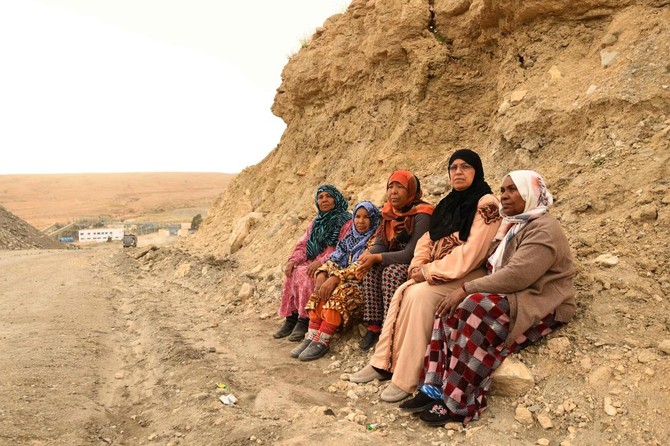
Mothers of unemployed Tunisian men sit at a phosphate production plant in Kef Eddour, in the Metlaoui mining region. (AFP)
Updated 20 March 2018
Follow

For youth in Tunisia mining region, it’s ‘mine or die’

METLAOUI: Dozens of unemployed youths camp out around phosphate mines in central Tunisia, demanding jobs as part of a wave of protests aimed at focusing attention on alleged state neglect.
The surge in anger is the latest in the North African nation’s mining region, where one of the country’s highest unemployment rates and a stark lack of infrastructure have fueled regular unrest.
The most recent confrontations broke out at the end of January, with demonstrators frustrated over hiring practices blocking work for six weeks.
Among the grey dunes of phosphate at the Kef Eddour quarry near the town of Metlaoui, 10 women and about 50 young men — sons and grandsons of miners — eat and sleep in a few prefabricated cabins.
“The phosphate company is the only thing here, we have no development, no jobs,” said Ali Ben Msalah, 25, who has been unemployed since finishing high school.
“For us, the solution is either emigration, death or prison.”
Next to him, Souad Smadah, 60, the daughter and wife of miners, nods as she warms couscous and tea over a fire for the young protesters.
She is angry that none of her five sons have managed to find work at the phosphate mines, accusing businessmen and trade unions of prioritising their relatives when hiring.
Smadah’s eldest earns 300 dinars ($125 or 100 euros) a month in a bakery, almost three-times less than a starting salary at the mine.

'Little Paris'

Metlaoui is rich in phosphate, a highly sought after ore used to make fertilizer of which Tunisia is the world’s fourth largest producer.
Boasting a swimming pool, cinema and tennis courts, it was once nicknamed “Little Paris.”
Today, however, the town’s jobless youth loiter along cratered roads, their teeth yellowed from polluted water.
The Gafsa Phosphate Company (CPG), a state monopoly, has long been the main source of jobs and income for the region.
Decades of corrupt or absent authorities sparked mass protests around the mines in 2008 that were brutally repressed by dictator Zine El Abidine Ben Ali.
His fall in a 2011 uprising which sparked the Arab Spring upheavals sparked hope of change.
But there has been no sign of improvement and a combination of lack of investment, skilled workers and unrest has even seen output nosedive.
“Since the revolution, we can no longer produce the desired tonnage,” said CPG’s general secretary, Ali Khmili.
The company, which used to produce up to 8 million tons a year, barely extracted 4.2 million last year.
The most recent disruption to the mine’s work began in January after the series of demonstrations and riots, fueled by price and tax increases and persistent unemployment, broke out in the region and across Tunisia.
Adding to the tensions are looming municipal elections scheduled for May, with legislative and presidential elections set for 2019.
In Gafsa, the heightening of political tensions has complicated negotiations with the protesters, paralysing production earlier this year.
The halt in work was “essentially linked to a lack of trust” between residents and the government, according to Rabeh Ahmadi, an activist with the Tunisian Forum of Economic and Social Rights (FTDES), an NGO specializing in social issues.
The government eventually demanded legal action and suspended some 1,700 hires in progress in an attempt to quell the unrest.

Unhappy residents

Mining slowly resumed this month and ministers were dispatched to the region last week. But residents unhappy with solutions proposed by the government have continued to disrupt production.
They say it is the only way to force those in power to pay attention to them, as phosphate is crucial to reaching the government’s target of three percent growth
CPG, which is running at a deficit largely because of recurring unrest, has not contributed to the state budget since 2011.
And some at the company warn that by targeting the phosphate output the demonstrators could end up just hurting their region even more.
“The protesters’ claims are legitimate, there is a total absence of the state in this area,” said Rafiq Smida, an CPG engineer and advocate for the phosphate industry.
“But if work there is blocked, 32,000 jobs are at risk.”

Israel’s new NGO regulations threaten vital aid to Palestinians

Displaced Palestinians stand next to destroyed houses in Nuseirat camp in the central Gaza Strip on December 19, 2025. (AFP)
Updated 10 sec ago
Follow

Israel’s new NGO regulations threaten vital aid to Palestinians

  • Bureaucratic pressure ‘is being used for political control, with catastrophic consequences,’ say relief workers

GAZA: New rules in Israel for registering nongovernmental organizations, under which more than a dozen groups have already been rejected, could have a catastrophic impact on aid work in Gaza and the West Bank, relief workers warn.

The NGOs have until Dec. 31 to register under the new framework, which Israel says aims not to impede aid distribution but to prevent “hostile actors or supporters of terrorism” operating in the Palestinian territories.
The controversy comes with Gaza, which lacks running water and electricity, still battling a humanitarian crisis even after the US-brokered October ceasefire in the war between Israel and Hamas, sparked by the Palestinian militant group’s Oct. 7, 2023 attack on Israel.
Israel’s Ministry of Diaspora Affairs and Combating Antisemitism said that, as of November 2025, approximately 100 registration requests had been submitted and “only 14 organization requests have been rejected ... The remainder have been approved or are currently under review.”
Requests are rejected for “organizations involved in terrorism, antisemitism, delegitimization of Israel, denial of the crimes of Oct. 8,” it said.
The amount of aid entering Gaza remains inadequate. 
While the Oct. 10 ceasefire agreement stipulated the entry of 600 trucks per day, only 100 to 300 are carrying humanitarian aid, according to NGOs 
and the UN.
The NGOs barred under the new rules include Save the Children, one of the best-known and oldest in Gaza, where it helps 120,000 children, and the American Friends Service Committee, or AFSC.
They are being given 60 days to withdraw all their international staff from the Gaza Strip, the occupied West Bank, and Israel, and will no longer be able to deliver any aid.
The forum that brings together UN agencies and NGOs working in the area on Thursday issued a statement urging Israel to “lift all impediments,” including the new registration process, that “risk the collapse of the humanitarian response.”
The Humanitarian Country Team for the Occupied Palestinian Territory, or HCT, warned that dozens of NGOs face deregistration and that, although some had been registered, “these NGOs represent only a fraction of the response in Gaza and are nowhere near the number required just to meet immediate and basic needs.”
“The deregistration of NGOs in Gaza will have a catastrophic impact on access to essential and basic services,” it said.
Several NGOs declined to be quoted on the record due to the issue’s sensitivity, saying they had complied with most of Israel’s requirements to provide a complete dossier.
Some, however, refused to cross what they described as a “red line” of providing information about their Palestinian staff.
“After speaking about genocide, denouncing the conditions under which the war was being waged and the restrictions imposed on the entry of aid, we tick all the boxes” to fail the registration, predicted the head of 
one NGO.
“Once again, bureaucratic pressure is being used for political control, with catastrophic consequences,” said the relief worker.
Rights groups and NGOs, including Amnesty International and Human Rights Watch, have accused Israel of carrying out a genocide against Palestinians in Gaza, a term vehemently rejected by the Israeli government.
“If NGOs are considered to be harmful for passing on testimonies from populations, carrying out operational work, and saying what is happening, and this leads to a ban on working, then this is very problematic,” said Jean-Francois Corty, president of French NGO Medecins 
du Monde.
The most contentious requirement for the NGOs is to prove they do not work for the “delegitimization” of Israel, a term that appears related to calling into question Israel’s right to exist, but which aid workers say is dangerously vague.
“Israel sees every little criticism as a reason to deny their registration ... We don’t even know what delegitimization actually means,” said Yotam Ben-Hillel, an Israeli lawyer who is assisting several NGOs with the process and has filed legal appeals.
He said the applications of some NGOs had already been turned down on these grounds.
“So every organization that operates in Gaza and the West Bank and sees what happens and reports on that could be declared as illegal now, because they just report on what they see,” he said
With the Dec. 31 deadline looming in just over a fortnight, concerns focus on what will happen in early 2026 if the selected NGOs lack the capacity and expertise of organizations with a long-standing presence.
Several humanitarian actors said they had “never heard of” some of the accredited NGOs, which currently have no presence in Gaza but were reportedly included in Trump’s plan for Gaza.
The US “is starting from scratch, and with the new registration procedure, some NGOs will leave,” said a European diplomatic source in the region, asking not to be named. 
“They might wake up on Jan. 1 and realize there is no-one to replace them.”