MOSCOW: Russian President Vladimir Putin struck a softer tone toward the West on Monday after winning his biggest ever election victory, saying he had no desire for an arms race and would do everything he could to resolve differences with other countries.
Putin’s victory, which comes at a time when his relations with the West are on a hostile trajectory, will extend his political dominance of Russia by six years to 2024. That will make him the longest-serving ruler since Soviet dictator Josef Stalin and has raised Western fears of spiralling confrontation.
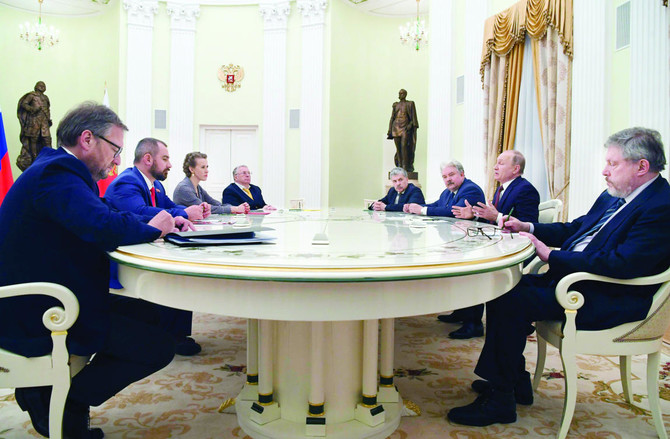
But Putin, 65, used a Kremlin meeting with the candidates he soundly defeated in Sunday’s election to signal his desire to focus on domestic, not international, matters, and to try to raise living standards by investing more in education, infrastructure and health while reducing defense spending.
“Nobody plans to accelerate an arms race,” said Putin.
“We will do everything to resolve all the differences with our partners using political and diplomatic channels.”
His comments, which are likely to be heard with some skepticism in the West following years of confrontation, mark a change in tone after a bellicose election campaign during which Putin unveiled new nuclear weapons he said could strike almost any point in the world.
With nearly 100 percent of the votes counted, the Central Election Commission (CEC), announced that Putin, who has run Russia as president or prime minister since 1999, had won 76.69 percent of the vote.
With more than 56 million votes, it was Putin’s biggest ever win and the largest by any post-Soviet Russian leader.
But the Organization for Security and Co-operation in Europe (OSCE), a rights watchdog, said restrictions on fundamental freedoms, as well as on candidate registration, had restricted the scope for political engagement and crimped competition.
“Choice without real competition, as we have seen here, is not real choice,” the OSCE said in a statement.
The CEC said earlier on Monday it had not registered any serious complaints of violations.
Backed by state TV and the ruling party, and credited with an approval rating of around 80 percent, Putin faced no credible threat from a field of seven challengers.
His nearest rival, Communist Party candidate Pavel Grudinin, won 11.8 percent while nationalist Vladimir Zhirinovsky got 5.6 percent. His most vocal opponent, anti-corruption campaigner Alexei Navalny, was barred from running.
Navalny, who had called on voters to boycott the election, urged his supporters not to lose heart and said his campaign had succeeded in lowering the turnout, accusing authorities of being forced to falsify the numbers.
Near-final figures put turnout at 67.7 percent, just shy of the 70 percent the Kremlin was reported to have been aiming for before the vote.
Kremlin spokesman Dmitry Peskov played down suggestions that tensions with the West had boosted turnout, saying the result showed that Russians were united behind Putin’s plans to develop the country.
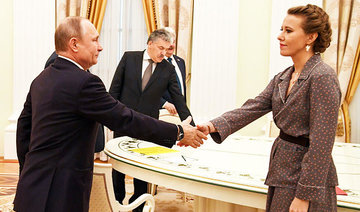
He said Putin would spend the day fielding calls of congratulation, meeting supporters, and holding talks with the losing candidates.
Chinese President Xi Jinping was among the first to offer his congratulations to Putin, but Heiko Maas, Germany’s new foreign minister, questioned whether there had been fair political competition.

After fresh mandate, Putin tells West: ‘I don’t want arms race’
US Catholic cardinals urge Trump administration to embrace a moral compass in foreign policy
- The three cardinals, who are prominent figures in the more progressive wing of the US church, took as a starting point a major foreign policy address that Pope Leo XIV delivered Jan. 9 to ambassadors accredited to the Holy See
ROME: Three US Catholic cardinals urged the Trump administration on Monday to use a moral compass in pursuing its foreign policy, saying US military action in Venezuela, threats of acquiring Greenland and cuts in foreign aid risk bringing vast suffering instead of promoting peace.
In a joint statement, Cardinals Blase Cupich of Chicago, Robert McElroy of Washington and Joseph Tobin of Newark, N.J., warned that without a moral vision, the current debate over Washington’s foreign policy was mired in “polarization, partisanship, and narrow economic and social interests.”
“Most of the United States and the world are adrift morally in terms of foreign policy,” McElroy told The Associated Press. “I still believe the United States has a tremendous impact upon the world.”
The statement was unusual and marked the second time in as many months that members of the US Catholic hierarchy have asserted their voice against a Trump administration many believe isn’t upholding the basic tenets of human dignity. In November, the entire US conference of Catholic bishops condemned the administration’s mass deportation of migrants and “vilification” of them in the public discourse.
The three cardinals, who are prominent figures in the more progressive wing of the US church, took as a starting point a major foreign policy address that Pope Leo XIV delivered Jan. 9 to ambassadors accredited to the Holy See.
The speech, delivered almost entirely in English, amounted to Leo’s most substantial critique of US foreign policy. History’s first US-born pope denounced how nations were using force to assert their dominion worldwide, “completely undermining” peace and the post-World War II international legal order.
Leo didn’t name individual countries, but his speech came against the backdrop of the then-recent US military operation in Venezuela to remove Nicolás Maduro from power, US threats to take Greenland as well as Russia’s ongoing war in Ukraine.
The US Conference of Catholic Bishops was consulted on the statement, and its president, Archbishop Paul Coakley, “supports the emphasis placed by the cardinals on Pope Leo’s teaching in these times,” said spokesperson Chieko Noguchi.
The White House didn’t immediately respond to the AP’s request for comment on Monday.
Cardinals question the use of force
The three cardinals cited Venezuela, Greenland and Ukraine in their statement — saying they “raised basic questions about the use of military force and the meaning of peace” — as well as the cuts to foreign aid that US President Donald Trump’s administration initiated last year.
“Our country’s moral role in confronting evil around the world, sustaining the right to life and human dignity, and supporting religious liberty are all under examination,” they warned.
“We renounce war as an instrument for narrow national interests and proclaim that military action must be seen only as a last resort in extreme situations, not a normal instrument of national policy,” they wrote. “We seek a foreign policy that respects and advances the right to human life, religious liberty, and the enhancement of human dignity throughout the world, especially through economic assistance.”
Tobin described the moral compass the cardinals wish the US would use globally.
“It can’t be that my prosperity is predicated on inhuman treatment of others,” he told the AP. “The real argument isn’t just my right or individual rights, but what is the common good.”
Cardinals expand on their statement in interviews with AP
In interviews, Cupich and McElroy said the signatories were inspired to issue a statement after hearing from several fellow cardinals during a Jan. 7-8 meeting at the Vatican. These other cardinals expressed alarm about the US action in Venezuela, its cuts in foreign aid and its threats to acquire Greenland, Cupich said.
A day later, Leo’s nearly 45-minute-long speech to the diplomatic corps gave the Americans the language they needed, allowing them to “piggyback on” the pope’s words, Cupich said.
Cupich acknowledged that Maduro’s prosecution could be seen positively, but not the way it was done via a US military incursion into a sovereign country.
“When we go ahead and do it in such a way that is portrayed as saying, ‘Because we can do it, we’re going to do it, that might makes right’ — that’s a troublesome development,” he said. “There’s the rule of law that should be followed.”
Trump has insisted that capturing Maduro was legal. On Greenland, Trump has argued repeatedly that the US needs control of the resource-rich island, a semiautonomous region of NATO ally Denmark. for its national security.
The Trump administration last year significantly gutted the US Agency for International Development, saying its projects advance a liberal agenda and were a waste of money.
Tobin, who ministered in more than 70 countries as a Redemptorist priest and the order’s superior general, lamented the retreat in USAID assistance, saying US philanthropy makes a big difference in everything from hunger to health.
The three cardinals said their key aim wasn’t to criticize the administration, but rather to encourage the US to regain is moral standing in the world by pursuing a foreign policy that is ethically guided and seeks the common good.
“We’re not endorsing a political party or a political movement,” Tobin said. The faithful in the pews and all people of good will have a role to play, he said.
“They can make an argument of basic human decency,” he said.