

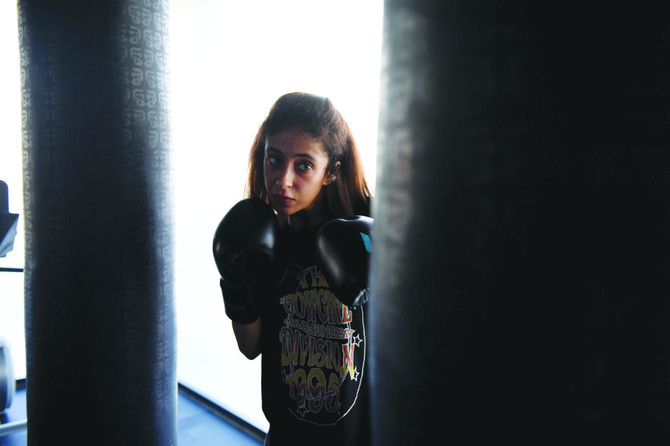
JEDDAH: Throwing punches in a gym tucked away from prying eyes, a Saudi Arabia female boxing trainer is the embodiment of a rapidly changing landscape in the Kingdom.
Halah Al-Hamrani, 41, runs a gym for women called FlagBoxing — its motto is Fight Like A Girl — in the western Red Sea city of Jeddah, offering fitness classes such as callisthenics, CrossFit, boxing and kickboxing. Al-Hamrani is working to empower a generation with little to no exposure to sports.
“On a daily basis, women who have never done sports walk into my class, some with their mothers,” Al-Hamrani told AFP at her gym, which opened in 2016.
“They walk out more confident. Many find their voice. The mothers approach me and say: ‘Thank you for offering such an empowering feeling’.”
At first blush, the gym screams California, not Saudi Arabia.
Wearing headbands and workout attire, women are seen lifting weights, practicing sparring techniques and pounding their fists into a punchbag.
Some of them crumple up their abaya gowns and toss them into a locker. They sweat it out over thumping music.
Around 150 women, including Saudis but also other Arabs, share a sense of camaraderie.
A note scribbled on a whiteboard reads: “I can’t wait to come back!”
Another banner on the wall reads “BADASS.”
“It sometimes feels like a tea party — without the tea and cookies,” Al-Hamrani jokes.
Under Crown Prince Mohammed bin Salman’s Vision 2030 reform plan, the government is seeking to jump-start women’s sports. Only four Saudi women featured in the Rio Olympics in 2016 after two were named in the team for London in 2012 — the first time the Gulf nation sent female athletes to the Games.
The Kingdom has since then been granting more prestige to the idea, appointing prominent Princess Reema bint Bandar to oversee women’s sports.
The country is also moving toward compulsory physical education classes for girls after a ban was scrapped in 2014. Al-Hamrani is involved in shaping the new public school sports curriculum.
As the daughter of an American mother and Saudi father, she was fortunate her parents were open-minded and encouraged sports from an early age.
That start has put her on track to become one of the Kingdom’s early pioneers of women’s boxing training.
For now, her low-profile gym operates out of a residential complex, behind opaque glass walls with no outdoor signage.
The location is available on her website, but even so, some first-timers have to call to find their way.
Some clients view the gym sessions as therapy, Al-Hamrani said. It offers them such a release that she said some of them end up crying.
“I used to be a timid mother who could not look people in the eye,” said a 36-year-old housewife and mother-of-four, and a regular at the gym.
“The gym gave me a voice that I had lost. It gave me strength that I never knew existed.”
But Al-Hamrani said some women have dropped out after they began “expressing themselves boldly” in a way that sometimes makes male relatives feel threatened.
“My husband is unhappy,” was one of the reasons Al-Hamrani was given.
Under the country’s guardianship system, a male family member — normally the father, husband or brother — must grant permission for a woman’s study, travel and other activities. Also holding back women’s sports is an acute shortage of professional female athletes and coaches.
Women’s gyms are slowly proliferating, but the idea of mixed gender sports remains taboo.
And some female professionals still caution against offending cultural sensibilities.
“Sports is empowerment,” said Lina Almaeena, a member of the Kingdom’s advisory Shoura Council, and director of Jeddah United, Saudi Arabia’s first women’s basketball team.
“We are not fighting for mixed gender, abaya-less sporting events. Our aim is not to go against our culture. Our goal is mass participation of women in sports.”


