Syrian TV: Syrian army gives Harasta rebels till 3pm to withdraw

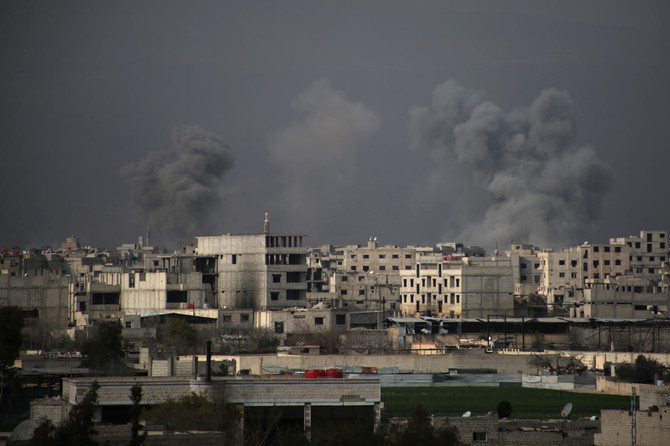
Smoke billows following Syrian government bombardment on the rebel-held besieged town of Harasta, in the Eastern Ghouta region on the outskirts of Damascus on March 10, 2018. (Ammar Suleiman/AFP)
Updated 18 March 2018
Follow

Syrian TV: Syrian army gives Harasta rebels till 3pm to withdraw

BEIRUT: Syrian state TV said the Syrian army had given rebels in the Harasta pocket of opposition-held eastern Ghouta till 3pm local time on Sunday to withdraw, citing its own correspondent.
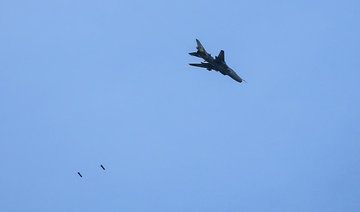
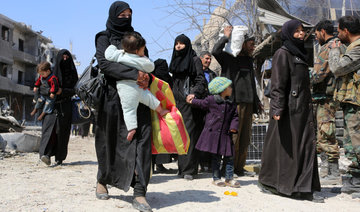
In a month-long assault, pro-Syrian government forces have marched into much of eastern Ghouta, the last major insurgent bastion around Damascus. They have splintered it into three besieged zones, the smallest of which is the Harasta pocket.


Morocco pushes to reform social security system amid inflation and economic pressure, PM says

Updated 6 sec ago
Follow

Morocco pushes to reform social security system amid inflation and economic pressure, PM says

  • Speaking at the World Economic Forum in Davos, Aziz Akhannouch said his government had expanded healthcare to more than 80 percent of its population

DUBAI: Morocco’s prime minister said on Tuesday that the country was pursuing radical social and economic reforms in the wake of inflationary and economic pressures.

Speaking at the World Economic Forum in Davos, Aziz Akhannouch said his government had expanded healthcare to more than 80 percent of its population, up from just 42 percent when he took office three years ago.

He said this also coincided with consistently strong economic growth and headline inflation reducing to below 1 percent. 

“In a world that doubts itself, Morocco has decided to protect its population, reform and look forward,” he told attendees in Davos.

In late 2025, Morocco was rocked by its largest demonstrations in over a decade as youth‑led groups mobilized nationwide against deteriorating public services, deepening social inequality, and chronic unemployment.

Akhannouch said the country was aware of the difficulties facing Moroccans and was determined to ensure the country would remain on a positive trajectory.

Part of this included the provision of financial aid to more than 12 million citizens, and the formation of trusts for orphans to be paid out when they turn 18.

“Health means dignity, if you want to have a decent life you have to have good health,” he said.

Nevertheless, Akhannouch noted that the government had not forgone its budgetary principles — and had in fact balanced the country’s debt payments and achieved successful fiscal reforms. He noted S&P’s decision in 2025 to raise Morocco’s sovereign rating to BBB‑/A‑3 and restore its investment‑grade status.

Speaking on the World Cup, set to be co-hosted with neighbors Spain and Portugal in 2030, he said the project was seen as a nation-building exercise that would help spur Morocco to develop its underlying infrastructure and provide employment opportunities for young Moroccans.

“It will be a growth accelerator,” he said.

“When we build new rail networks and upgrade cities it will have a long-term impact on people.”