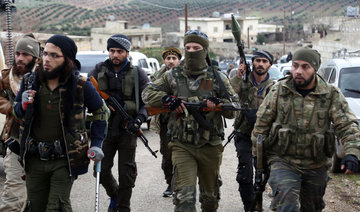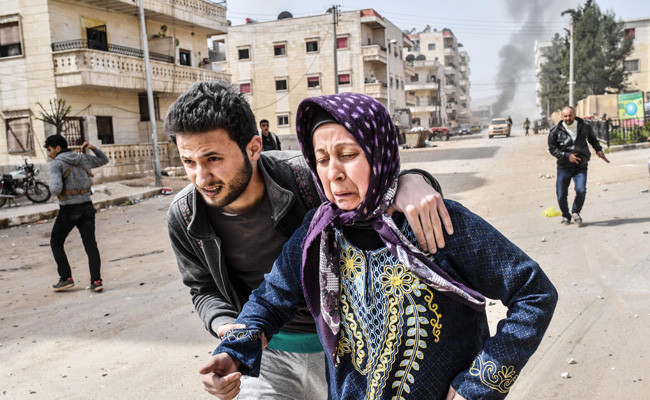

ISTANBUL/BEIRUT: Turkish forces and their Syrian opposition allies swept into the northwestern Syrian town of Afrin before dawn on Sunday, raising their flags in the town center and declaring full control after an eight-week campaign to drive out Kurdish YPG forces.
Turkish troops combed the streets for mines and improvised explosive devices, after Kurdish forces pulled back to Assad regime-controlled areas around the city of Aleppo and the Kurdish-held region east of the Euphrates River.
“Most of the terrorists have already fled with their tails between their legs. Our special forces and members of the Free Syrian Army are clearing the remains and the traps they left behind,” Turkish President Recep Tayyip Erdogan said. The Kurdish-dominated Syrian Democratic Forces said Turkish and Syrian opposition troops had torn down a statue in Afrin, in what it called a “blatant violation of Kurdish people’s culture and history.”
Kurdish militias elsewhere in the Afrin region would “strike the positions of the Turkish enemy and its mercenaries at every opportunity,” said Othman Sheikh Issa, co-chair of the Afrin executive council. “Our forces all over Afrin will become a constant nightmare for them.”
Turkey’s government spokesman Bekir Bozdag said the military campaign would continue to secure areas around Afrin and make sure food and medicine were available. “We have more to do. But the project of building a terrorism corridor and building a terrorist state is over,” he said.
Ankara launched an offensive against the town and surrounding areas on Jan. 20, slowly squeezing the militia and hundreds of thousands of civilians into the town center. At least 46 Turkish soldiers have been killed since then.
A Kurdish official, Hadia Yousef, told The Associated Press the YPG fighters have not fled the town, but have evacuated the remaining civilians because of “massacres.” She said clashes in the town were still underway.
The Britain-based Syrian Observatory for Human Rights said the Turkey-backed forces have taken control of half the town, with intense fighting still underway.
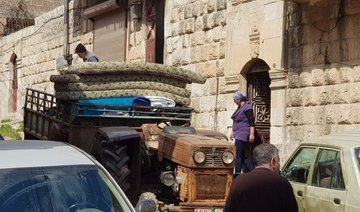
The Observatory says nearly 200,000 people have fled the Afrin region in recent days amid heavy airstrikes, entering Syrian government-held territory nearby. Syrian State TV on Sunday broadcast footage of a long line of vehicles and civilians on foot leaving Afrin. Erdogan has said the people of Afrin will return.
Turkey’s military meanwhile tweeted that its forces are now conducting combing operations to search for land mines and explosives.
The army posted a video on social media showing a soldier holding a Turkish flag and a man waving the Syrian opposition flag on the balcony of the district parliament building with a tank stationed on the street. The soldier called the capture a “gift” to the Turkish nation and to fallen soldiers on the anniversary of a famous World War I victory.
Footage by Turkey’s private Dogan news agency showed Syrian fighters shooting in the air in celebration.
Kurdish news websites showed images of Syrian fighters destroying a statue symbolizing the Kurdish new year celebrations that are being held this week. The statue was of Kawa, a mythological hero in Iran’s Zagros mountains who defeated a brutal ruler and lit fires to spread the news, ushering in spring.
The YPG has been a key US ally in the fight against the Daesh group, and seized large areas across northern and eastern Syria from the extremists with the help of coalition airstrikes.
But Erdogan has repeatedly said that NATO ally Turkey will not allow a “terror corridor” along its border.
Turkey also fears the establishment of a Kurdish self-ruled zone in Syria that could inspire its own Kurdish minority to press for greater autonomy. The Kurds are the largest stateless ethnic group in the Middle East, with some 30 million living in an area split between Iran, Iraq, Turkey and Syria.
The Kurdish militia and the Observatory said Turkish jets struck Afrin’s main hospital on Friday, killing over a dozen people. The Turkish military denied the allegations.
The World Food Programme distributed food to 25,000 people in the nearby towns of Nubl and Zahra, including refugees from Afrin, from where more than 150,000 people fled in the past few days.
In Syria’s other major flashpoint, the former opposition enclave of Eastern Ghouta on the outskirts of Damascus, Syrian President Bashar Assad visited troops on the front line in an area newly captured by his regime’s forces. Assad stood near a tank and was surrounded by soldiers, who cheered and pumped fists in the air. The main opposition group in the southern pocket of Eastern Ghouta said it was negotiating with a UN delegation about a cease-fire, aid and the evacuation of urgent medical cases.
“We are engaged in arranging serious negotiations to guarantee the safety and protection of civilians,” said Wael Alwan, the Istanbul-based spokesman for Failaq Al-Rahman. After a morning of calm, artillery fire and ground battles resumed across the enclave on Sunday afternoon, with heavy shelling of Douma, the main town.
(Additional input from AP)