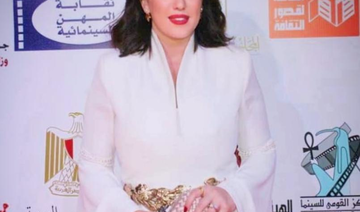
Luxor African Film Festival honors Gamil Ratib, Ghada Adel, Moussa Touré

1 / 2
Gamil Rateb (AFP)
2 / 2
Ghada Adel (Instagram)
Updated 18 March 2018
Follow

Luxor African Film Festival honors Gamil Ratib, Ghada Adel, Moussa Touré

DUBAI: The seventh edition of the Luxor African Film Festival (LAFF) kicked off on Friday and runs until March 22. This year, the festival is paying tribute to Egyptian actors Gamil Ratib and Ghada Adel and Senegalese director Moussa Touré.
LAFF was conceived by screenwriter Sayed Fouad as an alternative to the numerous cultural events inevitably centered around Alexandria and Cairo. Fouad also wanted an event that focused on African filmmaking, as he felt it was under-represented in Egypt. This year’s festival focuses on films from Rwanda.
Gamil Ratib, 91, is an icon of cinema and theater. Internationally, he is best known for his performance as Majid in the acclaimed 1962 movie “Lawrence of Arabia,” opposite Peter O’Toole, but he has appeared in over 50 feature films in his long career. Ratib received a Lifetime Achievement Award from Dubai International Film Festival in 2011.
Over the past two decades, Moussa Touré has established himself as one of Senegal’s most successful directors, renowned for his gritty take on the everyday life and culture of Africa. The 50-year-old has worked his way up through the ranks, starting out in the industry as an electrician but going on to work with some of the world’s most illustrious filmmakers, including Francois Truffaut.
Award-winning actress Ghada Adel, 43, has — like Ratib — impressed on stage and screen and in a variety of roles ranging from comedy to drama.
LAFF’s opening night also featured a tribute to the late Egyptian director Youssef Chahine, who is widely credited with launching Omar Sharif’s career, from Lebanese singer and actress Majida El Roumi, whom Chahine directed in his 1976 movie "Awdat Al Ibn Al Dal." . Chahine achieved both commercial and critical success during his distinguished career, and received a Lifetime Achievement Award from Cannes Film Festival in 1997.


Art Cairo spotlights pioneering artist Inji Efflatoun

Updated 11 sec ago
Follow

Art Cairo spotlights pioneering artist Inji Efflatoun

CAIRO: Art Cairo 2026 returned to Egypt’s bustling capital from Jan. 23-26, with visitors treated to gallery offerings from across the Middle East as well as a solo museum exhibition dedicated to pioneering Egyptian artist Inji Efflatoun.

While gallery booths hailed from across the Arab world, guests also had the chance to explore the oeuvre of the politically charged artist, who died in 1989.

Many of the pieces in the 14-work exhibition were drawn from the collection of the Egyptian Museum of Modern Art and cover four main periods of the artist’s work, including her Harvest, Motherhood, Prison and Knoll series.

While gallery booths hailed from across the Arab world, guests also had the chance to explore the oeuvre of the politically charged artist, who died in 1989. (Supplied)

Efflatoun was a pivotal figure in modern Egyptian art and is as well known for her work as her Marxist and feminist activism.

“This is the third year there is this collaboration between Art Cairo and the Ministry of Culture,” Noor Al-Askar, director of Art Cairo, told Arab News.

“This year we said Inji because (she) has a lot of work.”

Born in 1924 to an affluent, Ottoman-descended family in Cairo, Efflatoun rebelled against her background and took part heavily in communist organizations, with her artwork reflecting her abhorrence of social inequalities and her anti-colonial sentiments.

Many of the pieces in the 14-work exhibition were drawn from the collection of the Egyptian Museum of Modern Art and cover four main periods of the artist’s work, including her Harvest, Motherhood, Prison and Knoll series. (Supplied)

One untitled work on show is a barbed statement on social inequalities and motherhood, featuring a shrouded mother crouched low on the ground, working as she hugs and seemingly protects two infants between her legs.

The artist was a member of the influential Art et Liberte movement, a group of staunchly anti-imperialist artists and thinkers.

In 1959, Efflatoun was imprisoned under Gamal Abdel Nasser, the second president of Egypt. The artist served her sentence for four years across a number of women’s prisons in the deserts near Cairo — it was a period that heavily impacted her art, leading to her post-release “White Light” period, marked dynamic compositions and vibrant tones.

Grouped together, four of the exhibited works take inspiration from her time in prison, with powerful images of women stacked above each other in cell bunkbeds, with feminine bare legs at sharp odds with their surroundings.

Art Cairo 2026 returned to Egypt’s bustling capital from Jan. 23-26. (Supplied)

The bars of the prison cells obstruct the onlooker’s view, with harsh vertical bars juxtaposed against the monochrome stripes of the prison garb in some of her works on show.

“Modern art, Egyptian modern art, most people, they really don’t know it very well,” Al-Askar said, adding that there has been a recent uptick in interest across the Middle East, in the wake of a book on the artist by UAE art patron Sultan Sooud Al-Qassemi.

“So, without any reason, all the lights are now on Inji,” Al-Askar added.

Although it was not all-encompassing, Art Cairo’s spotlight on Efflatoun served as a powerful starting point for guests wishing to explore her artistic journey.