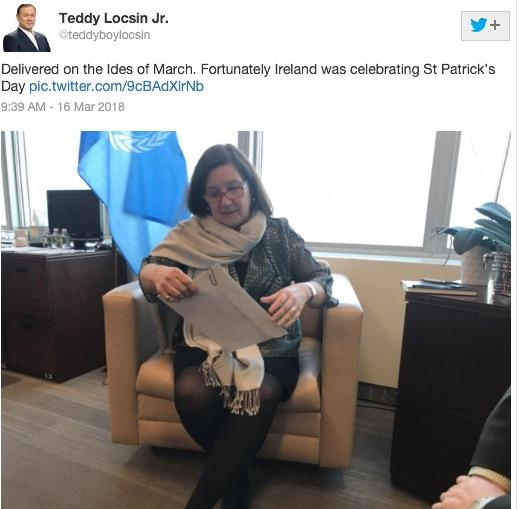
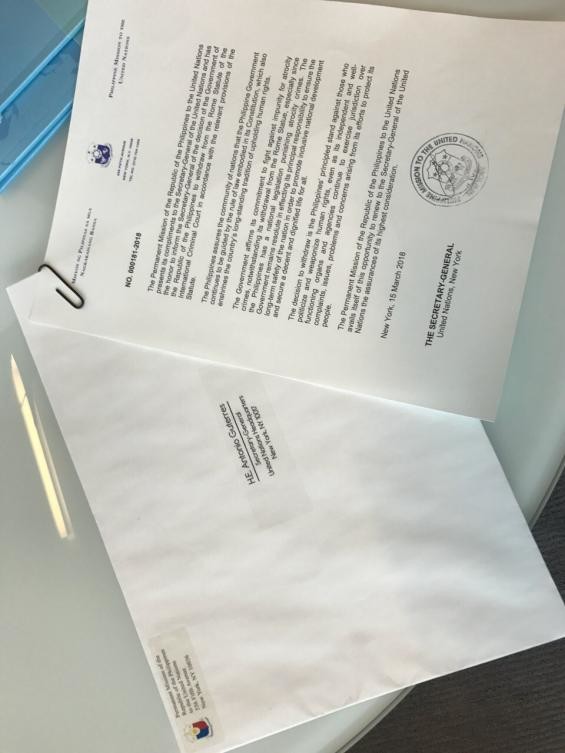
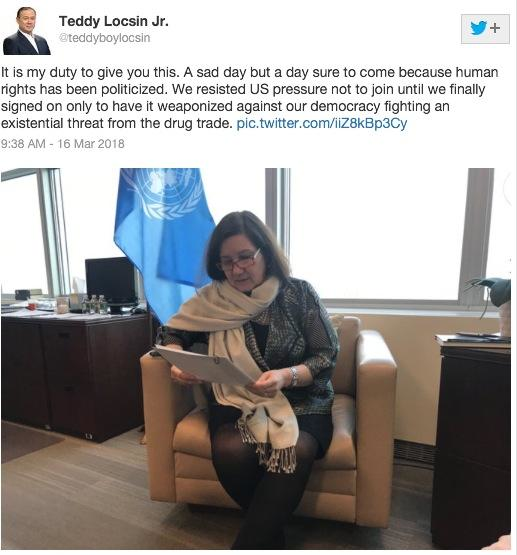
MANILA: The Philippines on Friday formally informed the UN of its withdrawal from the International Criminal Court (ICC).
This comes two days after President Rodrigo Duterte said the Philippines would withdraw ratification of the Rome Statute, the treaty that established the ICC, “effective immediately.”
As reasons for the withdrawal, Duterte cited what he said appears to be a “concerted effort” by UN officials to paint him as a “ruthless and heartless violator of human rights who allegedly caused thousands of extra-judicial killings,” and violations of due process by the ICC.
The decision reflects the Philippines’ “principled stand against those who politicize and weaponize human rights,” Manila said.
It assured the international community that it continues to be guided by the rule of law, and affirmed its “commitment to fight against impunity for atrocity crimes, notwithstanding its withdrawal from the Rome Statute.”
The government said it “remains resolute in effecting its principal responsibility to ensure the long-term safety of the nation in order to promote inclusive national development and secure a decent and dignified life for all.”
The countdown for the one-year withdrawal period from the ICC officially started on Thursday.
In explaining Manila’s decision, Foreign Minister Alan Peter Cayetano pointed to a “well-orchestrated campaign” to mislead the international community and “crucify” Duterte by distorting the human rights situation in the country.
“It is doubly lamentable that members of the international community, who include our own partners in the war against terror, have allowed themselves to be used as pawns by these individuals and organizations in undermining our own efforts to restore the rule of law,” Cayetano said in a statement.
He added that “there is no crime or liability to speak of” since the Duterte administration’s campaign against illegal drugs is a legitimate law enforcement operation designed to protect all Filipinos and uphold the rule of law.
It has always been the position of the Philippines that states have the inherent responsibility to adopt and implement measures, consistent with their respective laws, to effectively address threats to the safety and wellbeing of their citizens, Cayetano said.
He added that Duterte has identified the proliferation of illegal drugs, and its link to other forms of criminality, as a serious threat that had to be immediately addressed.
“The campaign we are waging against illegal drugs is consistent with the sovereign duty of any State to protect its people,” Cayetano said.
“Contrary to what some parties are trying to make it appear, there is no failure on the part of the Philippine Government in dealing with issues, problems, and concerns arising from this campaign.”
Duterte first threatened to withdraw from the ICC in November 2016, following Moscow’s move to cut ties with the court, which Russian President Vladimir Putin called “ineffective and one-sided.”
But Russia’s action was largely symbolic because like the US, it has not ratified the treaty and so is not under the ICC’s jurisdiction.
Last month, Duterte said he welcomed the ICC’s decision to conduct a preliminary examination on alleged drug killings in the Philippines.
“I hope you come… I welcome you, and if you want to find me guilty, go ahead. So be it,” he said. But on March 6, he said the ICC “cannot acquire jurisdiction over me, not in a million years.”


Philippines formally informs UN of withdrawal from ICC

Philippines formally informs UN of withdrawal from ICC


Pope Leo to visit Italy’s Lampedusa island in July
VATICAN CITY: Pope Leo XIV in July will visit the Italian island of Lampedusa, a landing point for migrants crossing the Mediterranean Sea from North Africa, the Vatican announced om Thursday.
The US pontiff has previously thanked the people of Lampedusa, which is just 145km off the coast of Tunisia, for the welcome they have given over the years to those who arrived, often on leaky, overcrowded boats.
Leo has also repeatedly spoken out against measures to clamp down on illegal migration.
He called the US administration’s treatment of immigrants “inhuman.”
Leo will visit Lampedusa on July 4, as part of a program of visits within Italy this summer, which includes a trip to Pompeii on May 8, the anniversary of his election, the Vatican said.
On May 23, he will meet pilgrims in the so-called “Land of Fires” in Campania, a southern Italian region blighted by toxic waste dumped by the mafia.
Leo’s predecessor, Francis, chose Lampedusa for his first official visit after becoming pontiff in July 2013.
In a definitive speech of his papacy, Francis denounced what he called “the globalization of indifference,” and the defense of migrants became a cornerstone of his papacy.
Leo became the first US head of the world’s 1.4 billion Catholics last May following Francis’s death.
In October, Leo said states had a right to protect their borders but a “moral obligation” to provide refuge.
“With the abuse of vulnerable migrants, we are witnessing, not the legitimate exercise of national sovereignty, but rather grave crimes committed or tolerated by the state,” he said, according to a speech published by the Vatican.
“Ever more inhuman measures are being adopted — even celebrated politically —that treat these ‘undesirables’ as if they were garbage and not human beings.”
Italian Prime Minister Giorgia Meloni’s government has taken a tough line on irregular migration, restricting the activities of charity rescue boats and seeking to speed up returns of people who fail to qualify for asylum.
Her ministers last week agreed on a new draft law that would allow the imposition of a “naval blockade” to stop migrant boats from entering Italian waters.
Almost 2,300 migrants have landed on Italy’s shores so far this year, compared to 5,600 in the same period in 2025 and 4,200 in the same period in 2024.
Yet many die trying to make the crossing, with at least 547 lives lost along Mediterranean routes so far this year, according to the UN’s International Organization for Migration.
Leo, who was born in Chicago and spent two decades as a missionary in Peru, has said he loves to travel.
He spent many years on the road when he served two, six-year terms as the superior of his Augustinian religious order, which required him to visit Augustinian communities around the world.
Pope Leo himself has said he hopes to visit his beloved Peru, as well as Argentina and Uruguay, trips that could happen toward the end of the year.


