MANILA: For well-off people like politician Pantaleon Alvarez, getting out of a bad marriage in the Philippines is pricey but feasible — but for the nation’s poorest and most vulnerable citizens it is nearly impossible.
That’s because heavily Catholic Philippines and the Vatican are the last two places on Earth where divorce is outlawed.
For the nation’s 100 million people, the only exit from a union gone wrong is an embarrassing — and labyrinthine — process that often amounts to a luxury.
But lawmakers, including Alvarez, have launched a new legislative effort to legalize divorce which activists believe could transform the lives of impoverished women trapped in toxic marriages.
The bill has been propelled forward by Alvarez, who is speaker in the lower House of Representatives and an ally of President Rodrigo Duterte.
In an interview with AFP, he said ending his first marriage cost him a million pesos ($19,200), which is more than triple what an average family in the Philippines makes in a year.
Like thousands of Filipinos, he did it through a civil procedure called annulment, whereby a judge declares a marriage invalid, generally because the spouses had a “psychological incapacity.”
It requires applicants to undergo a mental exam, testify in court and sometimes even claim they or their spouse entered the union with a disorder like narcissism.
The process can take anywhere from one to 10 years to wind through the creakingly slow and overburdened Philippine court system, costing at least $4,800.
Since 1999 lawmakers have regularly filed a bill to legalize divorce, only to see it languish in committee limbo — until now.
For the first time ever, House of Representatives lawmakers are poised to approve the bill after backing it in preliminary votes. It would then head to the Senate where it faces opposition from conservative members.
However, the bill enjoys rare bipartisan support, a sign Alvarez says of the urgency of addressing broken marriages.
“It’s a badge of stupidity because we are the only nation that does not see the problem,” Alvarez, 60, said.
The legislation would allow divorce and exempt poor people from legal fees, listing domestic violence, attempts to engage a spouse in prostitution and irreconcilable differences among the grounds for splitting up.
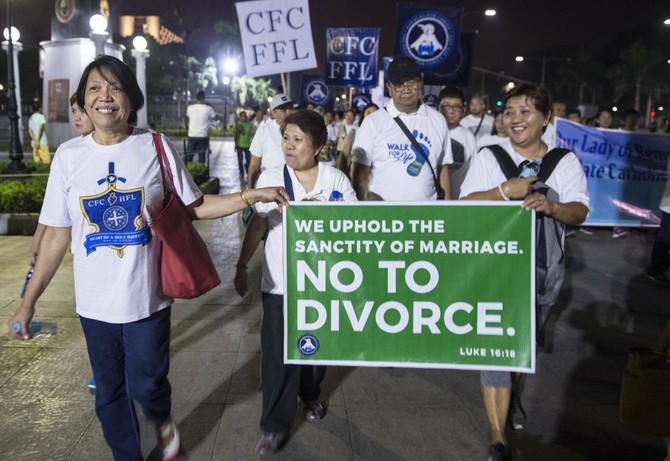
Not surprisingly, the country’s powerful Catholic Church, which counts about 80 percent of Filipinos as followers, has fiercely opposed the bill.
“It is not according to the scriptures, to the will of God and it does not help,” Manila bishop Broderick Pabillo said.
The church fought a pitched but ultimately unsuccessful battle in 2012 to halt a law providing free contraceptives to poor couples and teaching sex education in schools.
It has also backed an existing ban on abortion and gay marriage.
Surveys show a majority of Filipinos have supported legalizing divorce since 2014.
At the same time the number filing for annulments has grown steadily in the past decade, hitting over 10,000 in 2017, according to government statistics.
“Filipinos have become more open. They’ve been exposed to norms from other countries,” said Jean Franco, political science assistant professor at the University of the Philippines.
But with Catholic clergy lobbying and protesting against the bill, its final passage is uncertain.
The country’s outspoken leader Duterte, whose own marriage was annulled, has yet to wade into the debate.
Although he spoke in favor of upholding the ban during his 23 years as mayor of the southern city of Davao, he is mercurial on social issues.
A longtime critic of the church, Duterte voiced support for gay marriage in 2015, only to backtrack after securing the presidency in 2016, before endorsing it yet again last December.
He also has plenty on his plate, with international war crimes prosecutors launching a preliminary probe into his deadly war on drugs, which has also aroused the ire of the church.
Campaigners say the bill could offer a lifeline to women trapped in violent marriages.
“Divorce is a woman’s issue, especially for poor women who are being abused because it could provide them an out legally,” Elizabeth Angsioco, national chairwoman of the Democratic Socialist Women of the Philippines, said.
For women like Melody Alan who says she has endured 14 years of abuse from an unfaithful, alcoholic husband, the ban cannot be overturned soon enough.
“He strangled me, pushed me against a wall. I was crying and screaming. I couldn’t breathe,” Alan, secretary-general of the Divorce Advocates of the Philippines, said.
Alan, 44, said her husband agreed to accept an annulment if she paid for it — something she could in “no way” afford while raising four kids.
In 2010 she separated from her husband, who now has two children with another woman, but they remain legally married.
“I will file for divorce to get freedom (to say) that this is who I am now,” she said. “I can start anew.”


![]()
Philippine poor pay the price for Catholic church influenced divorce ban
Philippine poor pay the price for Catholic church influenced divorce ban

Latest updates


© 2026 SAUDI RESEARCH & PUBLISHING COMPANY, All Rights Reserved And subject to Terms of Use Agreement.