BRUSSELS: NATO Secretary General Jens Stoltenberg on Thursday backed a “proportionate” British response to a nerve agent attack on a former Russian spy, saying the incident must have “consequences.”
Stoltenberg said the poisoning of Sergei Skripal and his daughter, which he called the first offensive use of a nerve agent on the alliance’s territory since its foundation, came against the “backdrop of a pattern of reckless behavior” by Russia.
He said he would hold special talks with British Foreign Secretary Boris Johnson in Brussels on Monday over the attack in the city of Salisbury, but added that Britain had not invoked the alliance’s Article 5 mutual defense clause.
British Prime Minister Theresa May ordered the expulsion of 23 Russian diplomats and suspended some high-level contacts with the Kremlin after saying Moscow was “culpable” for the attempted murder of Skripal.
“Britain is not alone,” Stoltenberg told a news conference as he launched NATO’s annual reports.
“I am absolutely certain that the UK will respond and is responding in a proportionate and measured way. But at the same time, I fully support that there is a need for a response, because it has to have consequences when we see actions like we have seen in Salisbury.”
The former Norwegian premier said NATO itself was not taking any direct steps beyond offering political support, although it would offer “practical support” with the investigation if Britain wanted.
He said NATO was already responding strongly to years of Russian aggression including the annexation of Crimea, the conflict in eastern Ukraine, and meddling in western elections.
“The attack in Salisbury has taken place against a backdrop of reckless behavior by Russia over many years,” he said.
Stoltenberg said Britain had not asked for the triggering of NATO’s fundamental collective defense clause — which the United States used after the September 11, 2001 attacks.
“There has been no request for article 5 and it is for nations to ask for that,” he said.


![]()
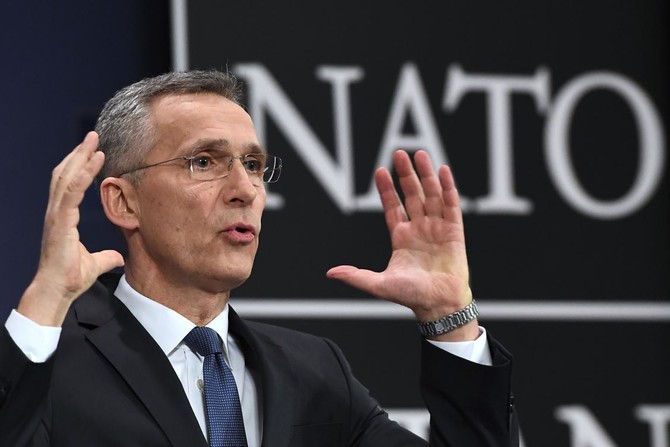
NATO chief says spy attack must have ‘consequences’ for Russia
NATO chief says spy attack must have ‘consequences’ for Russia


Latest updates




Recommended


© 2026 SAUDI RESEARCH & PUBLISHING COMPANY, All Rights Reserved And subject to Terms of Use Agreement.