Theresa May says UK to expel 23 Russian diplomats, Kremlin to retaliate

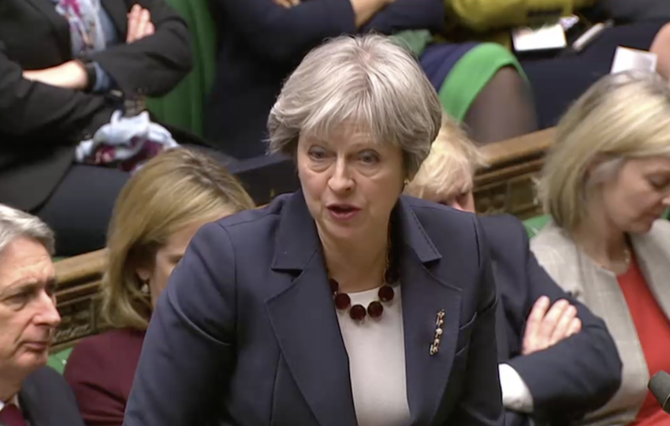
British Prime Minister Theresa May said on Wednesday she had come to the conclusion that Russia was culpable for the attempted murder of Sergei Skripal. (Screenshot)
Updated 14 March 2018
Follow

Theresa May says UK to expel 23 Russian diplomats, Kremlin to retaliate

LONDON: British Prime Minister Theresa May said on Wednesday she had come to the conclusion that Russia was culpable for the attempted murder of Sergei Skripal and his daughter.
In a speech in the British Parliament soon after Yakovenko's statement, Prime Minister Theresa May said Britain would expel 23 Russian diplomats, describing it as the single biggest expulsion in over 30 years.
Skripal, 66, and his daughter Yulia, 33, were found slumped unconscious on a bench outside a shopping centre in the genteel southern English city of Salisbury on March 4.
They have been in a critical condition in hospital ever since.
"There is no alternative conclusion, other than that the Russian state was culpable for the attempted murder of Mr Skripal and his daughter, and for threatening the lives of other British citizens in Salisbury,” May said.
“This represents an unlawful use of force by the Russian state against the United Kingdom," she said. “Under the Vienna Convention, the United Kingdom will now expel 23 Russian diplomats who have been identified as undeclared intelligence officers," May told parliament. “They have just one week to leave.”

May said the biggest expulsions from London in 30 years would degrade Russian intelligence capabilities in Britain for years to come.
“We will freeze Russian state assets wherever we have the evidence that they may be used to threaten the life or property of UK nationals or residents,” May said.
Russia's Ambassador to Britain Alexander Yakovenko warned London on Wednesday of reciprocal measures if Britain expelled Russian diplomats. The Russian embassy to the UK said all responsibility for the deterioration of the Russia-UK relationship lies with the current political leadership of Britain.
Moscow refused to comply with Britain's demands that it explain how Novichok — a form of nerve agent developed by the Soviet Union during the Cold War — came to be used in Britain. Russia said the U.K. must first provide samples of the poison collected by investigators.
Putin spokesman Dmitry Peskov told reporters on Wednesday that Britain has offered "baseless accusations which are not backed up by any evidence." He said Russia would cooperate with the investigation but does not see Britain's willingness to reciprocate.
"We hope reason will prevail and other countries will think hard how serious the evidence against Russia is," he said.
Russia has claimed that the nerve agent could have come from another former Soviet country, pointing to Moscow's foe, Ukraine.
Lawmaker Vladimir Gutenev, a member of the state commission for chemical disarmament, said Russia had scrapped its stockpile of Novichok.
"It is hard to say what may be happening in neighboring countries," he was quoted as saying by the Interfax news agency.
Meanwhile, the UK foreign office has told Britons travelling to Russia to be aware of the possibility of anti-British sentiment or harassment. It also advised Britons in the country to avoid commenting on politics publicly.
May also told parliament that British ministers and the royal family will not be attending the World Cup in Russia later this year after spy attack.


Pakistan killed over 80 militants in strikes on TTP camps in Afghanistan — official

Updated 59 min ago
Follow

Pakistan killed over 80 militants in strikes on TTP camps in Afghanistan — official

  • Saturday’s airstrikes followed a series of attacks inside Pakistan amid a surge in militancy
  • The Afghan Taliban authorities accuse Pakistani forces of killing civilians in the airstrikes

ISLAMABAD: Pakistan’s airstrikes in Afghanistan destroyed seven Tehreek-e-Taliban Pakistan (TTP) camps and killed over 80 militants, a Pakistani security official said on Sunday, with the Afghan Taliban accusing Pakistani forces of killing civilians in the assault.

Saturday’s airstrikes followed a series of attacks inside Pakistan amid a surge in militancy. Authorities say the attacks, particularly in Khyber Pakhtunkhwa province and the Pakistani capital of Islamabad, were carried out by the TTP and allied groups that Islamabad alleges are operating from sanctuaries in Afghanistan. Kabul denies this.

According to Pakistan’s information ministry, recent incidents included a suicide bombing at a Shiite mosque in Islamabad, separate attacks in Bajaur and Bannu, and another recent incident in Bannu during the holy month of Ramadan, which started earlier this week. The government said it had “conclusive evidence” linking the attacks to militants directed by leadership based in Afghanistan.

“Last night, Pakistan’s intelligence-based air strikes destroyed seven centers of Fitna Al-Khawarij TTP in three provinces of Nangarhar, Paktika and Khost, in which more than eighty Khawarij (TTP militants) have been confirmed killed, while more are expected,” a Pakistani security official, who spoke on condition of anonymity, told Arab News.


An earlier statement from Pakistan’s information ministry said the targets included a camp of a Daesh regional affiliate, the Islamic State Khorasan Province (ISKP), which claimed a suicide bombing at an Islamabad Shiite mosque that killed 32 people this month.

In an X post, Afghan government spokesperson Zabihullah Mujahid said Pakistani forces had violated Afghan territory.

“Pakistani special military circles have once again trespassed into Afghan territory,” Mujahid said. “Last night, they bombed our civilian compatriots in Nangarhar and Paktika provinces, martyring and wounding dozens of people, including women and children.”

 The Afghan Taliban’s claims of civilian casualties could not be independently verified. Pakistan did not immediately comment on the allegation that civilians had been killed in the strikes.

In a post on X, Afghanistan’s foreign ministry said it had summoned Pakistan’s charge d’affaires to Afghanistan Ubaid-ur-Rehman Nizamani and lodged protest through a formal démarche in response to the Pakistani military strikes.

“IEA-MoFA (The Islamic Emirate of Afghanistan’s Ministry of Foreign Affairs) vehemently condemns the violation of Afghanistan’s airspace and the targeting of civilians, describing it as a flagrant breach of Afghanistan’s territorial integrity & a provocative action,” it said in a statement.

“The Pakistani side was also categorically informed that safeguarding Afghanistan’s territorial integrity is the religious responsibility of the Islamic Emirate of Afghanistan; henceforth, the responsibility for any adverse consequences of such actions will rest with the opposing side.”

Tensions between Islamabad and Kabul have escalated since the Afghan Taliban returned to power in 2021. Pakistan says cross-border militant attacks have increased since then and has accused the Taliban of failing to honor commitments under the 2020 Doha Agreement to prevent Afghan soil from being used for attacks against other countries. The Taliban deny allowing such activity and have previously rejected similar accusations.

Saturday’s exchange of accusations marks one of the most direct confrontations between the two neighbors in recent months and risks further straining already fragile ties along the volatile border.