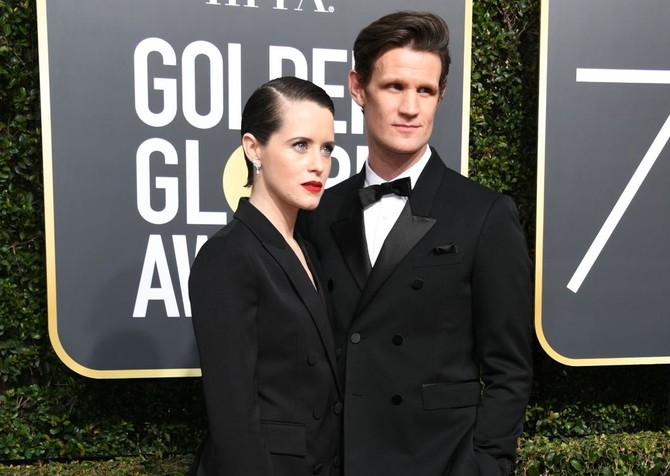
LOS ANGELES: She’s not known for histrionics, but Queen Elizabeth II would surely struggle to maintain her famous poise if she knew the actress playing her on “The Crown” earned less than the man portraying her husband.
Producers admitted Tuesday that Matt Smith, Prince Philip on the hit Netflix drama, negotiated a better deal than Claire Foy because of his perceived higher profile.
They did not reveal either salary — Foy’s was put at $40,000 an episode by Variety last year — but told a panel event in Jerusalem that Smith’s 2010-2013 starring role on the BBC’s “Doctor Who” had been the decisive factor.
The explanation has not appeased critics who argued that the discrepancy should only have shown up in the first season, before Foy was garlanded with awards and acclaim.
Foy, 33, was already making a name for herself in British costume drama, with roles in “Upstairs Downstairs” and “Wolf Hall,” when she was tapped to play the queen.
The part has earned her a host of award season nominations, including at the BAFTAs, Golden Globes, Emmys and Screen Actors Guild awards. She has won two SAGs and a Globe.
Suzanne Mackie, one of the show’s producers, told the Jerusalem audience the discrepancy was being resolved for the third season but that will not benefit Foy.
“The Crown,” which costs $7 million an episode to produce, is replacing its leads for the start of filming in July, with Olivia Colman stepping in as the queen and an actor to replace Smith not yet announced.
Helena Bonham-Carter will replace Vanessa Kirby as Elizabeth’s sister, the late Princess Margaret.
The series comes from the pen of Peter Morgan, who first lifted the veil on the private world of Elizabeth II in “The Queen” (2006), which was directed by Stephen Frears and earned Helen Mirren an Oscar in the title role.
ft/it
NETFLIX

Netflix pays its queen less than her consort on ‘The Crown’
Arts festival’s decision to exclude Palestinian author spurs boycott
- A Macquarie University academic who researches Islamophobia and Palestine, Abdel-Fattah responded saying it was “a blatant and shameless act of anti-Palestinian racism and censorship,” with her lawyers issuing a letter to the festival
SYDENY: A top Australian arts festival has seen the withdrawal of dozens of writers in a backlash against its decision to bar an Australian Palestinian author after the Bondi Beach mass shooting, as moves to curb antisemitism spur free speech concerns.
The shooting which killed 15 people at a Jewish Hanukkah celebration at Sydney’s Bondi Beach on Dec. 14 sparked nationwide calls to tackle antisemitism. Police say the alleged gunmen were inspired by Daesh.
The Adelaide Festival board said last Thursday it would disinvite Randa Abdel-Fattah from February’s Writers Week in the state of South Australia because “it would not be culturally sensitive to continue to program her at this unprecedented time so soon after Bondi.”
FASTFACTS
• Abdel-Fattah responded, saying it was ‘a blatant and shameless act of anti-Palestinian racism and censorship.’
• Around 50 authors have since withdrawn from the festival in protest, leaving it in doubt, local media reported.
A Macquarie University academic who researches Islamophobia and Palestine, Abdel-Fattah responded saying it was “a blatant and shameless act of anti-Palestinian racism and censorship,” with her lawyers issuing a letter to the festival.
Around 50 authors have since withdrawn from the festival in protest, leaving it in doubt, local media reported.
Among the boycotting authors, Kathy Lette wrote on social media the decision to bar Abdel-Fattah “sends a divisive and plainly discriminatory message that platforming Australian Palestinians is ‘culturally insensitive.'”
The Adelaide Festival said in a statement on Monday that three board members and the chairperson had resigned. The festival’s executive director, Julian Hobba, said the arts body was “navigating a complex moment.”
a complex and unprecedented moment” after the “significant community response” to the board decision.
In the days after the Bondi Beach attack, Jewish community groups and the Israeli government criticized Prime Minister Anthony Albanese for failing to act on a rise in antisemitic attacks and criticized protest marches against Israel’s war in Gaza held since 2023.
Albanese said last week a Royal Commission will consider the events of the shooting as well as antisemitism and social cohesion in Australia. Albanese said on Monday he would recall parliament next week to pass tougher hate speech laws.
On Monday, New South Wales state premier Chris Minns announced new rules that would allow local councils to cut off power and water to illegally operating prayer halls.
Minns said the new rules were prompted by the difficulty in closing a prayer hall in Sydney linked to a cleric found by a court to have made statements intimidating Jewish Australians.
The mayor of the western Sydney suburb of Fairfield said the rules were ill-considered and councils should not be responsible for determining hate speech.
“Freedom of speech is something that should always be allowed, as long as it is done in a peaceful way,” Mayor Frank Carbone told Reuters.