Iraqi PM reopens Kurdish airports to international flights

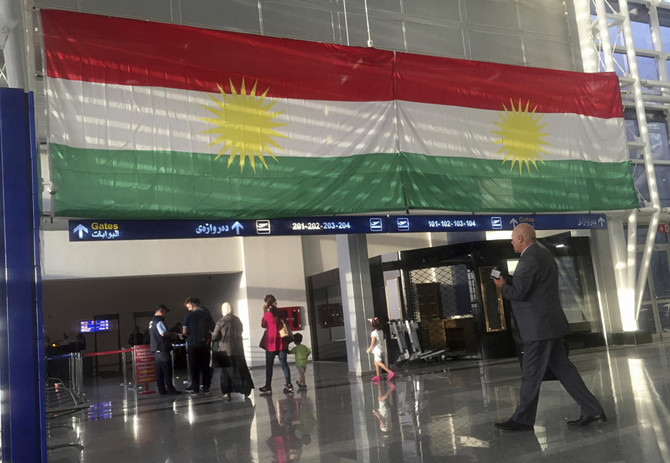
A Kurdish flag hangs in Irbil International Airport. Iraqi Prime Minister Haider Al-Abadi said that he is reopening airports in Iraq’s Kurdish region to international flights after federal authority was restored at the hubs. (AP Photo)
Updated 13 March 2018
Follow

Iraqi PM reopens Kurdish airports to international flights

BAGHDAD: Iraq is reopening airports in the country’s Kurdish region to international flights after federal authority was restored at the hubs, according to a statement from Prime Minister Haider Al-Abadi on Tuesday.
The announcement comes some six months after the airports were initially shut to international flights following a controversial referendum vote in northern Iraq’s self-ruled Kurdish region that overwhelmingly backed independence from Baghdad.
The airports are due to open “within a few days” government spokesman Saad Al-Hadithi told The Associated Press.
Al-Abadi described the move as “a gift to the people of Kurdistan,” during a meeting aired on Iraqi state television and added that the central government would also release salaries for government employees in the Kurdish region ahead of the celebration of the Kurdish new year later this month.
During the same meeting Tuesday, the interior minister added that 500 people suspected of having ties to the Daesh group were handed over to the central government from the Kurdish region.
At a news conference in Irbil, the prime minister of Iraq’s Kurdish region, Nechirvan Barzani, described Al-Abadi’s decision as “a step in the right direction,” and said he would continue to work to resolve issues between the region and the central government.
The Kurdish independence vote last September, though non-binding, was held across the autonomous region’s three provinces as well as in some disputed territories controlled by Iraqi Kurdish security forces but claimed by Baghdad.
The referendum was vehemently rejected by Baghdad and Iraq’s other neighbors, ratcheting up tensions in the region on the heels of military victories against the Daesh group.
The decision to lift the flight ban comes as Iraq is preparing for national elections slated to be held in May. Initially, Al-Aabdi’s tough line on Iraq’s Kurds translated into widespread public support among his base in Iraq’s Shiite-heartland.
However, Iraqi parliament remains deeply divided, raising fears of a protracted government formation process following national elections. Kurdish lawmakers boycotted a recent vote in parliament approving the country’s 2018 budget.
Iraq’s small landlocked Kurdish region has been increasingly isolated following the September referendum, straining relations with key allies such as the United States and neighboring Turkey.


Baghdad traders protest new customs tariffs

Iraqi traders protest against the imposition of customs duties on imported goods in Baghdad, Iraq, Sunday, Feb. 8, 2026. (AP)
Updated 57 min 51 sec ago
Follow

Baghdad traders protest new customs tariffs

  • The demonstrators gathered outside the General Customs Directorate on Sunday, chanting slogans against corruption and rejecting the new fees

BAGHDAD: Hundreds of traders and owners of customs clearance companies protested in central Baghdad on Sunday, demanding that Iraq’s government reverse recently imposed customs tariffs they say have sharply increased their costs and disrupted trade.
The new tariffs that took effect on Jan. 1 were imposed to reduce the country’s debt and reliance on oil revenues, as oil prices have fallen.
Iraq faces a debt of more than 90 trillion Iraqi dinars ($69 billion) — and a state budget that remains reliant on oil for about 90 percent of revenues, despite attempts to diversify.

We used to pay about 3 million dinars per container, but now in some cases they ask for up to 14 million.

Haider Al-Safi, Company owne

But traders say the new tariffs — in some cases as high as 30 percent — have placed an unfair burden on them. Opponents have filed a lawsuit aiming to reduce the decision, which Iraq’s Federal Supreme Court is set to rule on Wednesday.
The demonstrators gathered outside the General Customs Directorate on Sunday, chanting slogans against corruption and rejecting the new fees.
“We used to pay about 3 million dinars per container, but now in some cases they ask for up to 14 million,” said Haider Al-Safi, a transport and customs clearance company owner. 
“Even infant milk fees rose from about 495,000 dinars to nearly 3 million.”
He said that the new tariffs have caused a backlog of goods at the Umm Qasr port in southern Iraq and added that electric vehicles, previously exempt from customs duties, are now subject to a 15 percent fee.
“The main victim is the citizen with limited income, and government employee whose salary barely covers his daily living, those who have to pay rent, and have children with school expenses — they all will be affected by the market,” said Mohammed Samir, a wholesale trader from Baghdad.
Protesters also accused influential groups of facilitating the release of goods in exchange for lower unofficial payments, calling it widespread corruption. 
Many traders, they said, are now considering routing their imports through the Kurdistan region, where fees are lower.
The protests coincided with a nationwide strike by shop owners, who closed markets and stores in several parts of Baghdad to oppose the tariff increase. 
In major commercial districts, shops remained shut and hung up banners reading “Customs fees are killing citizens.”