Eve’s tomb in Jeddah — myth or reality?

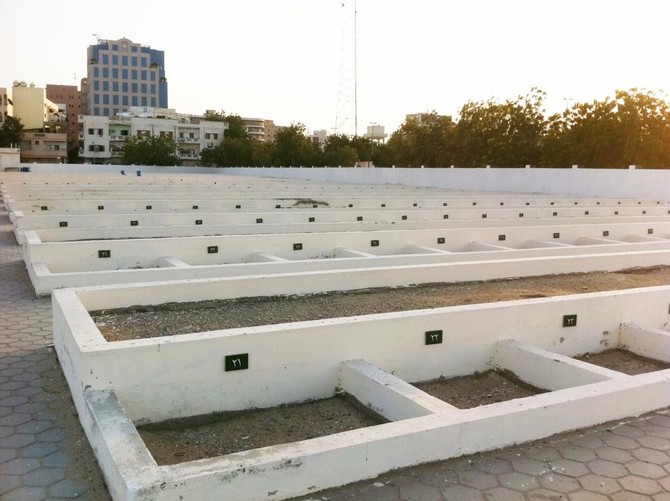
The inside view of the Cemetery of Eve in central Jeddah. (AN photo)
Updated 14 March 2018
Follow

Eve’s tomb in Jeddah — myth or reality?

JEDDAH: The claim that the tomb of Eve, mother of mankind, is in the Cemetery of Eve in central Jeddah has sparked a controversy.
During a tour to the graveyard, Arab News learned that it is difficult to locate the tomb of Eve and to determine the exact date of her death. Some accounts claim that Eve was buried in this cemetery, while many academics stress that there is no reliable evidence to back this claim.
The cemetery is in Ammaria neighborhood in the center of Jeddah. According to elderly residents, it dates back thousands of years. But Mohammed Youssef Trabulsi, who authored a book on Jeddah and its history, explained that all historical references do agree to Eve’s presence in this part of the world at some point in the ancient past but they differ over the exact location of her tomb. However, the cemetery is undeniably ancient, and a number of historians and travelers said that it dates back to the 9th century AH.
Adnan Al-Harthi, professor of civilization at Umm Al-Qura University in Makkah, said the scientific opinion on the issue of the tomb’s existence in Jeddah remains neutral. Al-Harthi said Ibn Jubair, an Arab geographer and traveler from the 6th century AH, said that, during his visit to Jeddah, he saw an old dome said to be the home of Eve. Ibn Battuta, another Arab traveler, also pointed to the presence of the dome during his journey to Jeddah in the 7th century AH.
Al-Harthi said scientific sources confirm that the habitat of Adam and Eve was Makkah, but there is no evidence that Eve was buried in Jeddah.
A number of historians and travelers told many stories indicating that the site of the tomb of Eve is in the same cemetery. Some sources even identified the dimensions of the tomb, and there are drawings of it in books.
Muhammad Al-Makki, a historian, wrote in his book “The True History of Makkah and the Noble House of God” that the Cemetery of Eve used to receive a large number of visitors during the Hajj season. Pilgrims used to go there after Hajj rituals and were exploited by fraudsters who used to sell them some of the cemetery’s soil to take back home.
Despite these tales, some historians doubted the existence of the tomb of Eve in the same cemetery. The contemporary Saudi writer, Muhammad Sadiq Diab, author of “Jeddah: History and Social Life,” said: “There is no legitimate evidence to confirm the existence of the tomb in the cemetery. I think it is just a myth.”
Another old story says there used to be three domes built on one of the large tombs inside the cemetery, and it was believed to be the tomb of Eve. But now there are no domes in the cemetery, all graves are similar, and there is nothing to indicate the tomb’s existence.


Saudi chef wins culinary competition

Updated 18 December 2025
Follow

Saudi chef wins culinary competition

  • Event aimed to empower chefs’ ability to showcase talent on global scale 
  • Bayan Abdullah Al-Sudani: It (has) encouraged me to participate in more challenging spaces

RIYADH: A Saudi has won the Saudi Elite Chefs competition at Horeca Riyadh.

The event, which was organized by the Culinary Arts Commission of the Ministry of Culture, in alignment with the ministry’s long-term goals, aimed to empower Saudi chefs’ ability to showcase their talent and creativity on a global scale.

Speaking to Arab News, the winner, Bayan Abdullah Al-Sudani, shed light on how the competition equipped her with confidence for the future, saying: “It was a big challenge, and I faced off against strong chefs. It (has) encouraged me to participate in more challenging spaces.”

On her future plans, Al-Sudani wants to give back to the industry, and added: “I look forward to opening the Bayan Academy soon so that I can support chefs and help them with the pastry sector specifically.”

Celebration and achievement were echoed throughout, and it was evident at the event that the culinary industry in the Kingdom is hungry for growth, recognition, and global competition.

Seba Zarea, general manager of strategy and program delivery at the Culinary Arts Commission, told Arab News of the many facets of the industry that the ministry was prioritizing.

Zarea said: “This competition is just one of the initiatives that the Culinary Arts Commission is working on. There are also local scholarships (and) vocational training. We are also working on attracting the best culinary schools to Saudi. For example, Le Cordon Bleu is opening next year in Misk City.”

Zarea stressed the rewards of events like the Saudi Elite Chefs competition, adding that the winner had a fast track to Bocuse d’Or and the World Pastry Cup — representing global opportunities to place both competitors and Saudi cuisine on the map.

Zarea added: “Food is a soft power and, in terms of tourism, food is a universal language so we codified the Saudi cuisine, an initiative started four years ago, and we came up with more than 1,300 codified recipes, items, and local produce from the Kingdom.”

Zarea went into depth on some of the behind-the-scenes efforts that have helped create the food that the Kingdom is able to showcase.

She shared the example of the Wild Plant Initiative, a program designed to explore plants of various regions in the Kingdom to discover new ingredients that can be integrated into Saudi cuisine.

These efforts go into helping to build an industry that is rooted in culture, creativity, and passion. 

In the same way that the Saudi Elite Chefs competition provides its winners and participants with the tools to bring their success to global attention, the Culinary Arts Commission works to elevate the Kingdom’s cuisine through tourism and hospitality.

Zarea said: “This sector is the easiest way to showcase the culture.”