Eve’s tomb in Jeddah — myth or reality?

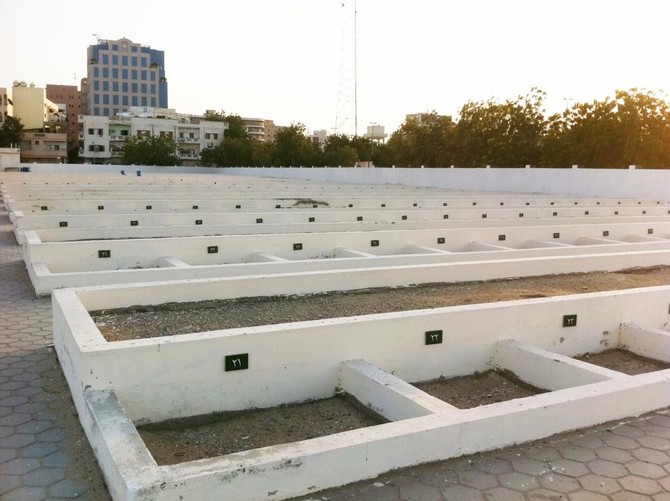
The inside view of the Cemetery of Eve in central Jeddah. (AN photo)
Updated 14 March 2018
Follow

Eve’s tomb in Jeddah — myth or reality?

JEDDAH: The claim that the tomb of Eve, mother of mankind, is in the Cemetery of Eve in central Jeddah has sparked a controversy.
During a tour to the graveyard, Arab News learned that it is difficult to locate the tomb of Eve and to determine the exact date of her death. Some accounts claim that Eve was buried in this cemetery, while many academics stress that there is no reliable evidence to back this claim.
The cemetery is in Ammaria neighborhood in the center of Jeddah. According to elderly residents, it dates back thousands of years. But Mohammed Youssef Trabulsi, who authored a book on Jeddah and its history, explained that all historical references do agree to Eve’s presence in this part of the world at some point in the ancient past but they differ over the exact location of her tomb. However, the cemetery is undeniably ancient, and a number of historians and travelers said that it dates back to the 9th century AH.
Adnan Al-Harthi, professor of civilization at Umm Al-Qura University in Makkah, said the scientific opinion on the issue of the tomb’s existence in Jeddah remains neutral. Al-Harthi said Ibn Jubair, an Arab geographer and traveler from the 6th century AH, said that, during his visit to Jeddah, he saw an old dome said to be the home of Eve. Ibn Battuta, another Arab traveler, also pointed to the presence of the dome during his journey to Jeddah in the 7th century AH.
Al-Harthi said scientific sources confirm that the habitat of Adam and Eve was Makkah, but there is no evidence that Eve was buried in Jeddah.
A number of historians and travelers told many stories indicating that the site of the tomb of Eve is in the same cemetery. Some sources even identified the dimensions of the tomb, and there are drawings of it in books.
Muhammad Al-Makki, a historian, wrote in his book “The True History of Makkah and the Noble House of God” that the Cemetery of Eve used to receive a large number of visitors during the Hajj season. Pilgrims used to go there after Hajj rituals and were exploited by fraudsters who used to sell them some of the cemetery’s soil to take back home.
Despite these tales, some historians doubted the existence of the tomb of Eve in the same cemetery. The contemporary Saudi writer, Muhammad Sadiq Diab, author of “Jeddah: History and Social Life,” said: “There is no legitimate evidence to confirm the existence of the tomb in the cemetery. I think it is just a myth.”
Another old story says there used to be three domes built on one of the large tombs inside the cemetery, and it was believed to be the tomb of Eve. But now there are no domes in the cemetery, all graves are similar, and there is nothing to indicate the tomb’s existence.


Saudi meteorology center warns of heavy rain across Kingdom, public told to avoid flood-prone areas

Updated 27 min 49 sec ago
Follow

Saudi meteorology center warns of heavy rain across Kingdom, public told to avoid flood-prone areas

  • Stay away from valleys and waterways at least until Thursday, Civil Defense cautions
  • National Center for Meteorology center warns of possible thunderstorms and dust storms

RIYADH: Saudi Arabia’s National Center for Meteorology (NCM) has warned of thunderstorms across the Kingdom that could lead to flash floods, and officials cautioned the public against venturing in low-lying places prone to flooding.

In its weather forecast for Sunday, the meteorology center said “moderate to heavy thunderstorms are expected, leading to flash floods, accompanied by hail showers and active winds that will stir up dust and sand” in several provinces of the Kingdom.

These include Riyadh, Qassim, Hail, Madinah, Makkah, Al-Baha, Asir, Jazan and parts of the Eastern Province. Light to moderate storms are expected in parts of the Northern Borders, Al-Jouf and Tabuk, the NCM said.

In a separate advisory, the General Directorate of Civil Defense urged the public to avoid places prone to flash floods and valleys at least until December 18.

 A lake forms in the desert following days of rain in Rafha city in the Northern Borders Province, near the Saudi border with Iraq. (SPA)

Since the past few days, various parts of Saudi Arabia had been blessed with light to moderate rain as full winter weather set in.

In separate reports, the Saudi Press Agency published images of beautiful landscapes that have emerged after being revitalized by rain.

Deserts rejuvenated

Among these are Al-Nafud (The Great Nafud Desert) in the Kingdom’s north, where moderate to heavy rainfall have “transformed the landscape, turning the golden sand dunes into stunning formations,” and also created streams and lakes.

Plants are beginning to sprout in Al-Nafud Desert after getting rain. (SPA)

“The cool weather has since made the Nafud a prime destination for desert and camping enthusiasts from inside and outside (Rafha) governorate,” SPA said.

Rain have also rejuvenated the Imam Turki Bin Abdullah Royal Reserve, the Kingdom’s second-largest nature reserve, spanning parts of the Northern Borders, Hail, Qassim, Al-Jouf and Eastern Province.

In the Northern Borders province, the Wadi Arar has come alive, refilling the province’s 11 operational dams. 

With streams flowing into Wadi Arar, dams in the Northern Borders province are being replenished. (SPA)

“The deserts of Arar City ... have become an enchanting destination for hikers and nature enthusiasts following recent rainfall. The resulting rainfalls have created a stunning scenery, with flowing streams winding through sand dunes and ravines,” SPA said.

Cool, verdant mountains 

In Asir and adjacent provinces in the southwest, fog shrouding mountain peaks and the city of Abha have resulted in beautiful winter sceneries, attracting nature lovers and photography enthusiasts.

Abha city in Asir shrouded with fog as full winter weather sets in. (SPA)

Futher south in Najran province, days of rain have increased vegetation cover and revitalized the valley’s natural streams.

One of the foremost attractions is the Wadi Mughaydid on the slopes of the Sarawat range’s Maghra Mountains in northwest Najran, renowned for its pristine natural beauty.

Stretching 25 kilometers from Bir Askar Park to Shaab Baran, the valley’s unique geography combines verdant plains with towering mountains, making it an ideal destination for hiking and nature enthusiasts, according to SPA.

View of Wadi Mughaydid in Najran coming to life following days of rain. (SPA)