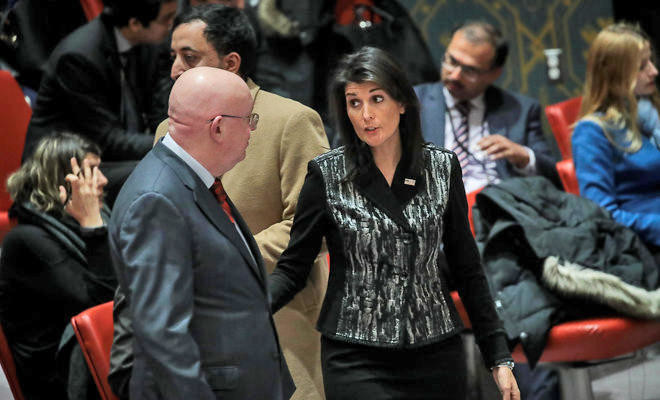
NEW YORK: US Ambassador Nikki Haley told the UN Security Council on Monday that a Syrian cease-fire approved two weeks ago “has failed”.
“This is no cease-fire. This is the Assad regime, Iran, and Russia continuing to wage war against their political opponents,” Haley said.
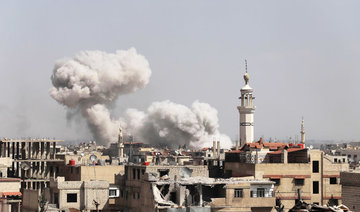
The ambassador spoke as Syrian regime forces continued attacking Eastern Ghouta despite a 30-day UN truce.
She added that the US “remains prepared to act if we must,” if the UN fails to do so. The US asked the Security Council to demand an immediate 30-day cease-fire.
UN Secretary-General Antonio Guterres again likened the chaos in rebel-held Eastern Ghouta to “hell on earth”
Guterres told the UN Security Council that “Syria is bleeding inside and out” and, despite some aid truck deliveries to the besieged Damascus suburb, the UN cease-fire deal of Feb. 25 had not been implemented.
“There has been no cessation of hostilities. Violence continues in Eastern Ghouta and beyond — including in Afrin, parts of Idlib and into Damascus and its suburbs,” Guterres told envoys in New York.
“Particularly in Eastern Ghouta, airstrikes, shelling and ground offensives have intensified after the adoption of the resolution and claimed many hundreds of civilian lives — some even reporting the toll at more than 1,000.”
The Syrian army’s offensive in Eastern Ghouta, backed by air and artillery strikes, has killed at least 1,160 people since Feb. 18, a war monitor said, as President Bashar Assad seeks to crush the last major rebel stronghold near the capital Damascus.
Russia, an ally of Assad, and Damascus say the UN cease-fire does not protect the fighters in Eastern Ghouta, arguing that they are terrorists.
The assault is one of the heaviest in the war, which enters its eighth year this week.
The ferocity of the Eastern Ghouta assault prompted condemnation from Western countries and calls for a cease-fire.
Hadi Al-Bahra, a member of the Syrian Negotiation Commission, was due to address the Security Council later on Monday. He urged Western powers to help civilians in Eastern Ghouta.
“I’m asking for the US and other permanent (UN council) members to put pressure in front of their own responsibility that it’s not permissible for the killing of civilians and for continuing the siege on Ghouta and other areas in Syria,” Al-Bahra told Arab News in an interview.
The US and other powers saved lives by intervening when Daesh overran Yazidi communities in Sinjar, Iraq, in 2014, and again in Kobani, Syria, the following year, Al-Bahra said. They should do the same for civilians in Eastern Ghouta now, he said.
Al-Bahra, who was president of the Syrian National Coalition from 2014-2015, urged Western governments to use targeted sanctions and trade curbs to pressure Assad and his backers, rather than draft more UN documents.
“We are tired of statements,” Al-Bahra said. “They need to find a way to turn this resolution into an implementable, enforceable resolution. If somebody is against providing real protection for civilians, let them show it.”

US threatens action over ‘sham’ Syria cease-fire
Trump and Netanyahu to discuss next phase of Gaza plan
- Gaza process stalled with difficult steps ahead
- Iran, Lebanon also on the agenda, says Netanyahu
JERUSALEM/PALM BEACH, Florida: US President Donald Trump is expected to push for progress in the stalled ceasefire in Gaza when he meets with Israeli Prime Minister Benjamin Netanyahu on Monday for talks that will include Israel’s concerns over Hezbollah in Lebanon and Iran.
Netanyahu said this month that Trump had invited him for talks, as Washington pushes to establish transitional governance and an international security force for the Palestinian enclave.
Trump has said he could meet with the Israeli leader soon, but the White House has not confirmed details. The White House did not respond to a request for comment about the meeting. Netanyahu, who is expected to visit Trump’s Mar-a-Lago beach club, said on December 22 that discussions were expected to cover the second phase of the Gaza ceasefire, as well as Iran and Lebanon.
Washington brokered ceasefires on all three fronts, but Israel is wary of its foes rebuilding their forces after they were considerably weakened in the war.
Next steps in Gaza ceasefire plan
All sides agreed in October to Trump’s ceasefire plan, which calls for Israel to withdraw from Gaza and Hamas to give up its weapons and forgo a governing role in the enclave.
US Secretary of State Marco Rubio said last week that Washington wants the transitional administration envisioned in Trump’s plan — a Board of Peace and a body made up of Palestinian technocrats -
to be in place soon to govern Gaza, ahead of the deployment of the international security force that was mandated by a November 17 UN Security Council resolution. But Israel and Hamas have accused each other of major breaches of the deal and look no closer to accepting the much more difficult steps envisaged for the next phase. Hamas, which has refused to disarm and has not returned the remains of the last Israeli hostage, has been reasserting its control, as Israeli troops remain entrenched in about half the territory.
Israel has indicated that if Hamas is not disarmed peacefully, it will resume military action to make it do so.
While the fighting has abated, it has not stopped entirely. Although the ceasefire officially began in October, Israeli strikes have killed more than 400 Palestinians — most of them civilians, according to Gaza health officials — and Palestinian militants have killed three Israeli soldiers.
Lebanon ceasefire also tested
In Lebanon, a US-backed ceasefire that was agreed to in November 2024 ended more than a year of fighting between Israel and Hezbollah and required the disarmament of the powerful Iran-backed Shiite group, beginning in areas south of the river adjacent to Israel.
While Lebanon has said it is close to completing the mission within the year-end deadline of disarming Hezbollah, the group has resisted calls to lay down its weapons.
Israel says progress is partial and slow and has been carrying out near-daily strikes in Lebanon, which it says are meant to stop Hezbollah from rebuilding. Iran, which fought a 12-day war with Israel in June, said last week that it had conducted missile exercises for the second time this month. Netanyahu said Israel is not seeking a confrontation with Iran, but was aware of the reports, and said he would raise Tehran’s activities with Trump.
Trump in June ordered US strikes on Iranian nuclear sites but has since then broached a potential deal with Tehran.