Middle East clubs have fallen out of love with the AFC Champions League

1 / 3
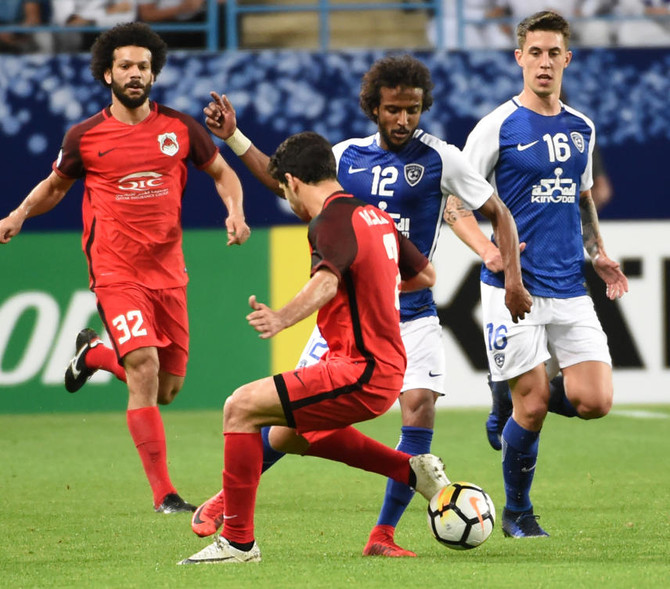
Al-Rayyan's Mohammed Alaaeldin (C) views for the ball against Al-Hilal's Yasir Shahrani during the AFC Champions League football match between Saudi Al-Hilal and Qatari Al-Rayyan. (AFP)
2 / 3
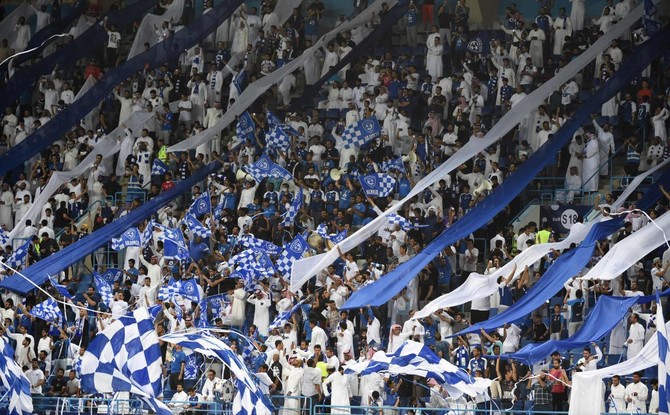
Saudi Arabia's Al-Hilal fans watch the AFC Champions League football match between Al-Hilal and Qatari Al-Rayyan. (AFP)
3 / 3
Al-Ain FC's Japanese defender Tsukasa Shiotani (C) and Emirati defender Mohamed Ahmed (R) vie for the ball against Esteghlal FC's Senegalese midfielder Mame Baba Thiam (L) during their AFC Champions League group (D) match at Hazza Bin Zayed Stadium in Al-Ain on March 6, 2018. (AFP)
Updated 11 March 2018
Follow

Middle East clubs have fallen out of love with the AFC Champions League

DUBAI: In Europe, the Champions League is the ultimate prize. Merely participating in it, or even just qualifying for its playoff stages, has come to be seen as an achievement in itself.
Ever since the competition replaced the old European Cup at the start of the 1992-93 season, it has changed Europe’s football landscape.
Finishing in “Champions League places” has replaced winning trophies as the target for all but the most elite of clubs. In South America, winning the Copa Libertadores has always been, and remains, the be-all-and-end-all for all top clubs.
And even in Africa, the CAF Champions League gets the blood going like no other competition.
And then there is Asia. While there is no doubting that the AFC Champions League remains the premier continental competition, one in which top regional teams such as Al-Hilal and Al-Ain continue to perform credibly, there exists an underlying, inexplicable apathy from West Asian clubs toward the tournament.
Perhaps it is born out of an inferiority complex to East Asia teams.
The first three seasons of AFC Champions League were claimed by Al Ain (2002-03) and Saudi Arabia’s Al Ittihad (2004, 2005). Since then, however, no team from West Asia has lifted the trophy in 12 attempts.
Early indications are that this will not change in 2018.
The performances of Middle Eastern and Gulf teams in the competition so far have been poor to say the least.
Emirati clubs in particular have fared adequately at best, and dismally at worst. Al-Wahda and Al-Wasl are respectively bottom of their groups, having failed to collect a single point between them. Al-Ain are third in Group D after three draws. Domestic champions Al-Jazira, having faced Real Madrid in the Club World Cup semifinal, are in the best position of the Arabian Gulf League (AGL) teams, in second place — and a qualification spot ­— in Group A.
Of the two Saudi teams, Al-Ahli lead Al-Jazira by three points after two wins and a draw. Al-Hilal, a team that prides itself as the most decorated in Asian football, have struggled and are currently bottom of Group D, a point behind Al-Ain, the team they eliminated in last year’s quarterfinals.
Indeed, Al-Hilal’s loss to Al-Esteghlal last month cost Ramon Diaz his job at the club that still leads the Saudi league table. That the two Saudi teams that finished third and fourth in the 2016-17 league table, Al-Nassr and two-time winners Al-Ittihad, were barred from this year’s competition for logistical reasons, has hardly helped.
Only Qatari clubs have exceeded expectations, with Al-Duhail leading their group, while traditional rivals Al-Sadd and Al-Rayyan sit second in their respective groups.
While the prestige of being champions of Asia is craved, the financial rewards ($4 million for the winners) and television money pale into insignificance when compared with the pots of gold on offer on other continents, and even compared to the salaries the Gulf clubs pay to their highest earning foreign players.
For that reason, among many others, the guarantee of domestic glory takes priority for some clubs over the remote possibility of continental glory against the powerhouses of the East.
And for some, other carrots are often dangled.
Last year, Al-Jazira all but abandoned the pursuit of Champions League progress in favor of securing the AGL title and the certainty of taking part in the 2017 FIFA Club World Cup.
Al-Ain, seemingly running away with the Emirati league title, might not have a similarly modest outlook, but will surely already be eyeing potential once-in-a-lifetime clashes against Real Madrid, Barcelona, Bayern Munich or Manchester City next November in Abu Dhabi.
Rightly or wrongly, but somewhat understandably, the prospect of sharing a stage with Cristiano Ronaldo or Lionel Messi is a far more mouthwatering one than another quarterfinal or semifinal against familiar regional opposition.
And that raises perhaps the most existential issue with the current AFC Champions League format. Familiarity has bred, if not contempt, then certainly boredom.
Every new edition of the AFC Champions League increasingly throws up groups consisting of teams from Saudi Arabia, the UAE, Qatar, Iran and Uzbekistan. More often than not, those teams are the same as previous years, and the match-ups are repeats of recent seasons.
Lack of participation from countries like Syria, Jordan, Lebanon, Kuwait and Iraq, owing to licensing issues, no doubt adds to the sense of ennui and lack of eclecticism around the competition’s West Asia half.
It might be too early to write off the Arab teams halfway through the group stage of this year’s AFC Champions League. But the trend of recent seasons does not offer too much encouragement either.
The continent’s most coveted prize is in danger of losing its shine in western Asia.


Own goal enough for Al-Ahli as Matchday 24 win keeps pressure on Al-Nassr

Updated 27 February 2026
Follow

Own goal enough for Al-Ahli as Matchday 24 win keeps pressure on Al-Nassr

  • Al-Ahli eke out 1-0 win over Al-Riyadh to keep pressure on Al-Nassr
  • Milan Borjan own goal separated the sides at Prince Faisal bin Fahd Stadium

RIYADH: Matchday 24 of the Saudi Pro League kicked off on Thursday, less than 24 hours after the conclusion of the delayed Matchday 10. With the FIFA Arab Cup, World Cup Qualifiers and FIFA World Cup sandwiching the 2025/26 campaign, resting periods have been few and far between outside the international breaks.

With fixtures coming thick and fast, Al-Ahli opted to rest Riyad Mahrez and Enzo Millot for their clash with Al-Riyadh in the capital. Ramadan has further challenged the league schedule, with Matthias Jaissle’s side only arriving in Riyadh at 5:30pm — just hours before kick-off.

With their previous outing against Damac still dominating conversation, Jaissle was keen to ensure his players did not fall into the same trap — namely, being caught off guard by an opponent’s unexpectedly proactive style.

To his relief, Al-Ahli were largely in control this time. Yet the absence of Mahrez limited their creative spark. Relying heavily on Wenderson Galeno down the left, Al-Riyadh did well to crowd the Brazilian and deny him space to operate.

The bane of any expansive side is a compact 5-4-1, and that is precisely how Al-Riyadh’s recently appointed Brazilian manager Mauricio Dulac set his team up. A long-time assistant to former Al-Riyadh coach Odair Hellmann, this marks Dulac’s first managerial role.

Al-Ahli’s attacking routes were severely restricted throughout the first half. Al-Riyadh denied them the opportunity to press high, Mahrez’s trademark diagonals were absent, and finding Ivan Toney in the six-yard box proved a difficult task.

On the rare occasions the visitors broke the defensive line, Milan Borjan stood firm in goal — there was no getting past the Canadian.

That was until first-half stoppage time. Al-Ahli had one more weapon in their arsenal: set-pieces. A lofted delivery from Galeno’s free-kick met the head of Roger Ibañez, who nodded the ball towards goal. Borjan pushed it away, but it was too late — the ball crossed the line.

VAR intervened within seconds. Ibañez was a shoulder offside, and the opener was chalked off. It was a notable twist, particulary as the simultaneous fixture between Al-Fateh and Damac in Al-Ahsa featured a celebration aimed squarely at Al-Ahli and VAR.

Earlier in the week, Damac equalised late against Al-Ahli via Yakou Méïté, only for the goal to be overturned. Méïté reacted angrily and lashed out at referees, but Al-Ahli escaped with the three points. Méïté followed up with a goal against Al-Fateh, and celebrated by mimicking the referee’s VAR signal.

Back in Riyadh, Al-Ahli returned for the second half with renewed intensity. Zakaria Hawsawi grew more adventurous from left-back, threading lofted balls over the Al-Riyadh defence.

In the 53rd minute, he found Toney behind the last defender, but the Englishman’s volley was adeptly saved by Borjan. Five minutes later, Galeno latched onto Hawsawi’s cross and thought he had broken the deadlock — only for the linesman’s flag to rise once again.

Al-Ahli pushed, but as time ticked away, it seemed the coveted winner would elude them. However, once again, set pieces proved decisive.

In the 75th minute, a corner from Saleh Abu Al-Shamat was parried by Borjan, only for his effort to be bundled into his own net, sending the travelling supporters into a frenzy.

After last week’s scare, Al-Ahli knew they had to finish the job. Cue Ibañez, who surged forward from deep before slipping the ball through to Toney to seal the game with what would have been his 24th goal of the season. The run itself deserved a goal, but Toney was flagged inches offside.

Despite another difficult outing, Al-Ahli did enough to secure a clean sheet and grind out a 1-0 victory to move top on 59 points — one ahead of Al-Nassr, who are yet to play this weekend.

Elsewhere, Méïté’s equaliser was later cancelled out by a 77th-minute Mourad Batna penalty, in a match that saw fans commemorate him for surpassing 100 goal contributions with Al-Fateh.

Batna had earlier missed from the spot to the frustation of the home fans, but Al-Fateh’s undefeated streak against Damac at home remains intact as the encounter ended 1-1.

Saudi Pro League action resumes on Friday, with Al-Hazem hosting Al-Ettifaq, Al-Ittihad welcoming Al-Khaleej, and one of Riyadh’s top derbies in Al-Shabab and Al-Hilal. All games kick-off at 10:00pm, in the league’s unified Ramadan schedule.