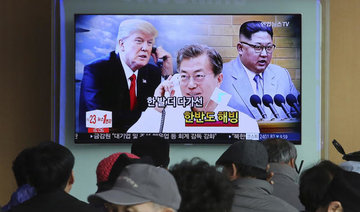
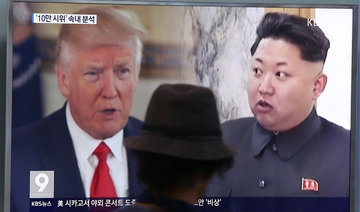
WASHINGTON: President Donald Trump tweeted that North Korea has promised to halt missile tests if the meeting between US president and his North Korean counterpart were to go ahead.
“North Korea has not conducted a Missile Tests since November 28, 2017 and has promised not to do so through our meetings. I believe they will honor that commitment!” Trump wrote on Twitter.
The White House has not released a date for a meeting between Trump and North Korean leader Kim Jong Un but Trump has said he will meet with the leader, who extended the invitation.
Earlier president Trump said that China’s President Xi Jinping is being “helpful” as the United States moves toward a summit with North Korean leader Kim Jong Un.Trump gave few details in a tweet about his telephone conversation with Xi Friday, but the White House had said the two leaders are committed to keeping the pressure on North Korea until it takes “tangible steps” toward de-nuclearization.
Trump tweeted that Xi “appreciates that the US is working to solve the problem diplomatically rather than going with the ominous alternative. China continues to be helpful!“
President Trump aslo spoke to the Japanese prime minister and French president about the forthcoming plans to talk to North Korea.
Hillary Clinton has warned that the Trump administration “was not recognizing the danger” in discussing nuclear disarmament with Pyongyang, and said Washington lacked experienced diplomats to handle the talks.
“If you want to talk to Kim Jong Un about his nuclear weapons you need experienced diplomats,” Clinton was quoted as telling Dutch tabloid Algemeen Dagblad in an interview published Saturday.
“These are people familiar with the dossiers and who know the North Koreans and their language,” Trump’s presidential rival said in an interview conducted in Amsterdam and published in Dutch.
“You cannot have diplomacy without diplomats,” she said, adding “the danger is not being recognized by the Trump government.”
Trump stunned the world this week by accepting an invitation to meet Kim before the end of May, an unexpected turnabout after months of intensifying brinksmanship that sent tensions soaring.
Liberal South Korean President Moon Jae-in, who some believe has maneuvered the two leaders to this position, declared Friday that the planned summit will be a “historical milestone” that will put the denuclearization of the Korean Peninsula “really on track.”
But there’s also considerable skepticism.
North Korea has made a habit of reaching out, after raising fears during previous crises, with offers of dialogue meant to win aid and concessions. Some speculate that the North is trying to peel Washington away from its ally Seoul, weaken crippling sanctions and buy time for nuclear development. It has also, from the US point of view, repeatedly cheated on past nuclear deals.
The North wants a peace treaty to end the technically still-active Korean War and drive all US troops from the Korean Peninsula, removing what it says is a hostile encirclement of its territory by Washington and Seoul.