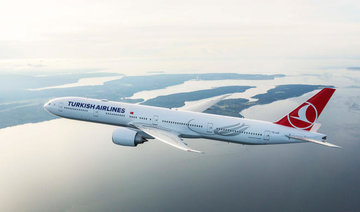
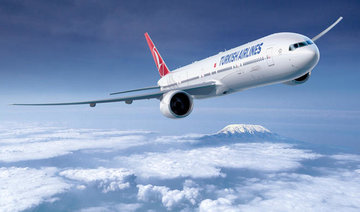
ISTANBUL: Turkish Airlines has confirmed plans to buy at least 50 wide-body aircraft from Airbus and Boeing as the flag carrier ramps up its ambitions ahead of a move to a new Istanbul airport.
The company said in a statement that it had agreed to buy 25 Boeing B787-9 aircraft, known as the Dreamliner, and 25 Airbus A350-900 aircraft.
In addition, it has the option to buy five more of each aircraft from both suppliers, meaning the eventual purchase could total 60 planes.
It said six would be delivered in 2019, 14 in 2020, 10 in 2021, 12 in 2022, 11 in 2023 and 7 in 2024.
Airbus indicated that the catalogue price of the 25 A350s alone would amount to $9.5 billion.
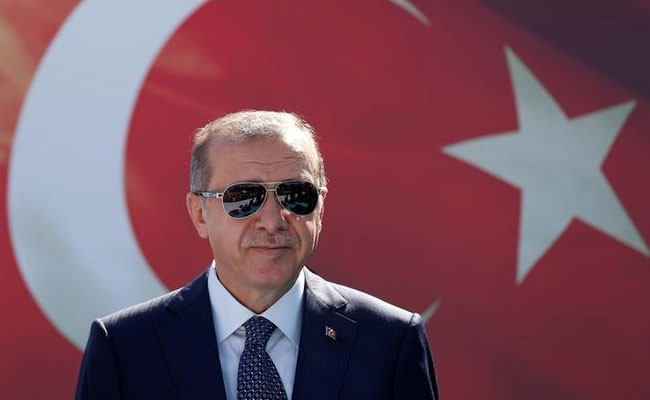
Turkish Airlines chief executive Ilker Ayci said that the announcement came after agreements signed during recent visits to France and the US — the homes of Airbus and Boeing — by President Recep Tayyip Erdogan.
He hailed the deals as a “very important initiative to meet the need for wide-body aircraft at the new airport” and strengthen the fleet ahead of the 100th anniversary of the founding of modern Turkey in 2023.
“We believe this will not just accelerate the steady rise of Turkish Airlines, but also contribute to Turkish civil aviation as a whole,” Ayci said, quoted by the Anadolu news agency.
The government plans to open the new airport by Istanbul’s Black Sea coast on Oct. 29, hoping to make it a global hub that can compete with Dubai for transfer traffic.
Turkish Airlines, which is 49-percent owned by the government through a wealth fund, has grown exponentially in recent years in a rise strongly supported by Erdogan to create a national champion.
Passenger numbers have swelled from just 14 million in 2005 to 69 million in 2017.
And the airline is targeting a total of 74 million passengers in 2018 and wants to expand its fleet from 329 at present to 424 planes by 2023.

Turkish Airlines to buy at least 50 Airbus and Boeing planes as Istanbul airport takes on Dubai
UNCTAD, Social Development Bank launch fellowship to power Saudi entrepreneurs
RIYADH: The Social Development Bank has signed a memorandum of understanding with UN Trade and Development to launch the “Empretec Saudi Fellowship,” a new initiative aimed at equipping high-potential Saudi entrepreneurs with advanced training and tools to scale their ventures.
The agreement was signed on the sidelines of the second edition of the DeveGo 2025 forum, held on Dec. 21–22 at the King Abdulaziz International Conference Center in Riyadh. The event brought together entrepreneurs, policymakers, and representatives from regional and international organizations, alongside public and private sector leaders.
Featuring more than 150 exhibitors, 85 speakers, and 45 workshops, the forum focused on sharing local and global best practices and strengthening the Kingdom’s entrepreneurial ecosystem.
The Empretec Saudi Fellowship is part of UNCTAD’s flagship capacity-building program to promote entrepreneurship and support micro, small, and medium-sized enterprises and startups. Active in more than 40 countries, the program seeks to develop personal entrepreneurial behaviors through intensive training, access to international experts, and technical tools that help transform promising ideas into scalable, high-impact businesses.
Rebeca Grynspan, UNCTAD secretary-general, said Saudi Arabia offers fertile ground for entrepreneurial growth.
“Saudi Arabia has a wonderful platform to bring everybody up, and the entrepreneurs here are so eager. They have ideas, creativity, and energy,” she told Arab News. “If they come through our program with the Social Development Bank, which does a wonderful job, they will be more successful — because that’s what we want.”
In his opening remarks, Saudi Minister of Human Resources and Social Development Ahmed Al-Rajhi, who also chairs the SDB board, highlighted the rapid evolution of the Kingdom’s startup landscape.
“The Kingdom is witnessing a qualitative transformation in the entrepreneurship and freelance ecosystem, enabling young men and women to enter new promising sectors such as artificial intelligence, renewable energy, advanced technologies, and venture capital,” he said. “This provides broader opportunities to contribute to innovation, expansion, and global competitiveness.”
During a tour of the exhibition alongside Al-Rajhi, Grynspan met a wide range of small and medium-sized businesses and handicraft makers, praising the depth of local talent. She noted that participants spanned the full spectrum of enterprises — from early-stage ventures to more established and sophisticated companies — reflecting a rich diversity of experience.
Al-Rajhi said the Social Development Bank invests more than SR8 billion annually to support enterprises and entrepreneurs, helping raise employment in bank-financed businesses from about 12,000 in 2021 to more than 140,000 in 2025.
Beyond financing, the bank runs several non-financial programs, including the Jada 30 business communities, which have incubated more than 4,300 enterprises across 13 cities, and the Dulani Business Center, which has delivered over 67,000 consultations benefiting more than 150,000 male and female entrepreneurs.
Speaking on the broader economic outlook, Grynspan added: “This is a wonderful place to come. Now is an economy that is thriving, is a population that is hopeful. And you have these young, talented people that are only waiting for an opportunity to make it happen for everybody.”
During the forum, the bank also signed multiple cooperation agreements spanning key sectors such as finance, education, energy, healthcare, heritage, the nonprofit sector, and freelance work. The partnerships align with SDB’s strategy to build an integrated system of financial and non-financial empowerment tailored to the needs of entrepreneurs, startups, and micro-enterprises.