NEW DELHI: India and France pledged Saturday to work together to ensure freedom of navigation in the Indian Ocean and signed an agreement to expedite construction of a major nuclear power plant in India by a French company.
After talks with French President Emmanuel Macron in New Delhi, Indian Prime Minister Narendra Modi also highlighted a solar alliance and cooperation between the two countries in defense, security, technology, space and counterterrorism.
Macron, who arrived in New Delhi on Friday for a four-day visit to India, said France and India should be key partners.
“And I dream to have more and more Indian citizens coming to France — studying, becoming entrepreneurs, creating startups — and I want my country to be a best partner in Europe, an entry point,” Macron said at a reception ceremony.
“I want to double the number of Indian students coming to France,” he said later on Twitter.
Modi said it was critical for the two countries to cooperate in the Indian Ocean region.
“Both our countries believe that for world peace, progress and prosperity in the future, the Indian Ocean region is going to play a very important role,” he said.
To help ensure freedom of navigation, the space agencies of the two countries signed an accord to help them detect, identify and monitor sea vessels.
The United States considers India a critical anchor in a regional strategy for the Indian and Pacific Oceans to blunt an increasingly assertive China. India is rallying support of countries including France and Australia on the maritime security front.
Shivani Singh, an Indian researcher on nuclear security, said France, like India, is an Indian Ocean power with a similar culture of strategic autonomy.
“France has the largest Exclusive Economic Zone in the world, of which 24 percent lies in the Indian Ocean region,” Singh wrote on her blog on Friday.
France has three Indian Ocean territories — Reunion, Mayotte and the French Southern and Antarctic Lands — comprising a total of almost 1 million French citizens.
“France also has military bases in Djibouti and the United Arab Emirates,” Singh wrote. “This gives France significant sovereign, demographic and economic interests to defend militarily in the region.”
France and India also agreed to exchange information and technical experts in the fields of environment and climate change.
The nuclear agreement is considered significant, with critics saying that Jaitpur, the site of the six-unit plant, which is to generate 9,900 megawatts of power in western India, is in a seismic zone. The opposition has grown since Japan’s nuclear accident in 2011, with several villagers refusing to hand over their land to the Indian government for the project.
On Saturday, the nuclear agreement was signed by state-run Nuclear Power Corporation of India and the French firm EDF.
Another agreement envisages reciprocal logistical support between the two countries’ armed forces.
In 2016, India signed an $8.78 billion deal with France to buy 36 Rafale fighter jets in “ready to fly” condition, meaning they will be made in France.
On Sunday, India and France will co-host the first meeting of the International Solar Alliance, an initiative launched by the two countries on the sidelines of the 2015 Paris Climate Conference.
India says that access to solar technology is becoming a reality, with costs coming down and grid connectivity improving.
The objective of the solar alliance of more than 120 countries is to work for efficient exploitation of solar energy to reduce dependence on fossil fuels.
France is the ninth-largest foreign investor in India. Bilateral trade between the two countries touched $10.95 billion during April 2016 to March 2017, according to India’s External Affairs ministry.
India’s main exports to France include textiles, boilers, electrical machinery and equipment, organic chemicals, railroad rolling stock, mineral fuels, leather goods, and gems and jewelry.
France mainly exports aircraft, medical instruments, organic chemicals, iron and steel, plastics, pharmaceuticals and chemical products to India.
Macron also paid homage to the tens of thousands of Indians who died in World War I, and said India is being invited to a major ceremony being planned in Paris for Nov. 11, the 100th anniversary of the war’s end.


India, France to work for Indian Ocean freedom of navigation
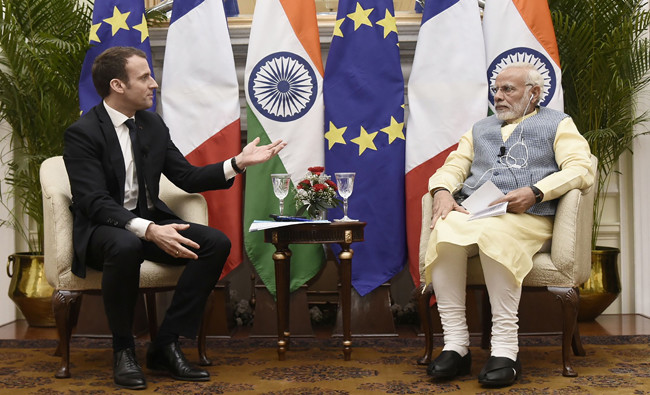

India, France to work for Indian Ocean freedom of navigation


Venezuela advances amnesty bill that could lead to mass release of political prisoners
- Such an amnesty is a central demand of the country’s opposition and human rights organizations with backing from the United States
CARACAS: Venezuela’s legislature on Thursday advanced an amnesty bill proposed by acting President Delcy Rodríguez that could lead to the release of hundreds of opposition leaders, journalists and human rights activists detained for political reasons.
Such an amnesty is a central demand of the country’s opposition and human rights organizations with backing from the United States. But the contents of the bill have not been released publicly, and rights groups have so far reacted with cautious optimism — and with demands for more information.
The bill, introduced just weeks after the US military captured then-President Nicolás Maduro, still requires a second debate that has yet to be scheduled. Once approved, it must be signed by Rodríguez before it can go into effect.
In announcing the bill late last month, Rodríguez told a gathering of justices, magistrates, ministers, military brass and other government leaders that the ruling party-controlled National Assembly would take up the legislation with urgency.
“May this law serve to heal the wounds left by the political confrontation fueled by violence and extremism,” she said in a pre-taped televised event. “May it serve to redirect justice in our country, and may it serve to redirect coexistence among Venezuelans.”
Rights groups, fearing some political detainees will be excluded, want more details about the requirements for amnesty before any final vote.
The Venezuelan Program for Education-Action in Human Rights, or PROVEA, issued a statement emphasizing that the bill must be made public urgently due to its potential impact on victims’ rights and broader Venezuelan society.
Based on what is known so far about the legislation, the amnesty would cover a broad timeline, spanning the administration of the late Hugo Chávez from 1999 to 2013 and that of his political heir, Maduro, until this year. It would exclude people convicted of murder, drug trafficking, and serious human rights violations, reports indicate.


