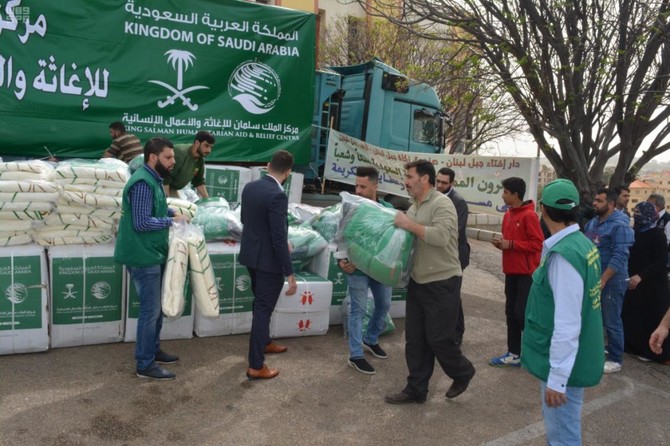
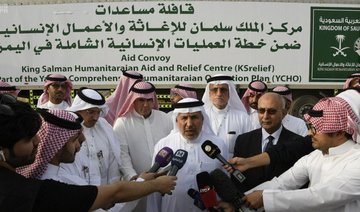
JEDDAH: The King Salman Humanitarian Aid and Relief Center (KSRelief) on Thursday distributed aid to civilians in Yemen trapped by mines or targeted by missiles fired by Houthi militias.
The aid, which included help with shelter as well as 300 packets of dates, benefited 1,000 people in Ma’rib governorate, and falls within the framework of the Yemen Comprehensive Humanitarian Operations (YCHO).
The center is helping to fight dengue fever by distributing food baskets to medical staff and needy families in the Mukalla region in Hadhramaut, whereas some 600 affected individuals and families have benefited from food rations.
The aid is the first stage of the campaign to fight dengue fever, which includes the distribution of 49,000 food baskets in the province.
Mobile clinics of KSRelief have also continued the provision of medical services to Syrian refugees in Zaatari camp, Jordan.
The number of Syrian refugees who received medical treatment provided by KSRelief clinics stood at 14,355 in February.
The KSRelief clinics treated cases that included pediatrics, heart disease, dentistry, general surgery, skin and allergies, ENT, general medicine, vaccines, internal diseases, nutrition, urinary tract, eyes, gynecology health care, laboratory, radiology, and pharmacy.

Saudi Arabia's KSRelief distributes aid to displaced Yemenis and Syrian refugees
Saudi authority sets new standards for beach operators on the Red Sea
JEDDAH: The Saudi Red Sea Authority has announced a new regulatory framework for beach operations, redefining beaches as managed operating sites rather than informal recreational spaces, the Saudi Press Agency reported.
The framework introduces standardized requirements for beach operators, focusing on licensing, safety, risk management and service quality across coastal tourism activities.
Under the regulations, beach operations will be permitted only through licensed entities, with license issued for two-year periods.
Renewal applications must be submitted at least 30 days before expiration. The authority said the system is intended to bring consistency to beach management and provide operators with clearer operational timelines.
The framework applies along more than 1,800 km of Red Sea coastline and establishes a unified national approach to regulating beach activities. The authority said no beach operation will be allowed without an official license.
The initiative supports the authority’s broader objectives to develop a coastal tourism sector that contributes SR85 billion ($22.66 billion) to GDP by 2030, creates approximately 210,000 jobs, and attracts 19 million visitors, the SPA noted.
To ensure a smooth transition, the regulations will come into effect one month after their announcement, while existing operators will be granted a one-year grace period to comply.
Safety forms a central pillar of the new framework. Licensing conditions include environmental permits, insurance coverage, approved safety plans, defined activity zones, and assessments of beach capacity.
Operators will also be required to provide licensed lifeguards, safety equipment, and systems for incident reporting and analysis.
The requirements extend to infrastructure and operation standards, including compliance with the Saudi Building Code to ensure accessibility for people with disabilities and structural safety.
Operators are also encouraged to align with international benchmarks such as Blue Flag standards and the ISO 13009:2024 for beach management, the SPA added.
The authority said this framework is designed to reduce operational risks, improve oversight and support the sustainable development of coastal tourism.
Unified requirements reduce operational risks, minimize inconsistencies, and improve the sector’s ability to attract financing and scale sustainably.