Just as history enshrines its heroes, it aggrandizes its villains.
The most fearsome perpetrators of evil can become calcified in the horror of their atrocities. It becomes easy to imagine them as stern, foreboding figures who could have only earned their impunity through obsessive, bloodthirsty rigor.
But of course, as Armando Iannucci’s “The Death of Stalin” illustrates, many of history’s monsters weren’t nearly as imposing as their reputations. They were idiots. They were vulgar, uncouth, hapless fools whose grip on power was as absurd as it was punishing. Their reigns were intensely cruel jokes.
In “The Death of Stalin,” Iannucci, having already thoroughly satirized modern-day Washington on “Veep,” travels back to 1953 Soviet Union and the days following Stalin’s collapse. That leap may seem greater than it is. Though the stakes are considerably higher in Stalinist Russia, the herd mentality of the power hungry to keep pace with political momentum is just as desperate. ‘Here, a wrong move won’t relegate you to morning television, but it will send you to Siberia, or worse. (OK, so the stakes aren’t that different.)
The frantic bumbling of hangers-on has been a specialty of Iannucci (“The Thick of It,” “Alan Partridge,” “In the Loop“), whose farces spin like particle-accelerating colliders, firing their paranoid, ever-strategizing characters off into ever-diminishing destinies.
Adapted by Iannucci, David Schneider, Ian Martin and Peter Fellows from Fabien Nury and Theirry Robin’s graphic novel, “The Death of Stalin” may be both Iannucci’s darkest and most timely satire yet. More than anything he’s done before, Iannucci has narrowed the distance between slapstick and savagery, prompting us to contemplate — even as we’re cackling — their uncomfortable proximity.
The movie begins with a scene that captures the expansive fear of life under Stalin. An orchestra, having just played for a radio broadcast, receives a request from their dictator — he’s a fan — for a recording of the performance. Since none was made, the orchestra and all in the audience are forced to recreate the broadcast, working well in the night. Just as the record is rushed off, a pianist (played by Olga Kurylenko) slips a personal note for Stalin into the sleeve. It’s this message — fittingly a hidden missive of honesty hidden in art — that Stalin (Adrian Mcloughlin) is reading when he keels over.
The news of the tyrant’s imminent death sets off a melee among the ministers of Stalin’s Politburo, who come running. Khrushchev (Steve Buscemi) arrives still dressed in his pajamas. The latest hastily scrambled list of names to be rounded up for the Gulag is recalled.
Most of “The Death of Stalin” captures, fairly realistically, the scheming and wrestling for power among Stalin’s cabinet — the motliest of crews. The race, at first, is to be the heir to Stalin’s policies and then, once the winds shift, to win the mantle of reformer, a feat requiring extreme political contortion. It’s a rich ensemble with varying accents, from Cockney to American, and uniform comic brilliance, including Michael Palin as Molotov, Jeffrey Tambor as Malenkov and Jason Isaacs as Zhukov.
But the primary drama is waged between Buscemi’s terrific Khrushchev and the exquisite Simon Russell Beale as Lavrentiy Beria, the secret police chief, who, when not ordering murders, dabbles in rape and pedophilia. That Beale creates such a character with even a hint of sympathy is a simply remarkably accomplishment.
There are hints and allusions throughout “The Death of Stalin” of the staggering horror just outside Kremlin walls. This is Iannucci’s first time working with real-life characters and it changes the trajectory and tone of the film. “The Death of Stalin,” which was banned from release in Russia, grows increasingly grim. The laughs dry up and painful truths settle in.
“The Death of Stalin,” an IFC Films release, is rated R by the Motion Picture Association of America for “language throughout, violence and some sexual references.” Running time: 107 minutes. Three stars out of four.


![]()
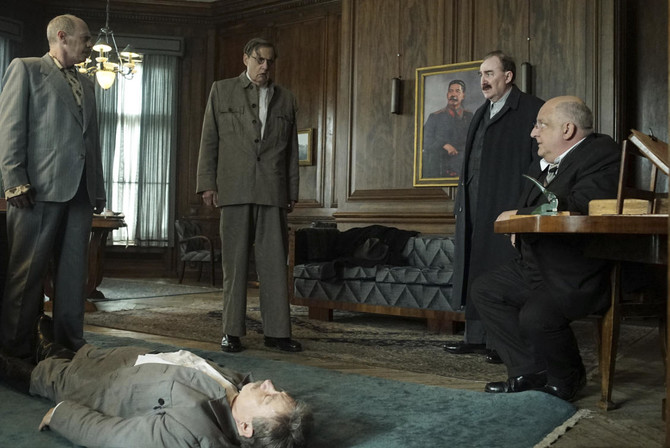
‘The Death of Stalin:’ A power vacuum full of comedy
‘The Death of Stalin:’ A power vacuum full of comedy


Latest updates


Recommended


© 2026 SAUDI RESEARCH & PUBLISHING COMPANY, All Rights Reserved And subject to Terms of Use Agreement.