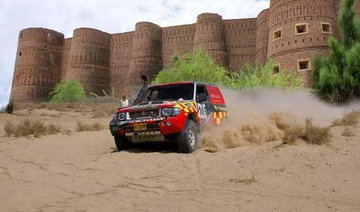
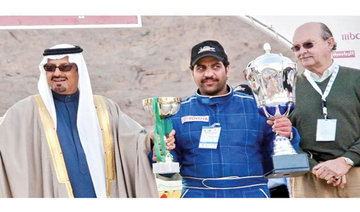
DUBAI: Be it brakes, bones or personal bests, cross-country rally drivers are accustomed to breaking things. Saudi Arabia’s Yasir Seaidan, however, is out to break something else this weekend at the Dubai International Baja.
Seaidan, who is competing in his third season of the FIA World Cup for Cross-Country Rallies, is intent on breaking the cycle and escaping from the fifth-place ranking that has come to be his own.
Fifth overall in last year’s championship, the 40-year-old finished fifth again in the opening round of the season in last month’s Baja Russia — Northern Forest. When he lined up on Thursday for the opening ceremony at Dubai Autodrome in his Toyota Hilux Overdrive — seeded fifth, naturally — he will be thinking only of the podium.
“Dubai is the only Baja with dunes and I’m good on dunes,” said Seaidan ahead of the three-day event that runs through the unforgiving Al Qudra desert. “The weather is perfect there at this time of year so I can be quite confident. Last year, I competed in the T2 category and finished third, so although I’m competing in T1 this year, I hope to do that again.”
His highest finish in the T1 category is, somewhat predictably, fifth. “I really hope I’m not stuck in this position,” he added.
According to organizers, the event will feature 88 drivers from 19 countries, competing in a range of vehicles, from T1 and T2 to quads, bikes and buggies. Seaidan, who started racing quads in 2002 before switching to cars in 2012, balances his racing career with senior roles in real estate, tourism and a motorsport company.
“To be racing all the year round for sure makes me need to work harder when I go back to the office,” he said. “But I’m trying to do my best to balance racing and working. My colleagues take some interest, but most believe that racing is too hard for them.”
The same cannot be said for Saudi Arabia’s newly-empowered female population. Soon to be permitted to drive unaccompanied, Saudi women are starting to show an interest in racing too. Seaidan says he will not be surprised if one day in the not-too-distant future, he is preparing to race in a field that includes women from his native country.
“Some girls in Saudi Arabia have already started asking how they can be a rally driver, so I believe in a few years you will see Saudi girls racing, yes,” he said.
It would be another milestone in what is proving a burgeoning motorsports industry in the Kingdom. Prince Abdulaziz bin Turki Al Faisal, a 34-year-old racing driver and Red Bull athlete, has been given the role of vice-chairman of the General Authority of Sport and last month Riyadh’s King Fahd International Stadium hosted the annual two-day Race of Champions. Although it was incorrectly billed as the country’s first international motorsport event, it was the first time in the event’s 30-year history that it had taken place in the Middle East.
“Everybody in Saudi Arabia loves motorsport, so the Race of Champions is just one more thing we can be proud of,” said Seaidan. “We currently have three rallies and the Saudi Motorsports Federation plans to increase this to five by next year. In 2008, the country hosted the Hail Baja (the opening round of that season’s FIA International Cup for Cross-Country Bajas), so I’m sure with the way things are going the federation will be planning to bring it back to the calendar soon.”
Saudi also has the Reem International Circuit on the outskirts of Riyadh.
“I think the future is bright for Saudi motorsport,” said Seaidan, “But first I need to do a good job in Dubai and get that podium.”
60 SECONDS WITH SEAIDAN
Favorite Driver: Jean-Louis Schlesser, French racing driver who has competed in touring cars, sports cars, cross-country and Formula One. Although he only competed in one F1 grand prix, he is renowned as the driver who stopped McLaren completing a perfect season in 1988. While being lapped by Ayrton Senna, Schlesser locked his brakes, crashed into the Brazilian and ended the race leader’s afternoon.

Jean-Louis Schlesser
Favorite Race: Rallye Oilibya du Maroc. One of the most visually stunning races on the FIA World Cup for Cross-Country calendar, the Moroccan event is often cited as Africa’s greatest rally race. First held in 2000, the event is set amid the Atlas Mountains and has been won a record four times by Schlesser. Qatari Nasser Al Attiyah equalled the Frenchman’s record last year and is expected to return this October to try and claim it for himself.

Rallye Oilibya du Maroc. (AFP)