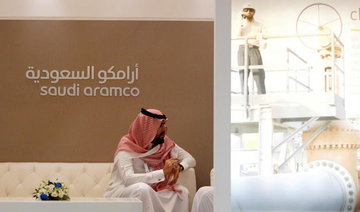
HOUSTON: Preparations for the initial public offering (IPO) of Saudi Aramco are going well but final decisions on timing of the share sale and the venue for any listing other than the Tadawul in Riyadh have yet to be taken, according to the government-owned energy giant’s CEO.
Amin Nasser told a gathering of energy industry peers at the CERAWeek by IHS Markit conference in Houston: “The IPO is progressing well. We became a joint stock company at the beginning of this year, so it is all progressing.
“But the big questions that are being asked — where and when will we list in addition to the Tadawul — are decisions for the shareholder and it is up to the shareholder to decide those questions.”
The conference was shown a copy of the telegram sent 80 years ago this week to announced that oil had been discovered at Aramco’s original well in Dhahran, which marks the origin of the company.
Daniel Yergin, founder of CERA, said that within six months Saudi Arabia became the 26th biggest oil producer in the world. Today Aramco is the biggest oil exporter and has the biggest reserves of any oil company.
Nasser said Aramco regards gas as a “very significant growth area” and he was trying to “capture growth areas in different parts of the world.” There has been speculation Aramco might do gas deals with Russian and even that it would but shale assets in the US.
In his speech from the podium, Nasser said that the original geologists in 1938 “always seemed to know where to go next, and what it would take to get there,” adding that he was also clear about the future of the oil industry.
He said that global oil demand continued to remain healthy, and that major producers were continuing to “show restraint” in supplying oil. He added that there were “multiple downside geopolitical risks to supply.”
But he added: “I am not unduly concerned about the recent volatility and expect the market to strengthen once the seasonal factors begin to fade.”
On the future of the industry, which some analysts say is in long-term decline because of the development of alternative energy sources, he said: “I am not losing any sleep over ‘peak oil demand’ or ‘stranded resources’.”
Nasser also warned that the oil market faces “multiple downside political risks,” and needs $20 trillion of investment over the next 25 years — the size of the American economy.
“Today I want to be clear about what really lies ahead for our industry, and the actions we must take to secure that future,” he said.
“We must leave people in no doubt that misplaced notions of ‘peak oil demandʼ and ‘stranded resourcesʼ are direct threats to an orderly energy transition and energy security,” he said, adding: “Oil and gas will continue to play a major role in a world where all energy sources will be required for the foreseeable future.”
Nasser pointed to flaws in all the various alternatives that have been advocated as future energy sources.
“The hot topic in energy transition is the future role of oil in transport. At the heart of it is the light duty road passenger vehicles segment (cars) that accounts for about 20 percent of global oil demand today. Many wrongly believe that it is a simple matter of electric vehicles quickly and smoothly replacing the internal combustion engine,” he said.
The future for alternatives to the motor car and internal combustion engine was “far more complex,” he said.


![]()

Aramco IPO preparations ‘progressing well’ but final decision lies with shareholder
Aramco IPO preparations ‘progressing well’ but final decision lies with shareholder

Latest updates


© 2026 SAUDI RESEARCH & PUBLISHING COMPANY, All Rights Reserved And subject to Terms of Use Agreement.