GENEVA: Flying cars — which have graced cinema screens for decades — are about to be launched for real, with the unveiling of a commercial model in Geneva this week.
From James Bond to The Jetsons, flying cars have long captured our imaginations. Now Dutch company Pal-V said they are almost ready to take to the streets, and the skies.
It unveiled its Liberty Flying Car — a sleek, red three-wheeled gyrocopter-type vehicle — at the Geneva Motor Show and said client deliveries could start next year.
The vehicles allow drivers to zip through traffic on the ground or simply fly above it.
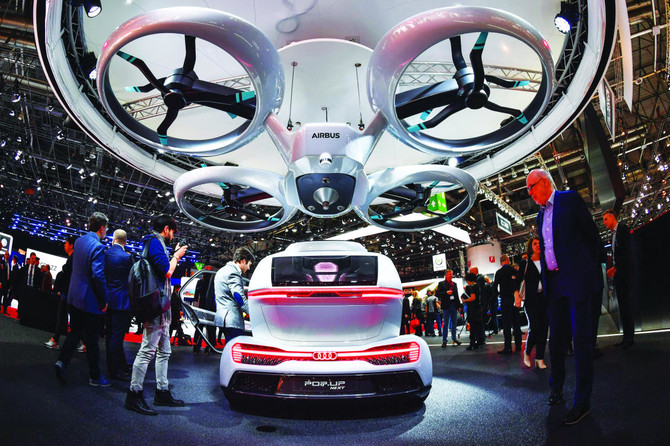
An alliance between Airbus, Audi and Italdesign also presented a concept flying vehicle, “Pop.Up Next” at the Geneva show.
That modular system, made up of an electric car with a huge quadcopter fastened to the roof, is expected to be commercialized from 2025, the companies said.
“Frustration” sparked the idea for Liberty for Pal-V (Personal Air and Land Vehicle).
In a plane, “you start at a point where you don’t want to start and you end up in a place where you don’t want to be,” company chief Robert Dingemanse told AFP.
“The Pal-V is the perfect product for city-to-city mobility,” he said, as “outside the cities you fly, inside the city you drive.”
The two-seater vehicle has retractable helicopter blades and is powered by a gasoline-fueled engine.
It can fly 500 km (310 miles), or drive nearly four times that distance without refueling, reaching a maximum speed of 160 km an hour.
Buyers are already lining up: For now the expected waiting time for delivery is around two years.
There are 10,000 strips in Europe available for take-off. “Because you can drive, that’s already enough,” Dingemanse said, adding that “every German will have a small airport within 10 or 20 km of his home.”
The modular Pop.Up Next has a radically different design — its passenger capsule resembles a futuristic gondola lift, with a giant quadcopter attached to the roof. Fully electric, it was conceived for mass transport in an urban setting.
The motorized base of the vehicle, which drives, and the upper part, which flies, can be detached to move autonomously.
Volkswagen’s Italdesign unit developed the passenger capsule while the motorized underbelly of the vehicle is based on Audi technology.
“I don’t know if you would use it every day,” Cousin said, adding that it would be good for “going to the airport (at a price) hardly more expensive than a taxi,” without the worry of traffic jams.
Airbus wants to launch the first urban trials by 2022, and is also looking into other uses, including transferring patients between hospitals and transporting goods at night.
“The convergence of certain technologies, especially in batteries and electric engines, is making it possible to develop this kind of vehicle — something that was impossible five or 10 years ago,” Cousin said.


![]()
Fantasy becomes reality as flying cars launch at Geneva Motor Show
Fantasy becomes reality as flying cars launch at Geneva Motor Show


Latest updates


© 2026 SAUDI RESEARCH & PUBLISHING COMPANY, All Rights Reserved And subject to Terms of Use Agreement.