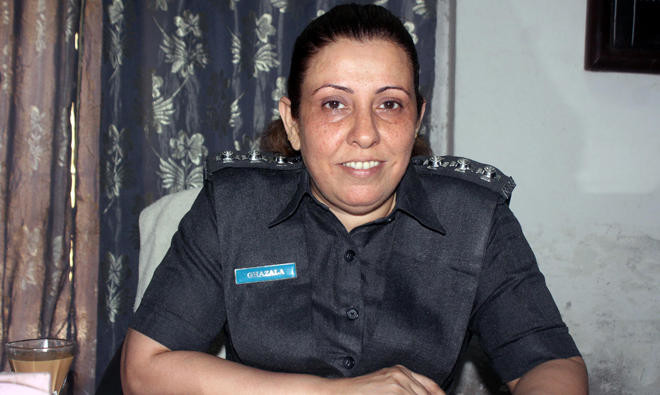
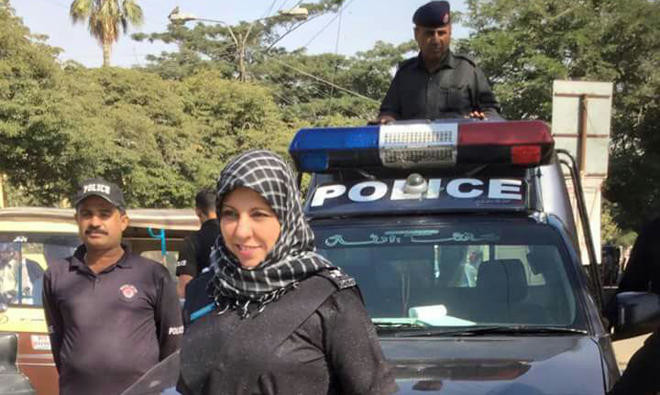
KARACHI: Moments after she assumed charge as the first woman Station House Officer (SHO) at Clifton Police Station, on April 8, 2014, Inspector Ghazala Perveen, was informed: “There has been a blast at Zamzama Street.”
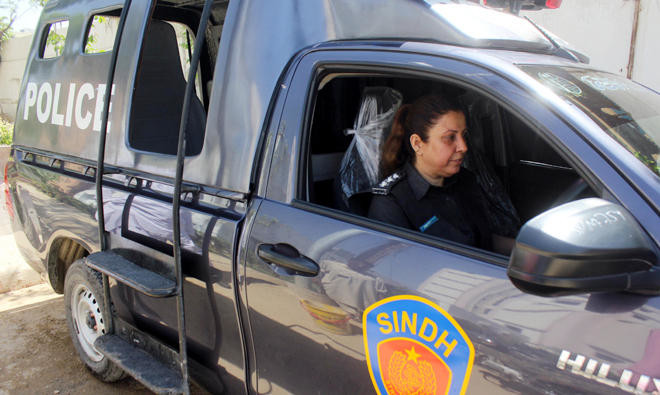
Ghazala accepted the challenge of commanding one of the city’s 103 police stations when the police force was fighting the war on terror across Karachi, aided by a Rangers-led targeted operation.
“My bosses asked me to reach on the crime scene and I just rushed,” Ghazala told Arab News.
“That was a historic day. Previously, women had only been appointed as SHOs in women police stations,” she recalled.
Though Clifton was not an easy place, Ghazala’s next assignment was even tougher. After serving less than two years, she was transferred as SHO of Mithadar Police Station in the old city, where traders routinely received extortion calls. Upon her appointment, the Senior Superintendent of Police (SSP) gave Ghazala the task of arresting absconding criminals who were facing cases in the city’s anti-terrorism courts.
“My SSP told me to take all the SHOs of the zone for the raid. But I ignored the advice, thinking in that case the success would be attributed to my male colleagues,” Ghazala said, recalling how she conducted the raid on her own and arrested a criminal absconding from a kidnapping case. “Everyone wondered how a woman could arrest a dangerous criminal. But I did.”
Ghazala, who says she has worn the lion's skin, was also seen digging a place near Katti Pahari – a neighborhood under Taliban influence before the Rangers’ operation – to recover arms.
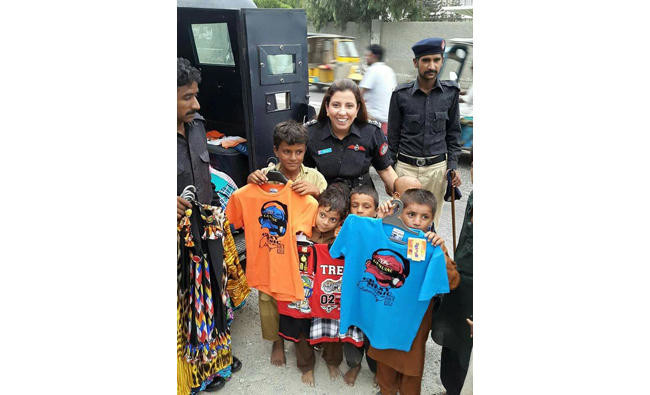
Tough on criminals, Ghazala is a kind-hearted person. “I don’t believe in violence and have never tortured a criminal to make disclosures”.
The woman cop, who has attended several training courses in the country as well as abroad, including one in Australia, said questioning again and again and using one’s mind yields better results than torture. “There was robbery at an eatery of an international food chain and when I saw the CCTV (footage), I observed that though the manager, who handed over the bag to the bandit, was looking frightened, there was a shine in his eyes which led me to guess that he was pretending to be scared,” said Ghazala. She nabbed the guy, named Kashif, who later confessed to his crime.
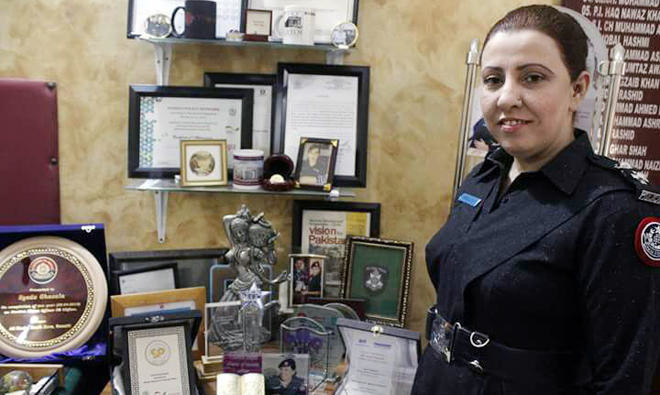
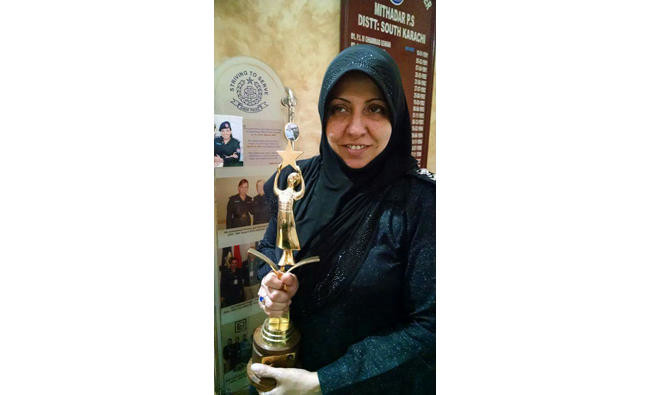
Now an accomplished officer and inspiration for thousands of girls, Ghazala said she was attracted to the police by the force’s uniform.
“The uniform was the driving force which took me from the teaching profession to the police,” she said.
“It was 1994. The first woman police station was just set up and inaugurated by former Prime Minister Benazir Bhutto. I, along with my fellow teachers and students, had come to see what the police station looked like. I had never seen a woman in
uniform,” she recalled.
She applied for the post of Assistant Sub-Inspector, and was selected. Now
she had the uphill task of getting the permission of her family of doctors and engineers, who had never seen a woman cop.
Since Ghazala was married her husband was leading the opposition. “Have you applied for the police? Are you crazy? Is police a department suitable for women? Ghazala was bombarded with many questions. “I told them, police are good people. And policewomen are the best ones.
"'Teaching is good for you,' my husband, who was working for the national airline, advised me. I told him that I would try this profession and if it turned out to be bad, I would quit and rejoin the teaching profession.”
Ghazala was promoted to Sub-Inspector in 2002 and subsequently appointed SHO at a woman police station.
When given the task of leading a male police station, Ghazala feared she might not have cooperation from the male subordinates. Her fears, however, proved unfounded. “I took it as a challenge as it was a new experience. I thought that the men wouldn’t mentally accept me as their boss.
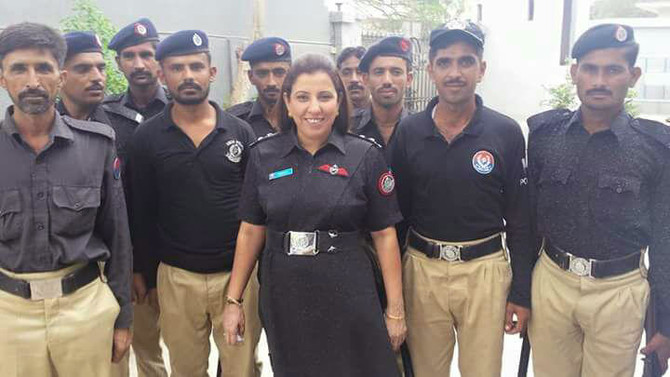
“The job was unexpected but the reception was also unexpected. I got a great reception. My service as SHO Clifton was the golden period of my career. The male bosses and subordinates were all very supportive,” Ghazala said.
“I have never seen anyone taunting me for being a cop. Apart from the opposition I faced before joining, it has always been praise from my family, relatives and the public.” She added: “I was the only policewoman among 150 policemen at the police
station.”
About 75 newly recruited female officers have gone for training at Razaqabad Academy, and 50 more are waiting. “Many highly educated girls are coming to the profession. They will change the scene,” she said.
“If you have a strong will, you can look after your family and simultaneously earn a name for yourself in any profession,” said Ghazala, whose job, although it has no specific duty hours, has never stopped her from taking care of her family.
“I faced no difficulties in the upbringing of my children as I lived in a joint family and got immense support from my in-laws and my husband.
“Women should believe in themselves. Don’t stop dreaming. Join any field and prove yourself as it’s your determination that takes you high. Being a woman is not a disadvantage. There is a lot of acceptance for excellence. Try to be excellent,” Ghazala said in her International Women’s Day message.


‘There is a lot of acceptance for excellence. Try to be excellent’



‘There is a lot of acceptance for excellence. Try to be excellent’

Indonesia’s new state mosque to hold first Eid prayers this year
- Mosque is located in Nusantara Capital City on Borneo island, a $32bn project set for 2045 completion
- Famous sculptor Nyoman Nuarta designed mosque, other government structures in new capital
JAKARTA: The state mosque in Indonesia’s planned new capital city, Nusantara, will hold its inaugural Eid Al-Fitr prayer this year, as the $62 million facility opens for its first run of Ramadan programs.
The Indonesian government has plans to relocate the capital to Borneo island to replace the overcrowded and sinking Jakarta on Java island, with the $32 billion megaproject scheduled for completion in 2045.
With a capacity of about 60,000 people, the mosque in East Kalimantan opened to the public last month, at the beginning of Ramadan.
“This mosque symbolizes that we are building the Nusantara Capital City with careful attention to spiritual, social and environmental aspects,” Troy Pantouw, spokesperson for the Nusantara Capital City Authority — the agency overseeing the new capital city — told Arab News on Saturday.
“We will hold Eid Al-Fitr prayers here and we are hoping that it would mark a historic momentum of unity here at Nusantara Capital City.”
Locally known as Masjid Negara, construction of the state mosque began in 2024. Its design was spearheaded by Balinese sculptor Nyoman Nuarta at the request of former President Joko Widodo.
Nuarta is one of Indonesia’s most famous visual artists and creator of the country’s tallest statue, Garuda Wisnu Kencana, located in Bali.
The 72-year-old is also the designer behind other main structures in Nusantara, including the new state palace.
This Ramadan marked many firsts for Masjid Negara, including its first taraweeh on Feb. 18, which was attended by thousands of worshippers in East Kalimantan.
In the same complex where the state mosque is located, the government has plans to build Christian churches, and Buddhist, Hindu and Confucian temples.
Indonesia, home to the world’s largest population of Muslims, officially recognizes Islam, Protestantism, Catholicism, Buddhism, Hinduism and Confucianism as religions.
“A church is now being built in the complex, and in the future there will also be houses of worship belonging to other religions. This reflects Nusantara’s values of harmony and respect,” Pantouw said.
“From the start, this area was designed to represent inter-religious harmony. We want the Nusantara Capital City to stand as a concrete example of how physical developments can be parallel to efforts to build tolerance in society.”