GWADAR: The inauguration of a water desalination plant is an important step for peace and development in Balochistan, Gwadar district authority said on Monday.
“This is a great initiative, and it’s a positive step toward resolving the problems of the people of Balochistan,” Deputy Commissioner of Gwadar Naeem Bazai told Arab News. “I am hopeful that the desalination project will also attract more investors. Besides, people are tired of depending on rain as their only source of water in the province. Another source is vital.”
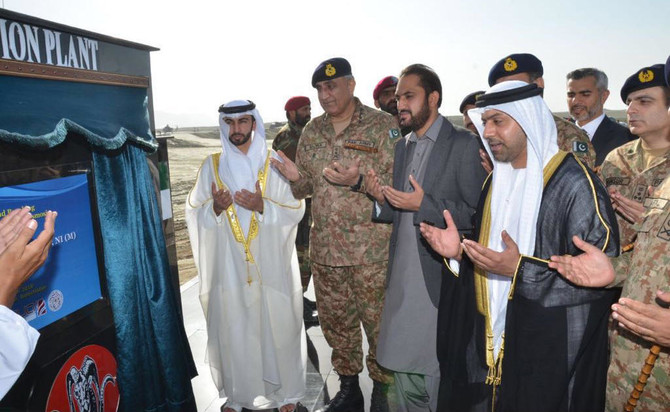
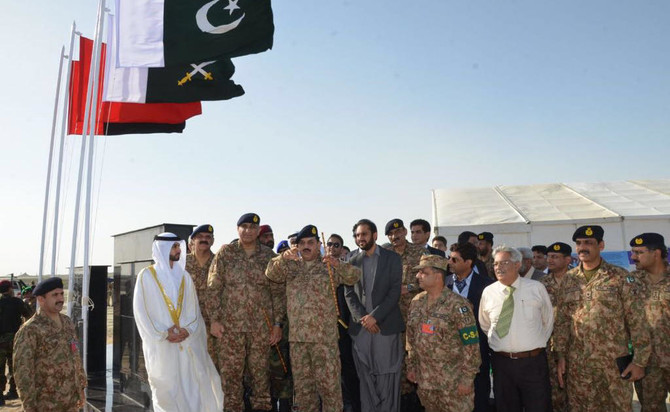
On Sunday, Chief of Army Staff (COAS) General Qamar Javed Bajwa, along with the United Arab Emirates and Swiss governments, inaugurated a water desalination plant in Gwadar.
The project aims to address the scarcity of drinking water by providing 4.4 million gallons water per day, with an additional capacity to increase to 8.8 million gallons per day, an Inter-Services public relations statement said. The project is set to reach completion in six to eight months.
Balochistan Chief Minister Mir Abdul Quddus Bizenjo and Commander Southern Command Lt. Gen. Asim Saleem Bajwa were among the prominent guests to grace the occasion.
As power remains an issue in the province, the deputy commissioner said Balochistan is producing about 17 megawatts of electricity but the demand for it is much higher. “Apart from this, if the basic facilities are provided to the people of Balochistan, then the government has done its job and the private sector will find ways to improve the living standards of the people.”
The COAS, while inaugurating the project, said all measures were being taken in coordination with the government, and that “would bring peace and prosperity to the province.”
Behram Baloch, a local journalist and activist, said: “The common man in Gwadar wants those basic facilities to be provided to them. And their No. 1 concern is water.”
The Army chief said that the prosperity of Balochistan was the prosperity of Pakistan.
“The people are hopeful that the COAS will keep his word and resolve the water scarcity issue before Ramazan,” said Behram.


Gwadar authorities welcome desalination plant

Gwadar authorities welcome desalination plant

Pakistan says it has received no request to join Gaza stabilization force
- Foreign Office says any decision on participating in an international mechanism will be guided by sovereign policy considerations
- It says Pakistan’s security collaboration with Saudi Arabia is longstanding and should not be narrowly viewed as troop deployment
ISLAMABAD: Pakistan has not taken any decision on joining a proposed International Stabilization Force (ISF) for Gaza and has received no formal request from the United States or any other country in this regard, the foreign office said on Thursday.
Trump’s Gaza plan, outlined as part of a 20-point framework, envisages the deployment of troops from Muslim-majority countries during a transitional stabilization phase, intended to support security and governance as the war-ravaged Palestinian territory moves toward reconstruction and a longer-term political settlement.
International media outlets claim Washington views Pakistan as a potentially significant contributor given its battle-hardened military, which has fought a brief but intense conflict with India this year and continues to combat insurgencies in its remote regions.
Responding to a query during his weekly media briefing, the foreign office spokesperson, Tahir Andrabi, said discussions on ISF for Gaza were ongoing in “certain capitals,” but Pakistan had neither committed to participate nor received any specific request.
“We have not taken a sovereign decision to participate in ISF as yet,” he said. “I am not aware of any specific request made to Pakistan. We will inform you about any development if it takes place.”
He added that while Gaza and Palestine remain part of Pakistan’s broader diplomatic engagements with regional partners, the Organization of Islamic Cooperation (OIC) and members of the United Nations Security Council, the issue of deploying a stabilization force had not been discussed as a standalone, structured agenda item.
“These discussions come up in the broader context of how to stabilize Gaza and ensure peace, but not as a specific, formal proposal,” he added.
The spokesperson maintained Pakistan supports efforts aimed at Gaza’s stabilization and peace but would make any decision on participation in international mechanisms strictly in line with its sovereign policy considerations.
In response to a question about a recent news report by Reuters about a possible visit by Pakistan’s Chief of Defense Forces Field Marshal Asim Munir to the United States to meet US President Donald Trump, Andrabi said there was no confirmation of such plans.
“I can contradict the report in its essence,” he said. “The report suggested as if a visit has been planned or finalized. I do not have any information on the timing or any future visit.”
Earlier, a White House official told Arab News on background no meeting was scheduled between Trump and Munir “at this time.”
The foreign office spokesperson stressed that official visits by Pakistan’s political or military leadership are announced formally by the government ahead of time.
“When an official visit takes place, there is an official announcement. I do not have any such information to share,” he added.
To a question regarding the Pakistan–Saudi Arabia Strategic Mutual Defense Agreement (SMDA) signed in September, he said security collaboration between Islamabad and Riyadh was longstanding, reiterating that the latest pact had only codified and further elaborated the partnership.
Andrabi maintained the pact should not be interpreted narrowly as the deployment of Pakistani forces, noting that defense cooperation covered a wide spectrum including training, joint exercises and institutional collaboration.
“As I said, it’s an ongoing process,” he said. “You should not read it just in the context of sending your forces. There are training, joint exercises that keep on going. If you interpret training as sending forces, I cannot say that. I mean, sending of forces is a very broad term. But our defense corporation, as I said, is ongoing.”


