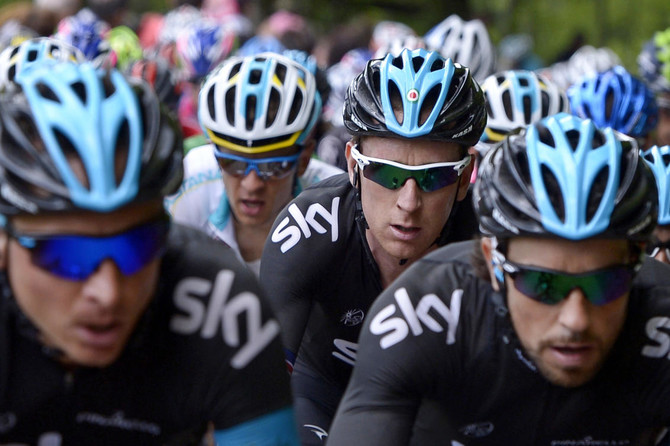
LONDON: British cycling great Bradley Wiggins said it was “so sad” after he and his former team were accused by MPs of manipulating drug rules before major races, including Wiggins’ 2012 Tour de France victory.
A report by the Digital, Culture, Media and Sport (DCMS) committee of the House of Commons published Monday, accused Wiggins and other Team Sky riders of using the drug triamcinolone not for its recognized purpose as an asthma treatment, but because it helped them lose weight without compromising their power in the saddle.
Russian computer hackers revealed three years ago that Wiggins had applied for therapeutic use exemptions (TUEs), which allowed riders to have injections of otherwise banned drugs, permitting him to take the powerful corticosteroid.
United Kingdom Anti-Doping (UKAD) launched an inquiry im September 2016 after the British newspaper Daily Mail reported a mystery package meant for the now-retired Wiggins had been delivered to Team Sky during a 2011 race in France.
It was alleged the package in question contained triamcinolone but Wiggins’ then doctor, Richard Freeman, insisted it was the decongestant fluimucil, a legal substance.
Freeman revealed he had lost a lone written record confirming this when his laptop was stolen while he was on holiday and after more than a year UKAD dropped its investigation, saying it had been hampered by a lack of “contemporaneous evidence.”
But the DCMS report, citing new evidence from an unnamed source, as well Freeman and Wiggins’s former coach Shane Sutton, dismissed the legal decongestant defense and said Sky, which had made much of its commitment to be drug free in a sport long tainted by doping scandals, had broken its own in-house rules. Australian coach Sutton, who quit as the performance director of British Cycling in the run-up to the 2016 Rio Olympics following an unrelated sexism row, told the committee that “what Brad was doing was unethical but not against the rules.”
But the 37-year-old Wiggins, a five-time Olympic gold medallist, said in a statement: “I find it so sad that accusations can be made, where people can be accused of things they have never done which are then regarded as facts.
“I strongly refute the claim that any drug was used without medical need. I hope to have my say in the next few days and put to my side across.”
His comments were backed up by Team Sky, who said they were “surprised and disappointed” the committee has chosen to present an anonymous claim in this way.
One thing the various inquiries did uncover was the extent of the close relationship between a Team Sky founded by Dave Brailsford and his old employers at British Cycling where he initiated the program that led to a slew of Olympic medals.
British Cycling chief executive Julie Harrington said the DCMS report was “thorough and timely,” adding in a reference to Team Sky: “Never again will we allow a situation to develop whereby our independence as the national governing body is called into question because of our relationship with a professional team.”
COMMENT: “SORRY STATE OF AFFAIRS FOR UK SPORT”
The revelations emerging from the DCMS report should surprise nobody. We have been here so many times before — global cycling and athletics have both been rife with doping scandals for decades, some suspicious and others blatant.
But for allegations of doping and the subsequent cover up to reach the highest echelons of the UK’s most respected sporting bodies and athletes is damning indeed. Accusations of “unethical behavior”, “unprofessionalism” and “misleading parliament” are all in the select committee’s report. Hardly words associated with organizations that for years have claimed to be a beacon of fair play in a sea of drug-taking.
It is time UK sports authorities stopped taking a “holier than thou” attitude — especially considering their finger-pointing at Russia and that country’s doping scandal — and held its hands up. Those in Britain were dismayed when the International Olympic Committee (IOC) recently lifted the suspension of Russia following its ban from Olympic participation. Now, their moral high ground has dropped somewhat.
The British public have been told consistently that its athletes were clean and that its admirable recent sporting success could be put down to the sheer talent of the competitors — but more importantly, continued investment and strong leadership from the top. These claims by the DCMS seriously dent that proposition. In the murky world of doping, Britain can no longer claim to be a leading light.