AMMAN: It is a rare thing — a success story in Jerusalem — and it has been achieved through an unusual combination of factors, both political and economic, and the intervention of a Christian leader.
The success story being celebrated is the announcement that Israel is to backtrack on plans for a draft law and suspend attempts to seize bank accounts for churches. But what led to this extraordinary event?
On Tuesday — following three days of protest — Israel backtracked from tax plans and draft property legislation.
The city’s Church of the Holy Sepulchre, revered by Christians as the site of Jesus’s crucifixion and burial, closed for three days in protest, reopened the following day.
Church leaders had gambled and taken the rare decision to close the ancient holy site, a favorite among tourists and pilgrims as a protest.
With the busy Easter holiday approaching, extra pressure was placed on Israel to re-evaluate and suspend the moves.
After a statement on Tuesday from the office of Israel’s Prime Minister Benjamin Netanyahu, Roman Catholic, Greek Orthodox and Armenian clergy agreed that the church would reopen on Wednesday morning.
Hanan Ashrawi, PLO executive committee member, believes that the battle between the Churches and Israel was forced on the churches.
“Both US President Donald Trump and Vice President Mike Pence have directly contributed to such an assault on the heart of Christianity in the place where it was born.
“Their illegal recognition of Jerusalem as Israel’s capital and moving the US Embassy to the occupied city have rendered them complicit in such an outrageous move.”
The Church, wanting to fight to show its credentials as an authentic part of the Palestinian social fiber, had little choice but to take a strong stand against Israel’s actions.
The rare decision by the leaders of three churches — Orthodox, Catholic and Armenians — to shut the church was only taken in despair at the chances of reaching an agreement with the Israelis.
The bank seizure plan aimed to extract about $150 million (SR562.5 million) of what the Jerusalem municipality considers back taxes.
The Church cited an agreement signed in the nineteenth century, which has been honored by Turks, Britain and the Jordanians, which stipulates how church properties and endowments should be dealt with by ruling powers.
Botrus Mansour, general director of the Baptist School in Nazareth, told Arab News that the Church leaders took a risk in their decision to shut the church doors.
Last year 33,000 students of Christian schools went on strike because of lack of public funds — even so that did not change anything.
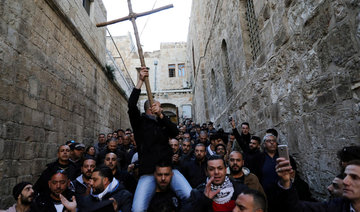
But not so this time around — images of the closed Church of Holy Sepulchre that were beamed around the world proved too powerful.
The closure of one of the most important churches in Christianity also meant that the three million tourists who visit Israel and Jerusalem each year would not get the chance to see inside the church.
A joint decision by Church leaders is rare. Differences among Christians in Jerusalem date back centuries. When the Muslim Caliph Omar came to the city he gave the keys of the Church of the Holy Sepulchre to the respected Nusseibeh Muslim family.
But perhaps the most important reason why the church leaders succeeded in securing an agreement was due to problems faced by Theophilus III, the head of the Orthodox Church.
Khaled Abu Arafeh, a former Palestinian minister of Jerusalem affairs during the short-lived Ismael Haniyeh government in 2007, told Arab News that the Orthodox patriarch wanted to improve his image among Palestinians. Palestinian Christians had called for his resignation over property deals made with Israelis.
“Theophilus III wanted to clean up his record with Palestinians, and so he incited the leaders of the other Churches to make the drastic move.
“Palestinian Christians accuse the Greek Orthodox church leader of selling church property to the Israelis.
“Mansour agrees with Abu Arafeh that the internal problems of the Orthodox Church played a big role in his lead role in taking the drastic decision to close Christianity’s most holy places.”
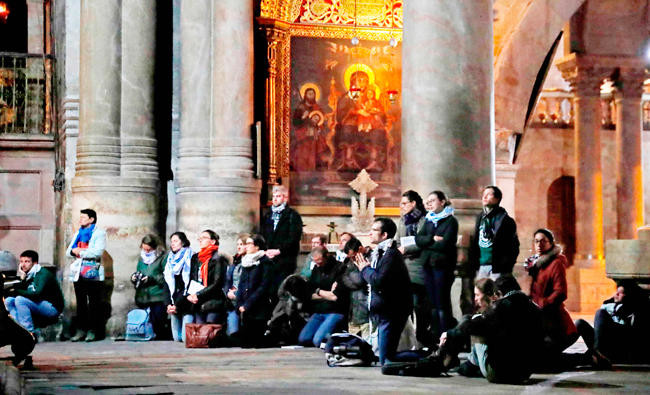
But Mansour believes that in the end the deciding factor was the sight of people praying outside the church.
“When two billion Christians around the world saw the image caused by Israel’s decision, the Netanyahu government had little recourse but to back away,” he told Arab News.


![]()
A Jerusalem success story: How Christian churches succeeded where politician failed
A Jerusalem success story: How Christian churches succeeded where politician failed

Latest updates


© 2026 SAUDI RESEARCH & PUBLISHING COMPANY, All Rights Reserved And subject to Terms of Use Agreement.