Egypt's chief prosecutor wants close monitoring of the media

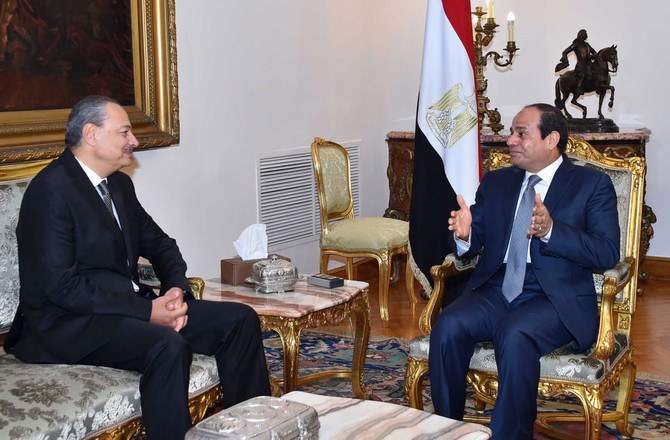
Egyptian President Abdel Fattah El-Sisi (R) meeting with Nabil Sadeq after he was sworn in as Egypt’s new Attorney General. (File Photo: AFP)
Updated 01 March 2018
Follow

Egypt's chief prosecutor wants close monitoring of the media

CAIRO: Egypt’s chief prosecutor has claimed “forces of evil” are working inside the media to maliciously hurt the national interest as the country gears up for its presidential election.
Nabil Sadeq reminded his staff on Wednesday to monitor journalists’ work and initiate legal action against any news outlets deemed to be a threat to security — the latest sign the government is exerting growing pressure on political rivals and opposition activists.
A statement issued by the prosecutor’s office warned that “the forces of evil” — a favorite phrase of Egyptian President Abdel Fattah El-Sisi — are seeking “to undermine the security and safety of the nation through the broadcast and publication of lies and false news.”
His remarks came amid an escalating row with the BBC over an investigative report by the UK-based broadcaster examining the political situation in Egypt in the build-up to the March 26-28 election.
Entitled “Crushing Dissent in Egypt,” the documentary, which aired on Saturday, said torture is “routine nationwide” and featured interviews with several dissidents, including one who claimed to have been held without trial for more than two years and electrocuted while in government custody. “Anyone opposing the regime is at risk,” the documentary said.
These allegations have provoked a furious backlash from officials and government supporters in the Egyptian press. The State Information Service, which accredits and monitors foreign media, said the 23-minute program was “flagrantly fraught with lies” and violated “internationally recognized professional norms.”
In an attempt to rebut the BBC’s claims that the government has turned forced disappearances into “a trademark of the El-Sisi era,” one television channel invited a 23-year-old student whose case featured in the documentary on to a talk show. In her appearance, the student said she had not been detained by masked police but had run away from her mother, married and had a child.
The BBC has told Reuters it stands by the “integrity of our reporting teams.”
The journalist behind the documentary, Orla Guerin, has had an illustrious career, working in Europe, Africa and the Middle East. She received an honorary MBE in 2005 for her “outstanding service to broadcasting.”
Egypt’s presidential campaign began on Saturday, with the incumbent El-Sisi running against Mousa Mustafa Mousa, a relative unknown on the political scene.
El-Sisi came to power in 2013, ousting the democratically elected president and Muslim Brotherhood member Mohammed Mursi in a military coup after widespread public protests against his rule. He was subsequently elected in 2014, winning almost 97 percent of the vote, and is the overwhelming favorite to win another four-year term this time.
The government has arrested several of El-Sisi’s political rivals in recent weeks, including Abdel Moneim Aboul Fotouh, founder of the Strong Egypt Party. He was accused of having ties to the Muslim Brotherhood, placed on a terrorist watch list and had his assets frozen after giving media interviews critical of the government during a trip to the UK.


Israeli attacks on Lebanon kill four, including security officer and child

Updated 7 sec ago
Follow

Israeli attacks on Lebanon kill four, including security officer and child

  • Lebanon’s health ministry says Israeli strike on village of Yanuh in the south killed three people
  • Israeli gunfire also killed one person in the border village of Aita Al-Shaab
BEIRUT: Israeli attacks on Lebanon killed four people on Monday including a Lebanese security forces member and his child, hours after the Israeli army seized a member of Islamist group Jamaa Islamiya.
Israel frequently strikes Lebanon despite a November 2024 ceasefire aimed at ending more than a year of hostilities with militant group Hezbollah.
On Monday, Lebanon’s health ministry said an Israeli strike on the village of Yanuh in the south killed three people.
The Israeli military said the strike targeted Ahmad Ali Salameh, who it alleged was Hezbollah’s head of artillery and had been working to restore the group’s capabilities.
In addition to Salameh, the strike killed a member of Lebanon’s security forces and his three-year-old child, who were passing by, according to Lebanon’s state-run National News Agency (NNA).
The Israeli military said the incident was “under review” after it was made “aware of the claim that uninvolved civilians were killed.”
Later on Monday, the health ministry reported that Israeli gunfire killed one person in the border village of Aita Al-Shaab, with the Israeli military saying it killed a Hezbollah member.
It alleged he was “gathering intelligence on (Israeli) troops and operated to rehabilitate Hezbollah’s terrorist infrastructure in southern Lebanon.”
In addition to recurring attacks, the Israeli army still has troops deployed on five border positions in Lebanon it deems strategic.
Monday’s incidents come hours after the Jamaa Islamiya group, an ally of Palestinian militants Hamas, accused Israel of seizing one of its officials, Atwi Atwi, from his home in the Hasbaya district, south Lebanon, and taking him to an unknown location.
The group, which has claimed responsibility for multiple attacks against Israel during the war with Hezbollah, condemned “the Israeli occupation forces’ infiltration.”
The Israeli military said that it “apprehended a senior terrorist” in the group who was then “transferred for further questioning in Israeli territory.”
Atwi’s capture came hours after Lebanese Prime Minister Nawaf Salam completed a two-day visit to the south, which suffered extensive damage during the conflict with Hezbollah, with thousands displaced.
Salam in a statement condemned Atwi’s “abduction,” calling it a “blatant attack on Lebanese sovereignty, a violation of the ceasefire agreement and “a breach of international law.”
Hezbollah meanwhile called on the state to “take deterrent measures and firm and clear positions, and to act immediately at all political, diplomatic and legal levels, and to work seriously to protect citizens.”
Lebanon accuses Israel of having abducted several other citizens since the start of the hostilities.
Hezbollah lawmaker Hussein Al-Hajj Hassan said last month that Israel was holding “20 Lebanese prisoners,” alleging 10 had been abducted “inside Lebanese territory after the ceasefire.”
Lebanon says Israel must release these detainees and withdraw from the border positions it retains, in addition to halting air strikes on Lebanon.