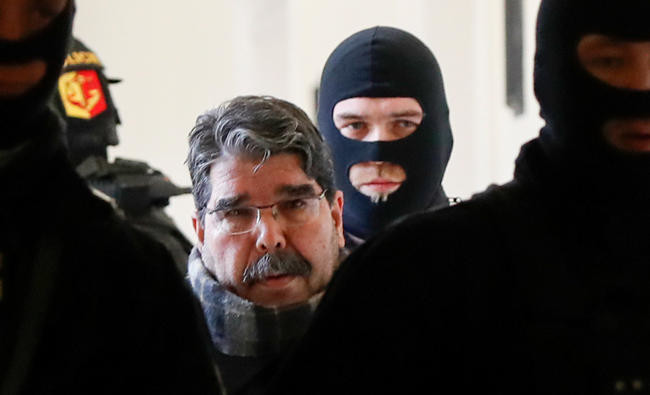
ANKARA: A Czech court’s decision to release a Syrian Kurdish leader wanted by Turkey has highlighted another fault line between Ankara and European countries.
Turkey was seeking a swift extradition of the former Syrian Kurdish Democratic Union Party (PYD) co-leader Salih Muslim after his arrest earlier this week in Prague.
Turkey accuses Muslim of being involved in a series of bloody terror attacks, and Ankara was furious that he was released on condition that he stay within EU territory.
Muslim, a Syrian citizen trained as a chemical engineer at Istanbul Technical University, was named on Turkey’s “most sought-after terrorists” list with a $1 million reward offered for his capture.
Muslim has been based in Europe for several years and has been conducting diplomatic meetings around the continent through PYD offices in France, Sweden and the Czech Republic. According to Russian news agency Sputnik, he also has a resident’s permit for Finland.
Ankara considers the PYD a Syrian affiliate of the Kurdistan Workers’ Party (PKK), which is listed as a terrorist organization by the EU, US and Turkey.
Should Muslim be extradited to Turkey, he would be the second leading Kurdish political figure to be caught since the arrest of PKK founder Abdullah Ocalan in 1999.
Criticizing the court’s decision, Turkish government spokesperson Bekir Bozdag said the ruling “amounts to support for terrorism.”
Meanwhile, Turkish Justice Minister Abdulhamit Gul said Turkey expects compensation from Czech authorities for the “mistake” made by letting Muslim walk free.
Experts say the decision highlighted Europe and Turkey’s diverging policies on counter-terrorism and Syria.
Nicholas Danforth, a senior policy analyst at the Bipartisan Policy Center’s National Security Project, said the ruling shows the extent to which disagreements over the Kurdish issue and rule of law will continue to bedevil Turkey’s relations with Europe, even when both sides want to improve the relationship.
Announcing that “Turkey will pursue Muslim wherever he goes,” Ankara also issued a diplomatic note to Prague.
Meanwhile, claims that Ankara would swap two Czech nationals held in custody in Turkey over terrorisms charges have been also been rejected by government officials.
Turkey and the Czech Republic are signatories to the Council of Europe’s European Convention on Extradition that provides for extradition between signatory parties of persons wanted for criminal proceedings. However, there is no bilateral agreement between the two countries in this field, while Muslim is not a Turkish national.
The Czech Republic does not list the list PYD as a terror group.
“It is not the first time that a European country has rejected Ankara’s request to extradite a criminal,” Nursin Atesoglu Guney, dean of economics, administrative and social sciences at Bahcesehir Cyprus University, told Arab News.
“For instance, Belgium has been a haven for many members of Revolutionary People’s Liberation Party, another left-wing terror group, and Brussels repeatedly ignored Ankara’s demands for their extradition, as in the case of Fehriye Erdal, who killed a prominent Turkish businessman and fled to Belgium,” she said.
According to Guney, such rulings show the EU’s hesitant approach to fighting terrorism.
“The only positive side of this release decision is to send a warning to all other wanted PYD members that they will not have a free hand in Europe due to arrest warrants issued for them,” she said.


![]()

‘Support for terrorism’: Turkey condemns release of Syrian Kurdish leader
‘Support for terrorism’: Turkey condemns release of Syrian Kurdish leader

Lebanon says 7 killed in Israeli strike on central Beirut
Beirut, Lebanon: Lebanon said an Israeli strike on central Beirut’s seafront killed at least seven people early on Thursday, another attack in the heart of the capital as Iran-backed Hezbollah launched more missiles at Israel.
The Israeli military said separately it had carried out strikes on Beirut’s southern suburbs overnight against Hezbollah, which had announced a major new operation against Israel.
Local media aired footage showing smoke rising along the seaside road area after the strike in central Beirut, which state-run National News Agency (NNA) said targeted a car.
“The Israeli enemy strike on Ramlet Al-Bayda in Beirut led to an initial toll of seven dead and 21 wounded,” the health ministry said in a statement.
It was the third attack in the heart of the capital since the Middle East war began. Israel has also repeatedly hit the southern suburbs of Beirut where Israeli military said on Thursday it had hit 10 Hezbollah targets.
The NNA reported on Thursday that Israeli strikes had also hit several towns in southern Lebanon, including Taybeh and Al-Sultaniyya as well as Qana, near the city of Tyre.
Hezbollah said early Thursday that it had fired off missiles at an Israeli military intelligence base in the suburbs of Tel Aviv.
Lebanon was drawn into the Middle East war last week when Hezbollah attacked Israel in response to the killing of Iranian supreme leader Ayatollah Ali Khamenei in US-Israeli strikes.
Israel, which kept up its strikes in Lebanon even before the war despite a 2024 ceasefire with Hezbollah, has since launched air raids across Lebanon and sent ground troops into border areas.
Its offensive has killed more than 630 people, according to Lebanese authorities, while more than 800,000 people have registered as displaced, with around 126,000 of them staying in collective shelters.
Some displaced people have been sleeping out in the open or in tents on the streets of Beirut, including in the seaside area of Ramlet Al-Bayda.
- Hezbollah operation -
Late Wednesday, French President Emmanuel Macron called for Israel to halt its ground offensive in Lebanon and on Iran-backed group Hezbollah to “immediately” stop attacks, after speaking with the country’s president Joseph Aoun.
Iran’s Revolutionary Guards said earlier that they had carried out a joint missile operation with ally Hezbollah against targets in Israel.
In turn, the Israeli military said early Thursday that “over the past hours, the IDF has begun a wide-scale wave of strikes targeting terror infrastructure belonging to the Hezbollah terrorist organization across Lebanon.”
It also said it hit “dozens of launchers” as well as Hezbollah intelligence and command sites in south Beirut.
It followed a string of Hezbollah statements saying its fighters fired barrages of rockets, advanced missiles and drones at towns, military bases and other locations, mainly in the Israel’s north.
On Wednesday, Israel pounded south Beirut and the country’s south and east, with the health ministry reporting several strikes that each killed at least eight people.
Authorities said a strike on an apartment in the densely populated Aisha Bakkar area in central Beirut wounded four people.
On Sunday, Israel hit a seafront hotel not far from Ramlet Al-Bayda, saying it was targeting Iranian foreign operations officers. Iran later said the raid killed four of its diplomats.
The Israeli military said separately it had carried out strikes on Beirut’s southern suburbs overnight against Hezbollah, which had announced a major new operation against Israel.
Local media aired footage showing smoke rising along the seaside road area after the strike in central Beirut, which state-run National News Agency (NNA) said targeted a car.
“The Israeli enemy strike on Ramlet Al-Bayda in Beirut led to an initial toll of seven dead and 21 wounded,” the health ministry said in a statement.
It was the third attack in the heart of the capital since the Middle East war began. Israel has also repeatedly hit the southern suburbs of Beirut where Israeli military said on Thursday it had hit 10 Hezbollah targets.
The NNA reported on Thursday that Israeli strikes had also hit several towns in southern Lebanon, including Taybeh and Al-Sultaniyya as well as Qana, near the city of Tyre.
Hezbollah said early Thursday that it had fired off missiles at an Israeli military intelligence base in the suburbs of Tel Aviv.
Lebanon was drawn into the Middle East war last week when Hezbollah attacked Israel in response to the killing of Iranian supreme leader Ayatollah Ali Khamenei in US-Israeli strikes.
Israel, which kept up its strikes in Lebanon even before the war despite a 2024 ceasefire with Hezbollah, has since launched air raids across Lebanon and sent ground troops into border areas.
Its offensive has killed more than 630 people, according to Lebanese authorities, while more than 800,000 people have registered as displaced, with around 126,000 of them staying in collective shelters.
Some displaced people have been sleeping out in the open or in tents on the streets of Beirut, including in the seaside area of Ramlet Al-Bayda.
- Hezbollah operation -
Late Wednesday, French President Emmanuel Macron called for Israel to halt its ground offensive in Lebanon and on Iran-backed group Hezbollah to “immediately” stop attacks, after speaking with the country’s president Joseph Aoun.
Iran’s Revolutionary Guards said earlier that they had carried out a joint missile operation with ally Hezbollah against targets in Israel.
In turn, the Israeli military said early Thursday that “over the past hours, the IDF has begun a wide-scale wave of strikes targeting terror infrastructure belonging to the Hezbollah terrorist organization across Lebanon.”
It also said it hit “dozens of launchers” as well as Hezbollah intelligence and command sites in south Beirut.
It followed a string of Hezbollah statements saying its fighters fired barrages of rockets, advanced missiles and drones at towns, military bases and other locations, mainly in the Israel’s north.
On Wednesday, Israel pounded south Beirut and the country’s south and east, with the health ministry reporting several strikes that each killed at least eight people.
Authorities said a strike on an apartment in the densely populated Aisha Bakkar area in central Beirut wounded four people.
On Sunday, Israel hit a seafront hotel not far from Ramlet Al-Bayda, saying it was targeting Iranian foreign operations officers. Iran later said the raid killed four of its diplomats.
Latest updates


© 2026 SAUDI RESEARCH & PUBLISHING COMPANY, All Rights Reserved And subject to Terms of Use Agreement.