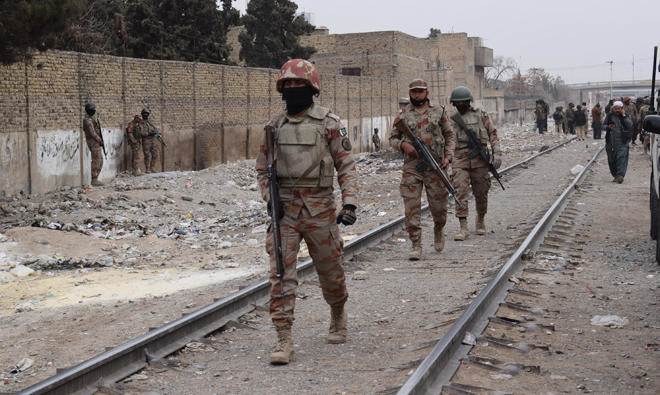
QUETTA: The provincial capital of Pakistan’s southwestern Balochistan province witnessed two militant attacks on law enforcement agencies on Wednesday in which six uniformed personnel were killed.
The first incident took place in the morning when an unidentified assailant tried to target Deputy Superintendent Police Hameedullah Dasti, killing two of his colleagues instead.
In the second incident, a suicide bomber hit a Frontier Corps camp in the city, killing four soldiers and injuring six others.
Security forces immediately cordoned off the area to evacuate the casualties and deal with the situation.
A proscribed militant faction, Tehreek-e-Taliban Pakistan (TTP), claimed the responsibility of the first attack in a statement sent to various media outlets in Pakistan. However, no group claimed the responsibility of the second incident by the time this report was filed.
Talking to Arab News, Deputy Inspector General Police Abdul Razzaq Cheema dismissed the TTP statement about the first attack, saying: “Nothing can be said until proper investigation of the incident is completed.”
He added that Dasti’s vehicle was ambushed while he was carrying out his official duties.
Quetta has witnessed an escalation in militant violence in recent weeks, and most of these attacks are directed against police and security officials.

Pakistan’s southwestern Quetta city targeted by militants again
Pakistan says responding to Afghan ‘offensive operations’ after border fire as tensions escalate
- Afghan Taliban spokesperson says “large-scale offensive operations” launched against Pakistani military bases
- Pakistan says Afghan forces opened “unprovoked” fire across multiple sectors along shared border
ISLAMABAD: Afghanistan’s Taliban authorities said on Thursday they had launched “large-scale offensive operations” against Pakistani military bases and installations, prompting Pakistan to say its forces were responding to what it described as unprovoked fire along the shared border.
The escalation follows Islamabad’s weekend airstrikes targeting what it said were Tehreek-e-Taliban Pakistan (TTP) and Daesh militant camps inside Afghanistan in response to a wave of recent bombings and attacks in Pakistan. Islamabad said the strikes killed over 100 militants, while Kabul said dozens of civilians were killed and condemned the attacks as a violation of its sovereignty.
In a post on social media platform X, Afghan government spokesperson Zabihullah Mujahid said Afghanistan had launched “large-scale offensive operations” in response to repeated violations by the Pakistani military.
Pakistan’s Ministry of Information said Afghan forces had initiated hostilities along multiple points of the frontier.
“Afghan Taliban regime unprovoked action along the Pakistan–Afghanistan border given an immediate, and effective response,” the ministry said in a statement.
The statement said Pakistani forces were targeting Taliban positions in the Chitral, Khyber, Mohmand, Kurram and Bajaur sectors, claiming heavy Afghan casualties and the destruction of multiple posts and equipment. It added that Pakistan would take all necessary measures to safeguard its territorial integrity and the security of its citizens.
Separately, security officials said Pakistani forces had carried out counterattacks in several border sectors.
“Pakistan’s security forces are giving a befitting reply to the unprovoked Afghan aggression with full force,” a security official said, declining to be named.
“The Pakistani security forces’ counter-attack destroyed Taliban’s hideouts and the Khawarij fled,” they added, referring to TTP militants.
The claims from both sides could not be independently verified.
Cross-border violence has intensified in recent weeks, with Pakistan blaming a surge in suicide bombings and militant attacks on militants it says are based in Afghanistan. Kabul denies providing safe havens to anti-Pakistan militant groups.
The clashes mark the third major escalation between the neighbors in less than a year. Similar Pakistani strikes last year triggered weeklong clashes before Qatar, Türkiye and other regional actors mediated a ceasefire in October.
The 2,600-kilometer (1,600-mile) frontier, a key trade and transit corridor linking Pakistan to landlocked Afghanistan and onward to Central Asia, has faced repeated closures amid tensions, disrupting commerce and humanitarian movement. Trade between the two nations has remained closed since October 2025.