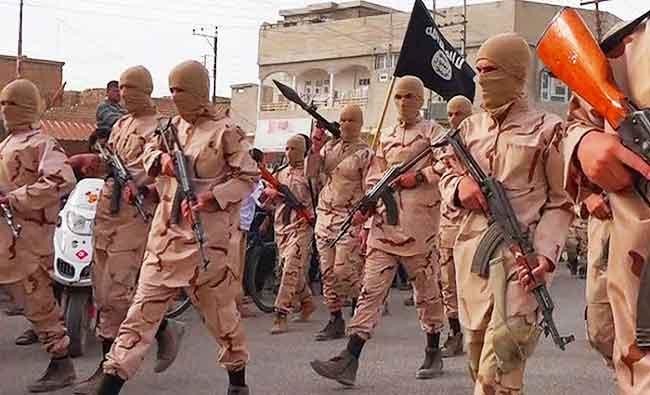
LONDON: As hundreds of radical volunteers who left Europe to fight for Daesh return home from the Middle East, the British government is facing growing scrutiny over how it deals with the wives and children who accompany them.
In June 2014 Daesh claimed to have established a caliphate across a large swathe of eastern Syria and western Iraq. It demanded that Muslims everywhere pledge allegiance to its self-declared state.
A mixture of hardened extremists, convicted criminals and vulnerable young high school students from across Europe rallied to the cause, encouraged by the militants’ slick social media campaign and their formidable reputation.
But as the true nature of life under Daesh’s brutal rule became apparent and the group gradually lost ground to an international military coalition led by the US, the volunteers began to trickle home.
Last week the European Border and Coast Guard Agency, Frontex, warned that hundreds of Daesh recruits drawn from the Continent are women whose precise roles “remains elusive.” This has left analysts divided over how the British government should deal with its returnees in the months and years ahead.
Scott Lucas, a professor of international politics at the University of Birmingham, told Arab News that Daesh recruits needed to be judged on a case-by-case basis.
“Should they be allowed back? Should they be detained? Do we let them live together in society? Or do we shun them? In my opinion, you have to look to some kind of integration if they haven’t committed a crime,” he said.
While local authorities in countries such as Denmark and Sweden run rehabilitation and reintegration programs for their returning militants, opinion in the UK is split over how best to deal with British radicals who went to Syria and Iraq.
In December, British Defense Secretary Gavin Williamson caused controversy when he told the Daily Mail that Britons who have fought for Daesh should never “be allowed back into this country.” His fellow minister Rory Stewart told BBC radio last autumn that “in almost every case” the only way to deal with British Daesh recruits was “to kill them” before they return home.
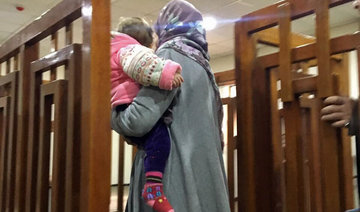
The recent Frontex report estimates that almost 1,000 women from Europe have joined militant groups in Syria, Iraq or Libya, with most of them filling the ranks of Daesh. Adding to an already complex situation are “several hundred minors” who were born or brought up in and around the battlefields of the Middle East. It warned that while the exact responsibilities of the female recruits have proved difficult to determine, “many women have expressed the desire to take more active roles within Daesh.”
But experts told Arab News that the UK would be wrong to try to arrest every extremist who arrives home in the weeks and months ahead.
“Reintegration programs are the way forward. If you put a blanket ban on all returnees associated with (Daesh) and just leave them out of the country, you’re not dealing with the issue,” said Lucas. “You’ll probably feed further radicalization by fueling their anger and estrangement.”
In 2006 the government of former Prime Minister Tony Blair formally announced a new counter-terrorism strategy known as Prevent, with the aim of identifying potential extremists and stopping them from joining radical groups. The strategy has proved highly divisive, with critics arguing that it encourages Muslims to spy on each other.
There is still no major government-run rehabilitation scheme for former Daesh members and in 2014 the UK passed legislation that allows it to strip terrorism suspects of their citizenship, even if it means they are left stateless.
Chris Doyle, the director of the Council for Arab-British Understanding, called for the cases of all returnees to be assessed on their own merits. He told Arab News many Daesh recruits “became deeply disillusioned by what they found” in Syria and Iraq and should be carefully integrated back into British society, while those who remained loyal to the extremist group could be imprisoned.
“We can’t create a situation where they feel they can’t return because there is no option for them,” he said.
Last October the Soufan Center, a New York-based think tank, estimated that 850 British Daesh recruits had gone to Syria or Iraq, compared to 915 from Germany and 1,910 from France. It estimated that 425 of the Britons had already returned home.
Anthony Glees, director of the center for security and intelligence studies at the University of Buckingham, told Arab News that the British government was right to try to stop Daesh recruits returning to the UK.
“We are talking about highly dangerous individuals who will have had battlefield experience and training in explosives. Their ‘brides’ may also have been radicalized by the violence their husbands have been involved in,” he said.

UK split over whether to kill or ‘cure’ Daesh recruits
Russia puts death toll from Ukrainian strike on occupied village at 27. Kyiv rejects accusation
Russian authorities said Friday that the death toll from a Ukrainian drone strike they said struck a café in a Russian-occupied village in Ukraine’s Kherson region rose to 27 people. Kyiv denied attacking civilian targets.
Svetlana Petrenko, spokeswoman of Russia’s main criminal investigation agency, the Investigative Committee, said in a statement that a Ukrainian drone strike on a café and hotel in the village of Khorly, where at least 100 civilians were celebrating New Year’s Eve overnight into Thursday, killed 27 people, including two minors. A total of 31, including five minors, were hospitalized with injuries.
A criminal probe on the charges of carrying out an act of terrorism has been opened, Petrenko said.
Kyiv denied attacking civilians. Spokesman of Ukraine’s General Staff, Dmytro Lykhovii, told Ukraine’s public broadcaster Suspilne on Thursday that Ukrainian forces “adhere to the norms of international humanitarian law” and “carry out strikes exclusively against Russian military targets, facilities of the Russian fuel and energy sector, and other lawful targets.”
Lykhovii said that General Staff has published an explicit list of targets that the Ukrainian army struck on the night of New Year’s Eve. The list did not include strikes on occupied parts of the Kherson region.
Lykhovii noted that Russia has repeatedly used disinformation and false statements to disrupt the ongoing peace negotiations.
The Associated Press could not independently verify claims made about the attack.
Russia’s accusations against Ukraine come amid a US-led diplomatic push to end the nearly four-year war in Ukraine. Earlier this week, Moscow alleged that Kyiv launched a long-range drone attack against a residence of Russian President Vladimir Putin in northwestern Russia overnight from Sunday to Monday.
Kyiv has called the allegations of an attack on Putin’s residence a ruse to derail ongoing peace negotiations, which have ramped up in recent weeks on both sides of the Atlantic.
In his New Year’s address, Ukrainian President Volodymyr Zelensky said that a peace deal was “90 percent ready” but warned that the remaining 10 percent, believed to include key sticking points such as territory, would “determine the fate of peace, the fate of Ukraine and Europe, how people will live.”
Trump’s special envoy Steve Witkoff said Wednesday that he, Secretary of State Marco Rubio and Trump’s son-in-law and adviser Jared Kushner had a “productive call” with the national security advisers of Britain, France, Germany and Ukraine “to discuss advancing the next steps in the European peace process.”
Elsewhere in Ukraine, Russia conducted what local authorities called “one of the most massive” drone attacks at Zaporizhzhia overnight.
At least nine Russian drones struck the city, damaging dozens of residential buildings and other civilian infrastructure, head of the regional administration, Ivan Fedorov, wrote on Telegram on Friday. There were no casualties, the official said.
Overall, Russia fired 116 long-range drones at Ukraine last night, according to Ukraine’s Air Force, which said that 86 drones were intercepted, while 27 more have reached their targets.
The Russian Defense Ministry reported Friday that its air defenses intercepted 64 Ukrainian drones overnight over multiple Russian regions.
Vyacheslav Gladkov, governor of Russia’s Belgorod region on the border with Ukraine, on Friday also accused Ukrainian forces of carrying out a missile strike on the city of Belgorod. Two women were hospitalized with injuries, Gladkov said. The strike shattered windows in multiple residential buildings and damaged an unspecified “commercial” facility and a number of cars, according to the official.
Svetlana Petrenko, spokeswoman of Russia’s main criminal investigation agency, the Investigative Committee, said in a statement that a Ukrainian drone strike on a café and hotel in the village of Khorly, where at least 100 civilians were celebrating New Year’s Eve overnight into Thursday, killed 27 people, including two minors. A total of 31, including five minors, were hospitalized with injuries.
A criminal probe on the charges of carrying out an act of terrorism has been opened, Petrenko said.
Kyiv denied attacking civilians. Spokesman of Ukraine’s General Staff, Dmytro Lykhovii, told Ukraine’s public broadcaster Suspilne on Thursday that Ukrainian forces “adhere to the norms of international humanitarian law” and “carry out strikes exclusively against Russian military targets, facilities of the Russian fuel and energy sector, and other lawful targets.”
Lykhovii said that General Staff has published an explicit list of targets that the Ukrainian army struck on the night of New Year’s Eve. The list did not include strikes on occupied parts of the Kherson region.
Lykhovii noted that Russia has repeatedly used disinformation and false statements to disrupt the ongoing peace negotiations.
The Associated Press could not independently verify claims made about the attack.
Russia’s accusations against Ukraine come amid a US-led diplomatic push to end the nearly four-year war in Ukraine. Earlier this week, Moscow alleged that Kyiv launched a long-range drone attack against a residence of Russian President Vladimir Putin in northwestern Russia overnight from Sunday to Monday.
Kyiv has called the allegations of an attack on Putin’s residence a ruse to derail ongoing peace negotiations, which have ramped up in recent weeks on both sides of the Atlantic.
In his New Year’s address, Ukrainian President Volodymyr Zelensky said that a peace deal was “90 percent ready” but warned that the remaining 10 percent, believed to include key sticking points such as territory, would “determine the fate of peace, the fate of Ukraine and Europe, how people will live.”
Trump’s special envoy Steve Witkoff said Wednesday that he, Secretary of State Marco Rubio and Trump’s son-in-law and adviser Jared Kushner had a “productive call” with the national security advisers of Britain, France, Germany and Ukraine “to discuss advancing the next steps in the European peace process.”
Elsewhere in Ukraine, Russia conducted what local authorities called “one of the most massive” drone attacks at Zaporizhzhia overnight.
At least nine Russian drones struck the city, damaging dozens of residential buildings and other civilian infrastructure, head of the regional administration, Ivan Fedorov, wrote on Telegram on Friday. There were no casualties, the official said.
Overall, Russia fired 116 long-range drones at Ukraine last night, according to Ukraine’s Air Force, which said that 86 drones were intercepted, while 27 more have reached their targets.
The Russian Defense Ministry reported Friday that its air defenses intercepted 64 Ukrainian drones overnight over multiple Russian regions.
Vyacheslav Gladkov, governor of Russia’s Belgorod region on the border with Ukraine, on Friday also accused Ukrainian forces of carrying out a missile strike on the city of Belgorod. Two women were hospitalized with injuries, Gladkov said. The strike shattered windows in multiple residential buildings and damaged an unspecified “commercial” facility and a number of cars, according to the official.
© 2026 SAUDI RESEARCH & PUBLISHING COMPANY, All Rights Reserved And subject to Terms of Use Agreement.