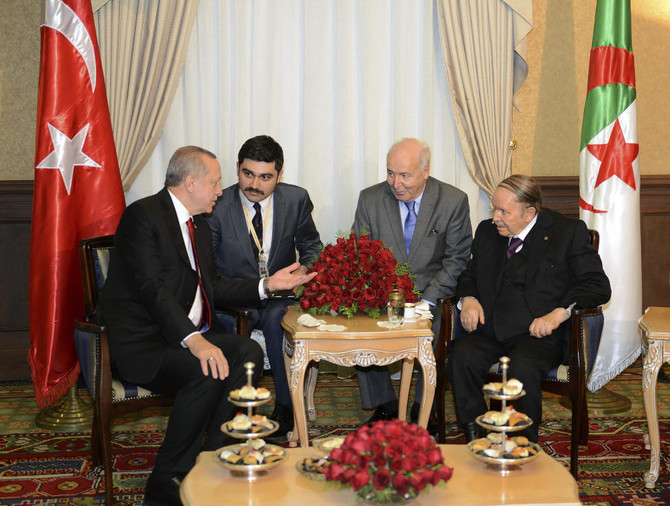
ALGIERS: Turkish President Recep Tayyip Erdogan welcomed the signing of trade deals with Algeria on Tuesday as he visited the country on the first leg of a tour of Africa.
Erdogan said the agreements would allow Ankara and Algiers to diversify trade pending the signing of “an agreement on the protection of investments as soon as possible.”
The Turkish president had already insisted, in an interview published in the Algerian daily Echorouk on Monday, on the need for the bilateral agreement to be finalized in order to “protect investments.”
“We see Algeria as an island of political and economic stability in the region. Our first trading partner in Africa is Algeria,” Erdogan said on Tuesday.
But “investments and trade will gain in volume as the work of our businessmen in Algeria is facilitated,” he said, without elaborating, in remarks made in the presence of Algeria’s Prime Minister Ahmed Ouyahia and Industry Minister Youcef Yousfi.
Currently worth around $4 billion, trade was expected to “reach $5 billion at the first stage, then $10 billion,” he said.
In his interview with Echorouk, Erdogan criticized Algeria’s importation barriers “which hinder the development of bilateral trade” and he also called for its visa regime to be eased for Turks, especially businessmen.
On Tuesday, he said he was “convinced” of the need to speed up cooperation in the energy sector, notably by developing “joint projects.”
Erdogan also welcomed Monday’s signing of a memorandum of understanding between Algerian state oil giant Sonatrach and Turkish groups Ronesans and Bayegan for $1 billion in petrochemical investments at Yumurtalik in southern Turkey.
At the conclusion of the agreement, Sonatrach is to provide the raw materials for the production of 450,000 tons of polypropylene each year, the Turkish president said.
Shortly after his arrival on Monday evening, Erdogan’s delegation signed seven agreements in hydrocarbons, agriculture, tourism, education, diplomacy and culture.
On Tuesday afternoon he met ailing Algerian President Abdelaziz Bouteflika, 80, who rarely appears in public.
The Turkish strongman — who has described his tour of Africa as “historic” — is expected in Nouakchott on Wednesday before heading to Senegal and Mali.


Erdogan hails Algeria trade deals on Africa tour
Erdogan hails Algeria trade deals on Africa tour


Ramallah talks focus on border crossings
- The meeting discussed ways to upgrade infrastructure and facilities at the Karama crossing, particularly arrival halls and cargo and transport areas, automate procedures and services, strengthen staff capacities, and combat smuggling
RAMALLAH: Palestinian Prime Minister Mohammed Mustafa chaired a meeting at his office in Ramallah on Saturday to review developments at border crossings, including the Karama crossing in the West Bank and the Rafah crossing in the Gaza Strip, as well as ways to develop and upgrade the crossings.
The meeting focused on improving the management and governance system for Palestinian crossings to clearly define the roles, responsibilities, and tasks of the parties involved, thereby contributing to the national economy, commercial activity, and travel services.
Mustafa reiterated that the crossings issue is a priority at all levels, as it directly affects citizens.
He stressed the need to intensify engagement with all parties to extend operating hours for passenger and cargo movement, and to develop travel and cargo transport mechanisms.
The meeting also discussed ways to upgrade infrastructure and facilities at the Karama crossing, particularly arrival halls and cargo and transport areas, automate procedures and services, strengthen staff capacities, and combat smuggling.
These measures aim to improve services for citizens, facilitate travel procedures, and enhance readiness to address congestion and travel crises, especially during the Umrah and Hajj seasons and holidays.
Meanwhile, according to local sources, Israeli forces forced Kamal Saeed Shawaneh, a Palestinian owner of a marble factory from the town of Kafr Thulth, south of Qalqilya, to carry out the demolition of his industrial facility located east of the town, on Saturday.
The facility, built on an area of roughly 300 square meters, suffered material losses estimated at more than $26,000. Israeli authorities claimed that Shawaneh did not have a permit for the factory’s construction.
The sources added that Israeli forces threatened Shawahneh with heavy fines if he did not carry out the demolition, noting that he had previously received a stop-work order for the factory in 2018.


