ISLAMABAD: Pakistan’s de facto finance minister, Miftah Ismail, has brushed off concerns that economic growth will suffer because of the country’s re-inclusion on a terrorist financing watch list, and lashed out against the US for seeking to “embarrass” his nation.
Washington last week persuaded member states of the Financial Action Task Force (FATF) to place Pakistan back on the “grey list” of nations with inadequate terrorist financing or money laundering controls. Pakistan was on the list for three years, until 2015.
The diplomatic setback has sparked anger in Islamabad against the US, which championed the motion against Pakistan at the FATF meeting in Paris.
It represented another blow to the worsening relationship between the uneasy allies, who have long differed on how to combat militants waging war in Afghanistan.
Ismail, officially the adviser on finance, revenue and economic affairs to Prime Minister Shahid Khaqan Abbasi, led Pakistan’s negotiations in Paris. He told Reuters that Washington did not seem genuinely eager to see Pakistan boost its terrorist financing regulations and was instead bent on humiliating the country.
“If the Americans were interested in working with us and improving our CTF (counter-terrorist financing) regulations, they would have taken the offer I was making them,” Ismail said. “But their idea was just to embarrass Pakistan.”
Ismail said that he urged the US to allow Pakistan until June to fix any outstanding CTF issues and ceded ground in negotiations to strike a deal, but that the US was determined to see Pakistan suffer.
US officials say Pakistan remains weak on terrorist financing prosecutions and has not done enough to combat money-raising capabilities of charities controlled by Hafiz Saeed, whom the US has designated a terrorist.
In the run up to the FATF meeting, Pakistan sought to gain favor by seizing control of parts of Saeed’s Jamaat-ud-Dawa (JuD) and Falah-e-Insaniat Foundation (FIF) charities, which the US terms "terrorist fronts" for militant group Lashkar-e-Taiba (LeT).
Ismail said Pakistan's law-enforcement shortcomings are often confused for lack of desire, especially at provincial level, where police officers are poorly trained when it comes to terrorist financing legislation.
“The will is there,” he added.
Pakistan hopes to be removed from the grey list in six to 12 months from June, when it will be officially placed on the watch list, Ismail added.
Despite rising growth on the back of improving security and China’s vast infrastructure investment, Pakistan’s economy has come under renewed stress during the past year.
Its foreign currency reserves are shrinking and the International Monetary Fund (IMF) has warned Pakistan's macroeconomic stability is weakening amid a ballooning current account deficit and a widening fiscal deficit.
Ismail said he did not foresee the FATF decision acting as a brake on Pakistan’s economy, which, with growth above 5 percent, is expanding at its fastest pace in a decade.
“I would rather not be in the list, but I don’t think it will hurt” economic growth, Ismail said, adding that ordinary Pakistanis would not see any impact from the FATF move.


![]()
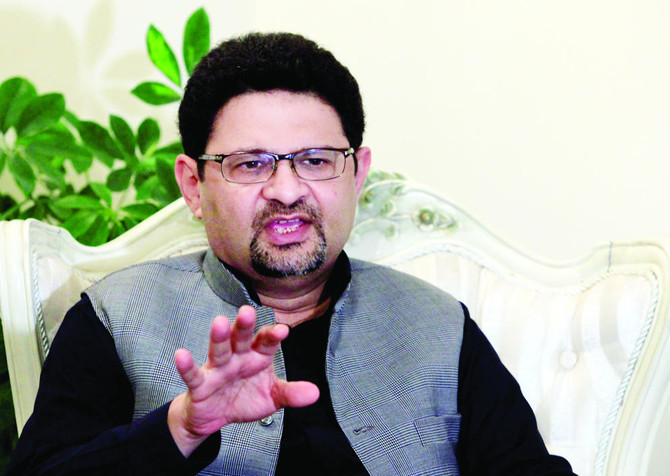
US trying to ‘embarrass’ Pakistan with terror financing list: Minister
US trying to ‘embarrass’ Pakistan with terror financing list: Minister


Latest updates


© 2026 SAUDI RESEARCH & PUBLISHING COMPANY, All Rights Reserved And subject to Terms of Use Agreement.