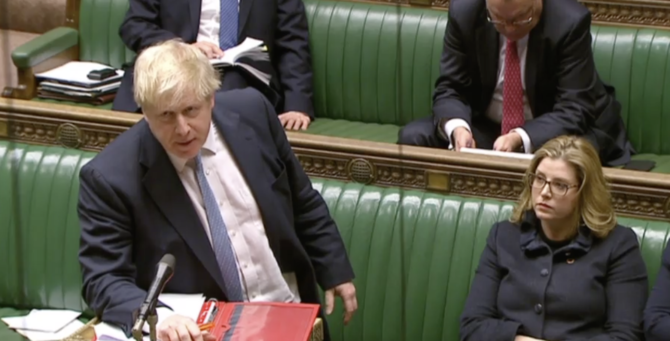
LONDON: The reports of chemical weapons attacks in Syria’s besieged enclave of Eastern Ghouta should be fully investigated, Britain’s foreign secretary said Monday.
“Hundreds of civilians have been killed in Eastern Ghouta in the last week alone and the House [of Commons] will have noted the disturbing reports of the use of chlorine gas,” Boris Johnson said.
“I call for these reports to be fully investigated and for anyone held responsible for using chemical weapons in Syria to be held accountable,” Johnson said, speaking at the House of Commons.
Johnson’s remarks came in response to an urgent question over the latest situation in Eastern Ghouta, where more than 500 people have been killed in bombing by the Syrian regime.
Johnson said he hopes the west “does not stand idly by” if incontrovertible evidence comes forward of further chemical weapons use in Syria.
The Foreign Secretary spoke of Britain’s “failure” to take action in 2013, when MPs rejected military action against Syria’s President Assad.
It came as Labour MP John Woodcock said the bodies of the latest violence in Syria “should be piled up in this chamber” as he urged ministers to do more.
Answering an urgent question in the Commons from Mr.Woodcock, Mr.Johnson was asked by Tory MP Jack Lopresti about the use of chemical weapons in Syria and the possibility of limited strikes on the Assad regime.
The Foreign Secretary said: “I think that many people in this country will certainly share his sentiments and I think many people believe that the United States of America did exactly the right thing when they responded to the abomination of the attack at Khan Sheikhoun in April with the strike at the Shayrat airfield.
“I think that it is certainly the case that if the OPCW (Organization for the Prohibition of Chemical Weapons) produces incontrovertible evidence of further use of chemical weapons by the Assad regime or their supporters, then I will certainly hope very much that the west does not stand idly by.”
The latest round of violence has been marred by fresh reports of chlorine gas use, as well as indiscriminate bombing and the targeting of hospitals.
“The men and women of Ghouta who lie in pieces, deliberately targeted by Assad’s Russia enabled bombs, the dead children whose faces are altered by the chlorine gas that choked them,” Mr.Woodcock said.
“They should not be strewn in the rubble of Eastern Ghouta. Those bodies should be piled up in this chamber and lain at the feet of governments of every single nation which continues to shrug in the face of this horror.”
He added that the UN Security Council “is broken while one of its permanent members flouts the basic laws and systems of order it was created to uphold”.
Johnson said the Syrian civil war has claimed 400,000 lives and driven 11 million people from their homes, “causing a humanitarian tragedy on a scale unknown anywhere else in the world.”
“The House should never forget that the Assad regime – aided and abetted by Russia and Iran – has inflicted the overwhelming burden of that suffering,” Johnson told British lawmakers.
“Assad’s forces are now bombarding the enclave of Eastern Ghouta, where 393,000 people are living under siege, enduring what has become a signature tactic of the regime, whereby civilians are starved and pounded into submission,” he said.
“With bitter irony, Russia and Iran declared Eastern Ghouta to be a ‘de-escalation area’ in May last year and promised to ensure the delivery of humanitarian aid.
“But the truth is that Assad’s regime has allowed only one United Nations convoy to enter Eastern Ghouta so far this year – and that carried supplies only for a fraction of the area’s people.”
Johnson said he “discussed the situation with my Turkish counterpart Mevlut Cavusoglu, and Saad Hariri, the prime minister of Lebanon.” Johnson said he also spoke with German Foreign Minister Sigmar Gabriel on Monday and will continue his conversation with other European counterparts.
“Britain has joined with our allies to mobilize the Security Council to demand a cease-fire across the whole of Syria and the immediate delivery of emergency aid to all in need,” Johnson said.
He said “after days of prevarication from Russia”, the Security Council on Saturday unanimously passed a resolution demanding that “all parties cease hostilities without delay” and allow the “safe, unimpeded and sustained delivery of humanitarian aid”, along with “medical evacuations of the critically sick and wounded”.
Johnson said “the warplanes of the Assad regime are still reported to be striking targets in the enclave” on Monday and “the UN has been unable to deliver any aid.”
He underlined that “hundreds of thousands of civilians are going hungry in Eastern Ghouta only a few miles from UN warehouses in Damascus that are laden with food.”
“The Assad regime must allow the UN to deliver those supplies, in compliance with Resolution 2401, and we look forward to Russia and Iran to making sure this happens, in accordance with their own promises,” he said, urging the fast delivery of humanitarian aid.
The British foreign secretary also said he has “instructed the UK Mission at the UN to convene another meeting of the Security Council to discuss the Assad regime’s refusal to respect the will of the UN and implement the cease-fire without delay.”
“Only a political settlement in Syria can ensure that the carnage is brought to an end and I believe that such a settlement is possible if the will exists,” he added.
Johnson also said Special UN Envoy Staffan de Mistura is “ready to take forward the talks in Geneva and the opposition are ready to negotiate pragmatically and without preconditions.”
“The international community has united behind the path to a solution laid out in UN Resolution 2254 and Russia has stated its wish to achieve a political solution under the auspices of the UN,” he said.
“Today, only the Assad regime stands in the way of progress. I urge Russia to use all its influence to bring the Assad regime to the negotiating table and take the steps toward peace that Syria’s people so desperately need.”


![]()
UK calls for investigation of Syria chemical attacks
UK calls for investigation of Syria chemical attacks


Latest updates


© 2026 SAUDI RESEARCH & PUBLISHING COMPANY, All Rights Reserved And subject to Terms of Use Agreement.