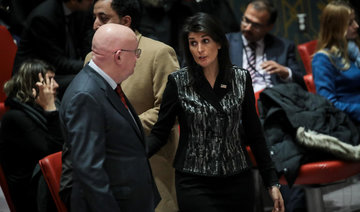
UNITED NATIONS: Nikki Haley, the US envoy to the United Nations, lashed out at Russia and threatened “to take actions” against it on Monday, after Moscow vetoed a UN Security Council resolution that condemned Iran for supporting Houthi militia in Yemen.
Haley blasted Russia for blocking censure of Tehran, saying it flew in the face of a report by a panel of UN experts, which found that Iran had failed to stop the transfer of drone and ballistic missile technology to the Houthis.
“If Russia is going to use its veto to block action against Iran’s dangerous and destabilizing conduct, then the United States and our partners will need to take actions against Iran that the Russians cannot block,” Haley warned, after the vote.
Although the British-drafted document was blocked on Monday, the 15-member council unanimously adopted a rival, Russian-proposed text that did not name Iran and extended a targeted sanctions regime over Yemen’s civil war until 2019.
The British-drafted document won 11 favourable votes at the 15-member Security Council but was blocked by Russia’s veto. China and Kazakhstan abstained, while Bolivia joined Moscow in voting against the measure.
The 329-page report by a UN panel of experts was formally released this month and concluded that Iran had violated a 2015 arms embargo after determining that missiles fired by the Houthis at Saudi Arabia last year were made in Iran.
Russia says the report’s findings are not conclusive enough to justify censure of Iran. While the report found that Tehran had broken the embargo by not blocking shipments, the experts said they could not identify the supplier.
“We cannot concur with uncorroborated conclusions and evidence which requires verification and discussions within the sanctions committee,” Russian ambassador Vassily Nebenzia told council members after deploying the veto.
“There’s a grave danger of toying with geopolitical maps, including with the use of the most volatile material, namely relations in the Islamic world, and relations between the Sunnis and Shiites,” he added, referencing two branches of Islam.
Saudi Arabia leads an Arab coalition that intervened in Yemen in 2015, backing President Abed Rabbo Mansour Hadi's internationally recognized government against the Iran-allied Houthi militia.
Sigurd Neubauer, a Washington based Gulf expert, told Arab News the spat between Russia and the western council members was a “game-changer” for the UN council, as it marked the first major division on Yemen.
“Until recently, the council was not divided on Yemen. Now that US President Donald Trump is pushing Iran and not accommodating Russia, the Yemen issue is becoming part of the wider US-Russia strategic competition,” Neubauer said.
“Going forward, this new dynamic between Washington and Moscow will complicate the already difficult UN peace process for Yemen. It marks a strategic failure on the part of Trump administration.”
James Farwell, a former Pentagon advisor, told Arab News that Britain, the US and other western powers were getting behind Riyadh with a view to constraining Iran’s growing influence in the Middle East.
“The Western partners are falling in behind Saudi Arabia out of concern that the Houthis do have a closer relationship with Iran,” Farwell said. “It’s about what can be done to checkmate Iranian expansion.”
Russia, which is aligned with Iran in its support for Syrian President Bashar Al-Assad, shows no signs of getting seriously involved in Yemen, but is seizing an opportunity to thwart its western rivals without investing any resources, Farwell, an expert connected with the Middle East Institute, said.
“Moscow is happy to sew chaos and disrupt what the US and its allies are doing,” said Farwell.
“But they are also treading careful because they’re wooing Saudi Arabia, which is a potential market for their arm sales and a country they could forge a stronger relationship with by raising suspicion that the US is not a reliable ally.”


![]()

Russia vetoes UN resolution to condemn Iran
Russia vetoes UN resolution to condemn Iran


Latest updates


© 2026 SAUDI RESEARCH & PUBLISHING COMPANY, All Rights Reserved And subject to Terms of Use Agreement.