DUBAI: British police said Monday four people were killed in an explosion at a property in Leicester, a central English city, last night, while four others remain in hospital, one with serious injuries.
There was no indication that the explosion was linked to terrorism.
“The cause of the explosion will be the subject of a joint investigation by the police and Leicestershire Fire and Rescue Service,” local police said in a statement.
“We would ask that the media and public do not speculate about the circumstances surrounding the incident, but at this stage there is no indication this is terrorist related.”
The police said that six fire crews were on scene, including a specialist search and rescue team, supported by two search dogs.
“We will work closely with colleagues from the police as our enquiries into the circumstances continue today,” the police said.
The apparent explosion occurred Sunday evening on a stretch of road containing commercial and residential properties close to the city center.
The electricity supply to a number of properties in the area was cut while emergency services deal with the incident, police said.
The Fire and Rescue Service said it received calls shortly after 7:00 p.m. (1900 GMT) from the public reporting an explosion and a building fire.
It immediately dispatched six fire engines, a spokeswoman said.
“We were en route when the police called to say a building had collapsed,” she added.
Additional specialist search and rescue units were then dispatched, including a search and rescue dog, according to the spokeswoman.
“We’ve got no indication of what the cause is at this moment,” the spokeswoman said.
Six people were taken by ambulance to Leicester Royal Infirmary hospital following the incident, according to University Hospitals of Leicester, which runs three area medical facilities.
“Two of these patients are in a critical condition, while four are walking wounded,” it said on Twitter.
Officials had earlier advised people only to attend the accident and emergency department “if absolutely necessary.”
The fire service spokeswoman also said representatives from gas and electric provider companies were in attendance at the scene, under routine procedures.
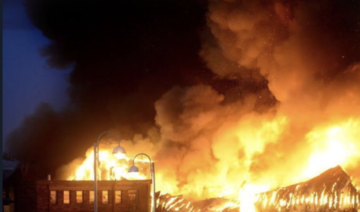
Pictures and videos posted on social media showed a property engulfed in flames visible from a distance, with rubble and debris scattered around.
Graeme Hudson told AFP he lives close to the scene and felt the blast.
“It was very scary,” he said. “I live five minutes away... but my house shook. I went out and saw massive smoke and big flames.
“I quickly went out to see what’s happened,” he added. “(I) didn’t stay for long there because (I felt) unsafe for my 11-year-old son.”

British police: Four killed in Leicester explosion
Bangladesh votes in world’s first Gen Z-inspired election
- Ousted PM Hasina’s Awami League party banned
- BNP, Jamaat in close race with big economic, geopolitical stakes
DHAKA: For years under former Prime Minister Sheikh Hasina, Bangladesh’s opposition had little presence on the streets during elections, either boycotting polls or being sidelined by mass arrests of senior leaders. Now, ahead of Thursday’s vote, the roles have reversed.
Hasina’s Awami League is banned, but many young people who helped oust her government in a 2024 uprising say the upcoming vote will be the Muslim-majority nation’s first competitive election since 2009, when she began a 15-year-rule.
The Bangladesh Nationalist Party (BNP) is widely expected to win, although a coalition led by the Islamist Jamaat-e-Islami is putting up a strong challenge. A new party driven by Gen-Z activists under the age of 30 has aligned with Jamaat after failing to translate its anti-Hasina street mobilization into an electoral base.
BNP chief Tarique Rahman told Reuters his party, which is contesting 292 of the 300 parliamentary seats at stake, was confident of winning “enough to form a government.”
Analysts say a decisive result in the February 12 vote, instead of a fractured outcome, is vital for restoring stability in the nation of 175 million after Hasina’s ouster triggered months of unrest and disrupted major industries, including the garments sector in the world’s second-largest exporter.
The verdict will also affect the roles of rival regional heavyweights China and India in the South Asian nation.
“Opinion polls suggest the BNP has an edge, but we must remember that a significant portion of voters are still undecided,” said Parvez Karim Abbasi, executive director at Dhaka’s Center for Governance Studies.
“Several factors will shape the outcome, including how Generation Z — which makes up about a quarter of the electorate — votes, as their choices will carry considerable weight.”
Across Bangladesh, black-and-white posters and banners bearing the BNP’s “sheaf of paddy” symbol and Jamaat’s “scales” hang from poles and trees and are pasted on roadside walls, alongside those of several independent candidates. Party shacks on street corners, draped in their emblems, blare campaign songs.
It marks a sharp contrast with past elections, when the Awami League’s “boat” symbol dominated the landscape.
Opinion polls expect the once-banned Jamaat, which had opposed Bangladesh’s India-backed 1971 independence from Pakistan, to have its best electoral performance even if it does not win.
China’s influence increases as India’s wanes
The election verdict will also influence the roles of China and India in Bangladesh in coming years, analysts have said. Beijing has increased its standing in Bangladesh since Hasina was seen as pro-India and fled to New Delhi after her ouster, where she remains.
While New Delhi’s influence is on the wane, the BNP is seen by some analysts as being relatively more in tune with India than the Jamaat.
A Jamaat-led government might tilt closer to Pakistan, a fellow Muslim-majority nation and a long-standing rival of Hindu-majority India, analysts say. Also, Jamaat’s Gen-Z ally has said “New Delhi’s hegemony” in Bangladesh is one of its main concerns and its leaders met Chinese diplomats recently.
Jamaat, which calls for a society governed by Islamic principles, has said the party is not inclined toward any country.
BNP’s Rahman has said if his party formed the government it would have friendly relations with any nation that “offers what is suitable for my people and my country.”
Bangladesh, one of the world’s most densely populated countries with high rates of extreme poverty, has been hit by high inflation, weakening reserves and slowing investment, which has pushed it to seek large-scale external financing since 2022, including billions of dollars from the International Monetary Fund and the World Bank.
Corruption is the biggest concern among the 128 million voters, followed by inflation, according to a survey by Dhaka-based think tanks Communication & Research Foundation and Bangladesh Election and Public Opinion Studies.
Analysts say Jamaat’s clean image is a factor in its favor, much more than its Islamic leanings.
“Voters report high intention to participate, prioritize corruption and economic concerns over religious or symbolic issues, and express clear expectations for leaders who demonstrate care, competence and accountability,” said the survey.
Nevertheless, BNP’s Rahman, son of former Prime Minister Khaleda Zia, is seen as the frontrunner to lead the next government. But if the Jamaat-led coalition emerges ahead, its chair, Shafiqur Rahman, could be in line for the top job.
Mohammad Rakib, 21, who is set to vote for the first time, said he hoped the next government would allow people to express their views and exercise their franchise freely.
“Everyone was tired of (Hasina’s) Awami League. People couldn’t even vote during national elections. People had no voice,” he said. “I hope the next government, whoever comes into power, will ensure this freedom of expression.”


