UNITED NATIONS: The UN Security Council on Sunday was considering two draft resolutions on Yemen after Russia put forward a rival text aimed at blocking action against Iran over missiles sent to the country’s Houthi rebels.
The council is set to vote on Monday on renewing sanctions on Yemen for a year, but a British-drafted text also calls for “additional measures” in response to a UN report which found that Iran had violated the arms embargo on Yemen.
The rival Russian-drafted text presented to the council on Saturday and seen by AFP would extend the sanctions regime on Yemen until February 2019 without any reference to the UN report’s findings on Iran and possible action targeting Tehran.
Diplomats said Russia could veto the British text, allowing for a vote on its own draft resolution.
Negotiations were continuing on Sunday.
The report by a UN panel of experts concluded that Iran was in violation of the 2015 arms embargo after determining that missiles fired by the Houthis at Saudi Arabia last year were made in Iran.
Russia maintains that the report’s findings are not conclusive enough to justify action against Iran.
Britain, backed by the United States and France, had initially sought to condemn Iran, but that was dropped in negotiations.
The last draft resolution expresses “particular concern” that “weapons of Iranian origin were introduced in Yemen after the imposition of the targeted arms embargo” and that Iran is in “non-compliance” with UN resolutions.
The council would express “its intention to take additional measures to address these violations,” according to the British-drafted text.
It adds that “any activity related to the use of ballistic missiles in Yemen” meets the criteria for imposing UN sanctions.
Iran has repeatedly denied arming the Houthis in Yemen, despite claims by the United States and Saudi Arabia that the evidence of an arms connection is irrefutable.
Russia, which has traditionally friendly relations with Iran, is providing military support along with Tehran to Syrian President Bashar Assad.
Russian Ambassador Vassily Nebenzia on Wednesday said the draft resolution should focus on renewing the mandate of sanctions monitors for Yemen instead of taking aim at Iran.
“It’s a resolution about the extension of the working group, not about Iran. So we should concentrate on extending the working group first,” he said.
While the report found that Tehran had violated the embargo by failing to block the shipments, the experts said they were unable to identify the supplier.
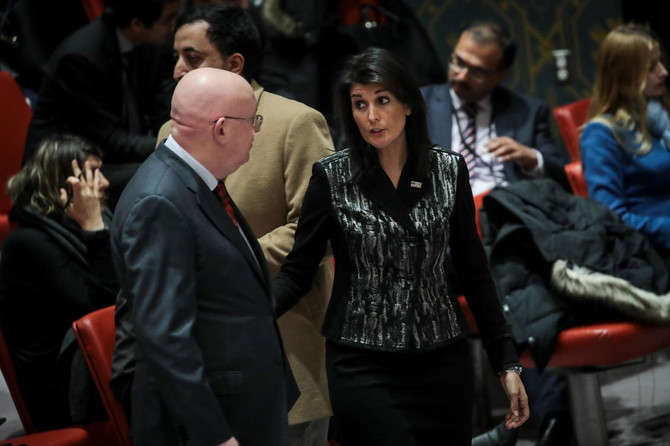
US Ambassador Nikki Haley is pushing for council action to rein in Iran and prevent the war in Yemen from escalating into a broader regional conflict.
In a New York Times editorial last week, Haley wrote that “the UN panel has given the world a chance to act before a missile hits a school or a hospital and leads to a dangerous military escalation that provokes a Saudi military response.”
A Saudi-led coalition supporting Yemen’s government has been fighting the Houthis since 2015 in a conflict that has led to what the United Nations describes as the world’s worst humanitarian crisis.
Russia can block council action by using the veto power it enjoys as one of the five permanent Security Council members, along with Britain, China, France and the United States.


Russia moves to block Iran missile criticism in UN resolution on Yemen
Russia moves to block Iran missile criticism in UN resolution on Yemen

In major policy shift on Syria, UN Security Council lifts sanctions on Hayat Tahrir Al-Sham
- Move reflects evolving Syrian political landscape in the post-Assad era, ending a global freeze on assets, travel ban and arms embargo
NEW YORK CITY: The UN Security Council on Friday removed Al-Nusra Front, the militant group that evolved into Hayat Tahrir Al-Sham, from its so-called Daesh and Al-Qaeda Sanctions List.
The move signals a major shift in international policy toward Syria’s evolving political landscape in the post-Assad era, and ends a global freeze on assets, travel ban and arms embargo that have been imposed on the group since 2014.
Al-Nusra Front and Hayat Tahrir Al-Sham were led by Ahmad Al-Sharaa, formerly Abu Mohammed Al-Julani, who is now Syria’s president and was a leading figure in the offensive that toppled the Assad regime.
The consensus decision by the Security Council’s sanctions committee was announced by the UK, which holds the presidency of the Security Council this month and was acting in the absence of the chair of the committee. It followed a request by the new Syrian authorities to delist “Al-Nusrah Front for the People of the Levant.”
The decision means measures that were applied to Hayat Tahrir Al-Sham under Security Council Resolution 2734, adopted in 2024, no longer apply. As a result, UN member states are notrequired to freeze the group’s funds, restrict the movement of its representatives, or block the supply or transfer of arms and related materiel.
Al-Nusra Front was added to the sanctions list for its ties to Al-Qaeda and involvement in the financing and execution of militant activities during the war in Syria. The UN initially continued to treat the group’s successor organization, Hayat Tahrir Al-Sham, as a listed alias.
Al-Sharaa has said the group severed all prior transnational jihadist links and is now solely focused on local Syrian matters.