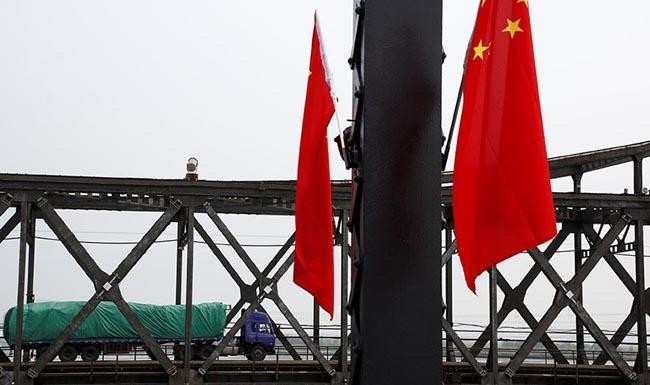
BEIJING: China’s January trade with North Korea fell to the lowest level since at least June 2014, the latest sign that China has kept up pressure on its isolated neighbor in line with United Nations trade sanctions.
China remains North Korea’s largest trading partner and sole major ally, though overall trade has fallen in recent months as the sanctions take effect.
Trade between China and North Korea totaled $215.97 million in January, down 52 percent from the year-earlier period and 31 percent month-on-month, final trade numbers from the General Administration of Customs showed on Friday.
The US has led an international campaign to tighten sanctions on North Korea to force it to give up development of nuclear weapons and missiles capable of hitting the US.
China has backed successive rounds of sanctions but has been wary of U.S. efforts to toughen these further and has been accused by US officials of not fully implementing existing UN steps.
The Trump administration plans to announce on Friday what is being billed as the largest package of sanctions yet against North Korea to increase pressure on Pyongyang for its nuclear and ballistic missile tests, a senior administration official said.
China’s exports to North Korea totaled $168.88 million in January compared with $257.73 million in December, while imports from North Korea were $47.09 million versus $54.68 million in December.
Data set to be released by China on Saturday will provide more detail on imports and exports of specific products to and from North Korea, shedding more light on which shipments were affected.
Beijing imported no iron ore, coal or lead from North Korea, and exported no oil products except for a tiny amount of jet fuel, in December, the third full month of the latest United Nations trade sanctions.

China January trade with North Korea falls to lowest since at least June 2014
IsDB announces $2.41bn in new financing for strategic development sectors
JEDDAH: The Islamic Development Bank has approved $2.41 billion in new financing for a series of transformative projects during its 364th Executive Board meeting, chaired by IsDB President Mohammed Al-Jasser.
The approvals underscore the bank’s ongoing commitment to regional cooperation, economic development, and climate- and environment-friendly investments that advance the UN Sustainable Development Goals across its member countries.
The new financing includes an additional $40 million for the Central Asia–South Asia Electricity Transmission and Trade Project (CASA-1000) in Tajikistan, aimed at boosting regional energy trade, improving electricity access and reliability, and mitigating climate change through the export of clean and renewable energy.
The bank also approved €116 million ($135 million) to upgrade Senegal’s Dakar Expressway Project.
The initiative is designed to improve health, education, and economic services for local populations, reduce traffic congestion and peak travel times, and enhance road safety measures to halve traffic-related deaths and injuries, with a particular focus on women and young pedestrians.
A $1.307 billion allocation was approved for Kazakhstan’s Economic and Industrial Zones Project to foster sustainable industrial development.
The initiative is expected to promote economic diversification, attract investment, create jobs, and boost global competitiveness through infrastructure upgrades and operational efficiency in special economic zones, industrial zones, and specialized industrial zones.
Bahrain will receive $330.07 million to expand its industrial capacity and strengthen economic competitiveness. The funding will support the development of modern industrial land with resilient infrastructure, advanced export-oriented manufacturing, effective internal connectivity, and reclaimed land facilities.
The project aims to stimulate private investment, generate employment, and reinforce Bahrain’s position as a regional industrial and logistics hub.
The IsDB approved $160 million to enhance utilities, water, and urban development sectors in Jordan.
The financing will secure future drinking water supply for Aqaba, Amman, and northern regions, support climate adaptation and mitigation, foster economic growth, and promote private sector participation in sustainable, long-term water solutions to alleviate severe water stress.
Azerbaijan was granted $436.67 million to improve agricultural productivity by reducing irrigation water losses and supporting sustainable rural development, in line with Azerbaijan’s 2030 vision.
The project will also promote green growth, strengthen climate resilience, and ensure long-term food security.
The approved projects reflect the IsDB’s strategic focus on fostering sustainable and inclusive growth across member countries by addressing critical infrastructure, energy, water, transport, and industrial development challenges.
These initiatives are expected to deliver lasting impact and contribute effectively to achieving the Sustainable Development Goals.