Hillside crashes onto Indonesian farmers; 5 dead, 18 missing

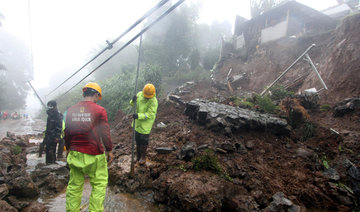
People take photos of a landslide in Brebes, Indonesia February 22, 2018, in this image obtained from social media. (Aji Santoso/via REUTERS)
Updated 23 February 2018
Follow

Hillside crashes onto Indonesian farmers; 5 dead, 18 missing

BREBES, Indonesia: Farmers were working in their rice paddies on the Indonesian island of Java, when the soggy hillside above them collapsed under the weight of torrential rains, killing five people and leaving rescuers digging for 18 missing.
Survivors described a sudden roar as Thursday’s landslide was unleashed, sweeping trees and everything else in its path toward the terraced rice fields below.
“The hill above us looked like it was spinning down,” said Watirah, a 53-year-old farmer from Pasir Panjang village, who with other villagers from the affected hamlet in Central Java’s Brebes district tried to outrun the sliding earth.
“I tried to keep going, tried to stand up and screamed loudly for help before I fell again,” said Watirah, who goes by a single name. “I felt my body was so weak I couldn’t stand up, but three people came to save me,” she said. Her husband, Minarto, who was working in a nearby field, also narrowly survived.
Hundreds of rescuers including soldiers and villagers were using their bare hands and farm tools to search for victims buried beneath tons of mud and soil. The search and rescue team was having difficulty finding victims because of the unstable muddy conditions and width of the landslide.
“Heavy equipment cannot be used,” said National Disaster Mitigation Agency spokesman Sutopo Purwo Nugroho.
Sutopo said 14 people were hospitalized with injuries. He said 18 others are missing based on reports from residents.
Local disaster official Eko Andalas said the landslide, which started in surrounding hills that are part of a forestry plantation, was triggered by torrential rains.
Disaster officials urged people to stay away from the area because of the risk of further landslides.
Seasonal rains cause widespread flooding and landslides across much of Indonesia, an archipelago of more than 17,000 islands. Millions of people live in mountainous regions and on flood plains.


Venezuela advances amnesty bill that could lead to mass release of political prisoners

Updated 06 February 2026
Follow

Venezuela advances amnesty bill that could lead to mass release of political prisoners

  • Such an amnesty is a central demand of the country’s opposition and human rights organizations with backing from the United States

CARACAS: Venezuela’s legislature on Thursday advanced an amnesty bill proposed by acting President Delcy Rodríguez that could lead to the release of hundreds of opposition leaders, journalists and human rights activists detained for political reasons.
Such an amnesty is a central demand of the country’s opposition and human rights organizations with backing from the United States. But the contents of the bill have not been released publicly, and rights groups have so far reacted with cautious optimism — and with demands for more information.
The bill, introduced just weeks after the US military captured then-President Nicolás Maduro, still requires a second debate that has yet to be scheduled. Once approved, it must be signed by Rodríguez before it can go into effect.
In announcing the bill late last month, Rodríguez told a gathering of justices, magistrates, ministers, military brass and other government leaders that the ruling party-controlled National Assembly would take up the legislation with urgency.
“May this law serve to heal the wounds left by the political confrontation fueled by violence and extremism,” she said in a pre-taped televised event. “May it serve to redirect justice in our country, and may it serve to redirect coexistence among Venezuelans.”
Rights groups, fearing some political detainees will be excluded, want more details about the requirements for amnesty before any final vote.
The Venezuelan Program for Education-Action in Human Rights, or PROVEA, issued a statement emphasizing that the bill must be made public urgently due to its potential impact on victims’ rights and broader Venezuelan society.
Based on what is known so far about the legislation, the amnesty would cover a broad timeline, spanning the administration of the late Hugo Chávez from 1999 to 2013 and that of his political heir, Maduro, until this year. It would exclude people convicted of murder, drug trafficking, and serious human rights violations, reports indicate.