FORT LAUDERDALE, Florida: The armed officer on duty at the Florida school where a shooter killed 17 people never went inside to engage the gunman and has been placed under investigation, officials announced Thursday.
The Valentine’s Day shooting at Marjory Stoneman Douglas High School by a gunman armed with an AR-15 style assault rifle has reignited national debate over gun laws and school safety, including proposals by President Donald Trump and others to designate more people — including trained teachers — to carry arms on school grounds. Gun-control advocates, meanwhile, have redoubled their push to ban assault rifles.
The school resource officer at the high school took up a position viewing the western entrance of the building that was under attack for more than four minutes, but “he never went in,” Broward County Sheriff Scott Israel said at a Thursday news conference. The shooting lasted about six minutes.
The officer, Scot Peterson, was suspended without pay and placed under investigation, then chose to resign, Israel said. When asked what Peterson should have done, Israel said the deputy should have “went in, addressed the killer, killed the killer.”
A telephone message left at a listing for Peterson by The Associated Press wasn’t immediately returned.
The sheriff said he was “devastated, sick to my stomach. There are no words. I mean, these families lost their children. .... I’ve been to the funerals. ... I’ve been to the vigils. It’s just, ah, there are no words.”
There was also a communication issue between the person reviewing the school’s security system footage and officers who responded to the school.
Coral Springs Police Chief Tony Pustizzi said during a Thursday news conference that the footage being reviewed was 20 minutes old, so the responding officers were hearing that the shooter was in a certain place while officers already in that location were saying that wasn’t the case.
“There was nothing wrong with their equipment. Their equipment works,” Pustizzi said. “It’s just that when the person was reviewing the tape from 20 minutes earlier, somehow that wasn’t communicated to the officers that it was a 20-minute delay.”
Pustizzi said the confusion didn’t put anyone in danger.
Shooting suspect Nikolas Cruz, 19, has been jailed on 17 counts of murder and has admitted the attack. He owned a collection of weapons. Defense attorneys, state records and people who knew him indicate that he displayed behavioral troubles for years.
Broward County incident reports show that unidentified callers contacted authorities with concerns about Cruz in February 2016 and November 2017. The first caller said they had third-hand information that Cruz planned to shoot up the school. The information was forwarded to the Stoneman Douglas resource officer. The second caller said Cruz was collecting guns and knives and believed “he could be a school shooter in the making.”
Also in November 2017, Cruz was involved in a fight with the adult son of a woman he was staying with shortly after his mother died, according to a Palm Beach County Sheriff’s Office report. On Nov. 28, a 22-year-old man at the Lake Worth home told the responding deputy the he tried to calm down Cruz, who had been punching holes in walls and breaking objects, but Cruz hit him in the jaw, and the man hit Cruz back.
The deputy found Cruz a short time later at a nearby park. Cruz told the deputy he had been angry because he misplaced a photo of his recently deceased mother, and he apologized for losing his temper.
The other man told the deputy he didn’t want Cruz arrested. He just wanted Cruz to calm down before coming home.
Politicians under pressure to tighten gun laws in response to the mass shooting floated various plans Thursday, but most fell short of reforms demanded by student activists who converged Wednesday on Florida’s Capitol.
Florida House Speaker Richard Corcoran said Thursday night that his chamber is going to recommend creating a special commission to investigate the “abject breakdown at all levels” that led to the shooting deaths.
The Republican said the commission, likely be led by a parent of one of the slain children, would have subpoena power.
Corcoran also said the news about the resource officer’s failure to respond did not dissuade him from moving ahead with what he was calling the “marshal” plan to let local law-enforcement officials train and deputize someone at the school who would be authorized to carry a gun.
“He’s not indicative of the law enforcement community; that’s not going to change our behavior at all,” Corcoran said.
State Sen. Bill Galvano, who is helping craft a bill in response to the shooting deaths, insisted the idea is not the same as arming teachers. He said the program would be optional and the deputized person would have to be trained by local law-enforcement agencies.
US Sen. Marco Rubio of Florida said a visit to Stoneman Douglas prompted him to change his stance on large capacity magazines. The Republican insisted he is willing to rethink his past opposition on gun proposals if there is information the policies would prevent mass shootings.
“If we are going to infringe on the Second Amendment, it has to be a policy that will work,” Rubio said in an interview Thursday with AP.
A day after an emotional meeting with survivors and their families, Trump tweeted his strongest stance yet on gun control. He said he would endorse strengthening background checks, banning “bump stock” style devices and raising the minimum age to 21 for buying certain rifles.
At a conference of conservative activists Thursday near Washington, Vice President Mike Pence said the administration would make school safety “our top national priority” after the shooting at the school in Parkland, Florida.
Calling school shootings “evil in our time,” Pence exhorted those in positions of authority “to find a way to come together with American solutions.”
It was a markedly different tone than that deployed on stage minutes earlier by NRA Executive Vice President and CEO Wayne LaPierre, who delivered an unbowed defense of gun ownership and lashed out at Democrats — saying they are using the tragedy for “political gain.”


![]()
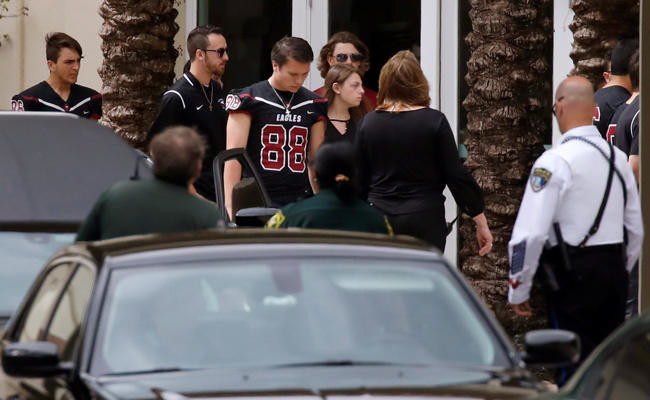
Sheriff says Florida school officer never went inside to confront gunman
Sheriff says Florida school officer never went inside to confront gunman
Latest updates


© 2026 SAUDI RESEARCH & PUBLISHING COMPANY, All Rights Reserved And subject to Terms of Use Agreement.