Peshawar High Court: Open Bala Hisar Fort to public

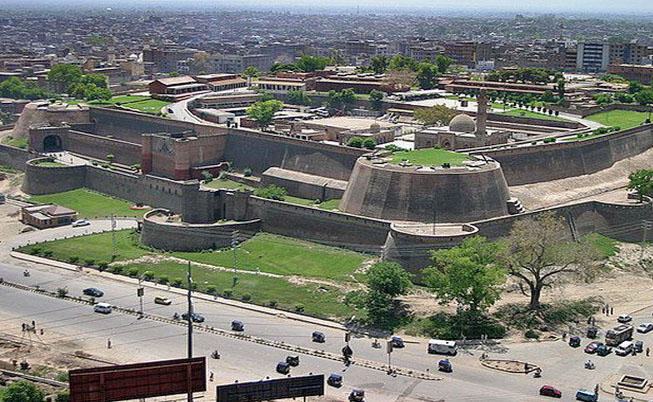
A general view of Bala Hisar fortress, in Peshwar. Bala Hisar was once the royal residence by the Durrani Empire, now houses the Pakistan's paramilitary, Frontier Corps headquarter since 1948. (Photo courtesy: social media)
Updated 22 February 2018
Follow

Peshawar High Court: Open Bala Hisar Fort to public

PESHAWAR: The Peshawar High Court has ruled that the 18th-century Bala Hisar Fort in the heart of the city should be open to the public.
The fort is currently home to a contingent of Pakistan’s paramilitary Frontier Corps (FC), which is engaged in Khyber Pakhtunkhwa (KP) province and the Federally Administered Tribal Areas (FATA).
The two-judge bench heard on Tuesday a petition filed by advocate Khurshid Khan, who argued that the fort is a historical landmark and should be open to the public so people can learn about the city’s history.
At an earlier hearing, the court directed the FC and the government to file their response, but they did not do so.
This prompted the court to rule that if the fort cannot be vacated, it should at least be open to the public and handed over to civil administration.
Abdul Munim, a member of the provincial assembly, said KP’s government supports the idea of handing over the fort to civil administration.
“According to our estimates, the Bala Hisar alone can boost KP’s tourism by almost 30 percent,” he told Arab News.
But a senior FC official told Arab News: “There’s sensitive gadgetry related to security that’s inappropriate for public viewership, as the law-and-order situation is already bad in the region.”
Both the civil administration and the FC refrained from officially commenting on the matter.
The fort, which was once used as a royal residence by the Durrani Empire, has housed the FC headquarters since 1948.
Bala Hisar means “elevated” or “high fort” in Dari Persian, and offers a panoramic view of the Peshawar valley. Parts of the fort are open to the public on Saturdays and Sundays.


Pakistan, seven Muslim nations back Palestinian technocratic body, stress Gaza-West Bank unity

Updated 15 January 2026
Follow

Pakistan, seven Muslim nations back Palestinian technocratic body, stress Gaza-West Bank unity

  • The National Committee for the Administration of the Gaza Strip was announced on January 14
  • Muslim nations call for consolidation of the ceasefire and unimpeded humanitarian aid into Gaza

ISLAMABAD: Pakistan and seven other Muslim-majority countries on Thursday welcomed the formation of a temporary Palestinian technocratic body to administer Gaza, stressing that it must manage daily civilian affairs while preserving the institutional and territorial link between the Gaza Strip and the West Bank amid the ongoing peace efforts.

In a joint statement, the foreign ministers of Pakistan, Egypt, Jordan, Saudi Arabia, Qatar, Türkiye, Indonesia and the United Arab Emirates said the newly announced National Committee for the Administration of the Gaza Strip would play a central role during the second phase of a broader peace plan aimed at ending the war and paving the way for Palestinian self-governance.

“The Ministers emphasize the importance of the National Committee commencing its duties in managing the day-to-day affairs of the people of Gaza, while preserving the institutional and territorial link between the West Bank and the Gaza Strip, ensuring the unity of Gaza, and rejecting any attempts to divide it,” the statement said.

The committee, announced on Jan. 14, is a temporary transitional body established under United Nations Security Council Resolution 2803 and is to operate in coordination with the Palestinian Authority, the ministers said.

The statement said the move forms part of the second phase of US President Donald Trump’s Comprehensive Peace Plan for Gaza, which the ministers said they supported, praising Trump’s efforts to end the war, ensure the withdrawal of Israeli forces and prevent the annexation of the occupied West Bank.

The top leaders of all eight Muslim countries attended a meeting with Trump in New York last September, shortly before he unveiled the Gaza peace plan.

The ministers also called for the consolidation of the ceasefire, unimpeded humanitarian aid into Gaza, early recovery and reconstruction and the eventual return of the Palestinian Authority to administer the territory, leading to a just and sustainable peace based on UN resolutions and a two-state solution on pre-1967 lines with East Jerusalem as the Palestinian capital.