AMMAN: Iraqi soldier Abdullah lost his left hand fighting the Daesh group but now he has a prosthetic one — thanks to a 3D printing lab in Jordan.
Abdullah was wounded in a mine blast as Iraqi forces battled to oust the jihadists from Iraq’s second city Mosul last year. His right hand was also seriously wounded.
The 22-year-old is one of a group of Iraqi, Syrian and Yemeni amputees to benefit from a 3D-printing prosthetics clinic at a hospital run by the medical charity Doctors Without Borders (MSF).
“It’s not easy to replace a hand, but at least the new device gives me some autonomy and means I don’t rely too much on my brother to eat,” said Abdullah, who asked not to use his real name.
Wearing jeans and a dark green shirt, he said he had been transferred from Mosul to a hospital in the Iraqi Kurdish regional capital Irbil before heading to Jordan.
“Now I feel better,” he said, managing a small smile. “I hope I can heal my right hand too.”
The 3D printing technique allows the team to create simple upper limbs without moving parts, slashing the costs of manufacturing advanced, custom-made prosthetic limbs, according to MSF.
The MSF Foundation, a wing of the charity dedicated to research and development, set up a prosthetics production center in Jordan’s Irbid last June.
A team of medics and technicians use the technique to help people born with genetic deformations as well as war wounded from across the region.
Doctors start by taking photos and measurements and sending them to the laboratory in Irbid, 100 kilometers (60 miles) north of Amman.
The data is entered into a system that designers use to create a virtual model of the limb, which is then printed and sent to MSF’s Al-Mowasah hospital in Amman for fitting.
Several organizations have developed 3D printing for amputees in recent years, but MSF says its project is a first in the Middle East.
The clinic aims to give orthopaedic care to as many people as possible affected by the region’s conflicts.
Project coordinator Pierre Moreau said it had treated 15 Syrians, Iraqis, Yemenis, Palestinians and Jordanians since its launch.
“We chose Jordan because we have one of the biggest hospitals and most advanced, and it is a stable place in the middle of a war region so we have access to patients from Syria, Iraq and Yemen,” he said in English.
It has also benefitted people born with deformities, such as seven-year-old Palestinian refugee Asil Abu Ayada from the Gaza camp northwest of Amman.
She lives with five brothers and her parents in a mud house, and was born without a right hand.
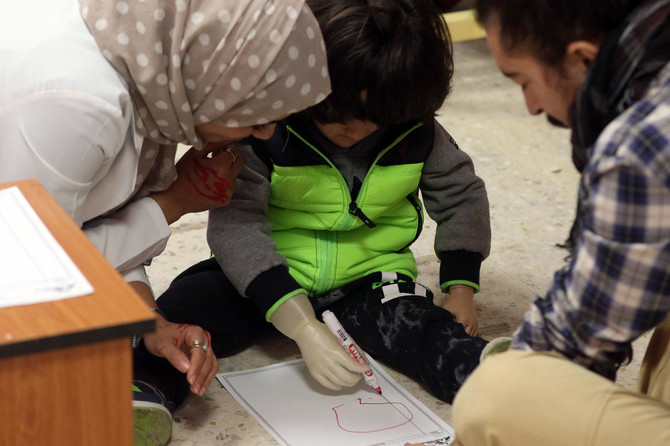
With her new prosthetic hand, she can now go to a normal school and even sketch drawings.
Too shy to speak to reporters, she sat manicuring her artificial fingers with the help of her sister Ines.
The 3D devices range in cost from $20 and $50 (euros) — a fraction of the cost of conventional prosthetic devices, which can cost thousands of dollars.
“You can design something that can suit this patient and is very specific to the activity of the patient,” Moreau said.
The new technique was developed by MSF in collaboration with “Fab Lab,” a digital manufacturing laboratory in Jordan.
Another beneficiary was Ibrahim al Mahamid, from Daraa in southern Syria, who suffered injuries to his left hand in a bombing raid in 2013.
A 33-year-old taxi driver, he had the hand amputated at a field hospital in Syria before moving to Jordan.
“The new prosthesis has given me hope to be able to go back to work and take care of family expenses,” he said.

Jordan 3D lab prints limbs for war wounded, disabled kids
Major airlines suspend, reroute flights amid US-Israel strikes on Iran
- Saudia says decision taken in line with aviation safety and security standards
- Emirates says regional airspace closures cause disruption to several of its flights
RIYADH: Major international airlines across the Middle East and South Asia have suspended, canceled or rerouted flights following ongoing US-Israel attacks on Iran and the resulting airspace closures, according to official statements issued via X.
Saudia said in an official statement that it had canceled a number of flights due to developments in the region and the closure of airspace. The airline said the decision was taken in line with aviation safety and security standards, noting that its Emergency Coordination Center is closely monitoring developments with relevant authorities. Saudia urged passengers to verify the status of their flights before heading to the airport and said guests would be notified of updates through the contact details associated with their bookings. The carrier added that further information would be announced in a subsequent statement if available.
بيان رسمي من #الخطوط_السعودية pic.twitter.com/CHfjKj9yLX
— Saudia Group | مجموعة السعودية (@SaudiaGroup) February 28, 2026
Air Arabia said its flights were experiencing cancellations, delays or rerouting as a result of the evolving situation and airspace closures. The airline advised passengers to check the status of their flights before traveling to the airport by visiting its website or contacting its call center. Customers booked on affected flights will be notified directly, the airline said, adding that further updates would be provided as the situation develops.
Air India announced a broader suspension, stating that “in view of the developing situation in parts of the Middle East, all Air India flights to all destinations in the Middle East have been suspended.” The airline said it remains committed to maintaining the highest standards of safety for passengers and crew and will continue to assess the safety and security environment for flight operations, adjusting services proactively as required. Air India said its teams would extend necessary support to passengers and advised customers to check flight status online or contact its 24/7 call center for assistance.
#TravelAdvisory
— Air India (@airindia) February 28, 2026
In view of the developing situation in parts of the Middle East, all Air India flights to all destinations in the Middle East have been suspended. We remain committed to maintaining the highest standards of safety for our passengers and crew. We will continue to…
Dubai-based Emirates reported that regional airspace closures had caused disruption to several of its flights. The airline said it is actively monitoring the situation, engaging with relevant authorities and adjusting operations in line with the latest developments. Emirates said it adheres to all regulatory requirements and follows guidance issued by aviation authorities. The carrier apologized to affected customers and said it is assisting them with rebooking, refunds or alternative travel arrangements, reiterating that the safety and security of passengers and crew remain its highest priority.
Due to multiple regional airspace closures, Emirates has temporarily suspended operations to and from Dubai.
— Emirates Support (@EmiratesSupport) February 28, 2026
Emirates urges customers to check https://t.co/Ucm3UswfVh and https://t.co/yehFUeWZQq for the latest updates before proceeding to the airport.
We are actively monitoring… pic.twitter.com/SLDC7iNaUN
Qatar Airways confirmed a temporary suspension of flights to and from Doha due to the closure of Qatari airspace. The airline said it is working closely with government stakeholders and relevant authorities to support impacted passengers and will resume operations once the airspace reopens. It warned that delays are anticipated when usual operations resume and said additional ground staff have been deployed at Hamad International Airport and other key airports to assist passengers.
Temporary Suspension of Qatar Airways Flights due to Qatari Airspace Closure
— Qatar Airways (@qatarairways) February 28, 2026
Qatar Airways Group confirms the temporary suspension of its flights to, and from, Doha due to the closure of Qatari airspace.
The airline is working closely with government stakeholders and the…
Meanwhile, Al Jazeera reported that British Airways had canceled flights to Tel Aviv and Bahrain, adding to the list of carriers adjusting operations.
Across their statements, airlines consistently cited airspace closures and safety considerations as the primary reasons for suspensions and disruptions, while urging passengers to monitor official channels for updates as the situation continues to evolve.


