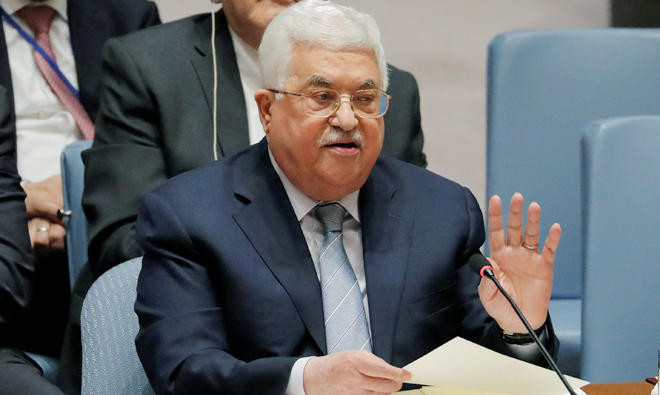
AMMAN: Palestinian President Mahmoud Abbas arrived in New York with the aim of convincing the world that Palestinians genuinely want peace through negotiations but that future talks should not be led solely by the US.
During his speech at the UN Security Council on Tuesday, he clearly succeeded in the first aim, but the second remains elusive.
Khalil Jahshan, executive director of the Arab Center Washington DC, told Arab News that Abbas “drove home the point of Palestinians wanting peace through negotiations, but this was a speech that should have been made 10 years ago.”
But he said the perception of Abbas’ departure before the Israeli and American ambassadors to the UN addressed the council was not encouraging.
“I concede he lost that small PR battle, but what is needed is substantive results and that doesn’t look good,” Jahshan said.
In his 33-minute address to the Security Council, the Palestinian president succeeded in reflecting the Palestinian desire for peace through negotiations.
Using the term “negotiations” 15 times, Abbas drove home Palestinian willingness to negotiate a peace deal. But the jury is still out on whether he succeeded in convincing the US and Israel to allow any other international party to co-chair future peace efforts.
Abbas came to New York after a global tour that took him to major European, Asian and African capitals with the aim of convincing major world powers to create a new peace formula.
The official Fatah spokesman and former UN envoy, Nasser Al-Qudwa, said Palestinians will accept any approach, except one with the US solely in charge.
“We can live with different formats, with P5, P5+, we can live with expanded quartet, and we can live with an international peace conference — anything that can do the job, provide the reasonable basis for negotiations, follow up the process, and sponsor it until it successfully concludes,” he said.
Anees Sweidan, head of external relations in the PLO, told Arab News that the US was not interested in peace talks. “They want to dictate an agreement and not to actually conduct talks about it.”
Abbas had managed 65 days without any face-to-face meetings with US officials following President Trump’s Dec. 4 announcement that the US embassy would be moved to Jerusalem, a decision that angered Palestinian, Arab and global leaders.
During this period the Palestinian Central Council sharply reduced contact with Israel on economic and security matters.
Following his speech, an unhappy Abbas left the Security Council hall without waiting to hear from the US or Israel.
After attacking Abbas and Saeb Erekat, the Palestinian negotiator, and siding only with the suffering of the Israelis, the US Ambassador to the UN, Nikki Haley, said that the American negotiating team is ready to talk but that the US will not seek out the Palestinians.
Israel’s UN representative Danny Danon criticized the Palestinian leader, saying that all Abbas had to do was travel 12 minutes to meet the Israelis instead of traveling 12 hours by plane to New York.
Marwan Muasher, a former Jordanian foreign minister and current vice president of studies at the Carnegie Endowment for International Affairs, told Arab News that Abbas has taken a difficult path by insisting on peace talks while rejecting the US as sole arbiter.
“While some might argue that the Americans are the only game in town in as far as the ability to get Israel to engage, it is clear Abu Mazen (Abbas) is not ready to play,” he said.
Abbas has stuck with the negotiations track and the UN, even though “we all know that it will be futile,” Muasher added.


![]()
Abbas treads a difficult path in bid to thwart US peace role
Abbas treads a difficult path in bid to thwart US peace role

Latest updates


Recommended


© 2026 SAUDI RESEARCH & PUBLISHING COMPANY, All Rights Reserved And subject to Terms of Use Agreement.