Crash forces Mark Cavendish out of Abu Dhabi Tour

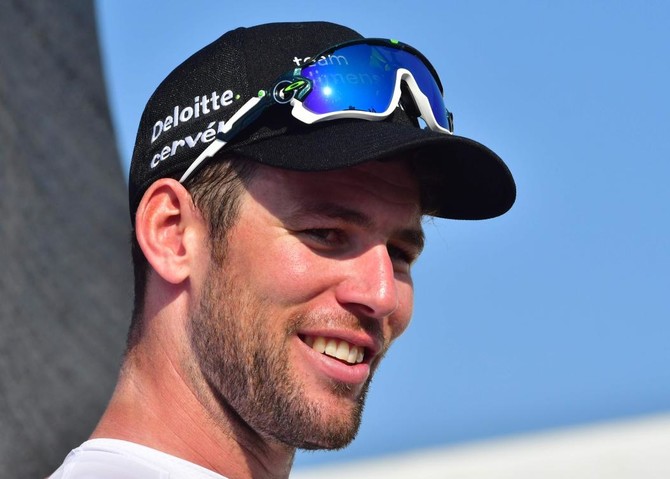
British rider Mark Cavendish (AFP/Giuseppe Cacace)
Updated 21 February 2018
Follow

Crash forces Mark Cavendish out of Abu Dhabi Tour

ABU DHABI: British sprint king Mark Cavendish made an early exit from the Abu Dhabi Tour on Wednesday after crashing before the official start of the first stage.
“Mark Cavendish went down in the neutral zone, falling on the same shoulder he broke last year. He got up and chased back to the peloton but had to abandon soon after. More info to come after medical check,” tweeted Team Dimension Data.
The former world champion collided with a car that had braked suddenly before reaching the start line in the western desert of Madinat Zayed, according to the official Abu Dhabi television channel.
Cavendish, who appeared to be suffering from shoulder and neck pain, was examined by a doctor and attempted to re-enter the peloton but bowed out a few kilometers later.
The 32-year-old, who won the third stage of the Dubai Tour on February 8, was one of the headliners of the five-stage Abu Dhabi Tour, which includes three stages particularly favorable to sprinters.
Cavendish was forced to abandon the Tour de France last year after a heavy crash at the fourth stage finish line left him with a broken shoulder, triggering the disqualification of winner Peter Sagan.


US invests in counter-drone tech to protect FIFA World Cup venues

Updated 13 January 2026
Follow

US invests in counter-drone tech to protect FIFA World Cup venues

The US will invest $115 million in counter-drone measures to bolster security around the FIFA World Cup and ​America’s 250th Anniversary celebrations, the Department of Homeland Security said on Monday, the latest sign of governments stepping up drone defenses.

The FIFA World Cup will be a major test of President Donald Trump’s pledge to keep the US ‌secure, with over ‌a million travelers expected ‌to ⁠visit ​for ‌the tournament and billions more watching matches from overseas.

The threat of drone attacks has become a growing concern since the war in Ukraine has demonstrated their lethal capabilities. And recent drone incidents have worried both ⁠European and US airports.

“We are entering a new era ‌to defend our air ‍superiority to protect our ‍borders and the interior of the ‍United States,” DHS Secretary Kristi Noem said in a statement. Defense companies are developing a range of technologies aimed at countering drones, including ​tracking software, lasers, microwaves and autonomous machine guns.

The DHS did not specify ⁠which technologies it would deploy to World Cup venues. The announcement comes weeks after the Federal Emergency Management Agency, which sits under DHS, said it granted $250 million to 11 states hosting World Cup matches to buy counter-drone technologies.

Last summer, New York Governor Kathy Hochul, a Democrat, called on Trump, a Republican, to bolster federal support for ‌defending against drone attacks.