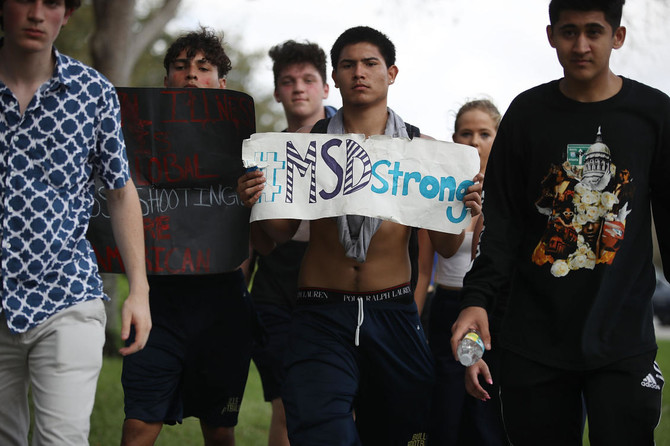
TALLAHASSEE, Florida/WASHINGTON: Dozens of teenaged survivors of the second deadliest public school shooting in US history marched on Florida’s capital on Wednesday to ask lawmakers to ban sales of assault rifles of the sort used to kill 17 students and educators last week.
Marjory Stoneman Douglas High School in Parkland, Florida, became the latest school targeted by a gunman using a semi-automatic AR-15 assault rifle, heated up the nation’s long-running debate about gun rights and public safety.
Dressed in jeans and T-shirts and carrying signs with the slogan “#Neveragain,” survivors of the Feb. 14 mass shooting met with lawmakers in Tallahassee, to ask for stricter controls on gun sales.
Investigators said the assault was carried out by 19-year-old former student Nikolas Cruz, who purchased an AR-15 nearly a year ago. Police have charged Cruz, who had been kicked out of Douglas for disciplinary problems, with 17 counts of premeditated murder.
“We want to see some common sense gun laws so this will never happen again,” said Rachel Padnis, a 16-year-old sophomore from the school near Fort Lauderdale.
She and classmates said they were dismayed but undeterred by the state’s Republican-controlled legislature’s Tuesday rebuff of a bid to bring up a bill to block sales of assault rifles.
President Donald Trump, a strong supporter of gun rights, was due to meet later Wednesday with parents, students and teachers who have been victims of gun violence, including those affected by the Valentine’s Day shooting in Florida.
The White House meeting comes a day after Trump said his administration would take steps to ban bump stocks, an accessory that enables a rifle to shoot hundreds of rounds a minute. A spokeswoman said the administration was open to the idea of setting national age limits on sales of assault rifles.
Florida state Sen. Bill Galvan, slated to be the upper chamber’s next president, has called for a bill to raise the legal age for purchasing assault rifles from 18 to 21, the same as it is for handguns.
At the Florida capital in Tallahassee, dozens of students packed into a meeting room and peppered Senate President Joe Negron, a Republican, with questions about why individuals should have continued access to assault rifles.
Negron declined to say whether he would support any specific gun control measures, saying, “That’s an issue we’re going to look at as we work to develop legislation.”
Trump talks
US President Donald Trump, a strong supporter of gun rights, was scheduled to host a “listening session” with high school students and teachers at the White House on Wednesday.
Trump’s support for any tightening of gun laws would mark a change for a Republican who was endorsed by the National Rifle Association gun lobby during the 2016 presidential campaign.
The NRA opposes an outright ban on bump stocks but has said it would be open to restrictions on the devices.
Under pressure after Parkland, the deadliest-ever shooting at a US high school, Trump on Tuesday directed the Justice Department to quickly complete a proposed rule that would treat “bump stocks” as machine guns, which could effectively outlaw them in the US.
Last October, a retired real estate investor and high-stakes gambler used multiple assault rifles equipped with bump stocks to kill 58 people at a Las Vegas outdoor concert, the deadliest attack by a single gunman in US history. Bump stocks have not played a prominent role in other recent US mass shootings.
Later this week, Trump will meet with local and state officials, and plans to talk with governors about the issue.
Trump generally favors a Senate bill on background checks, White House press secretary Sarah Sanders said Tuesday.
Calls for national student walk-outs and marches in the coming months have gained steam on social media, including the “March for Our Lives” on March 24 in Washington, spearheaded by Douglas students.
Scattered school walkouts in support of the Florida students were planned around the US on Wednesday, according to officials and local media.
The NRA has agreed to participate in a televised town hall on guns to be broadcast by CNN later today, the news network said. NRA officials did not immediately respond to requests for comment.
Gun violence on public school and college campuses has become so commonplace in the US in the last several years that administrators regularly stage drills to train students and staff in the event of a mass shooting.


Florida school massacre survivors push lawmakers for assault gun ban
Florida school massacre survivors push lawmakers for assault gun ban

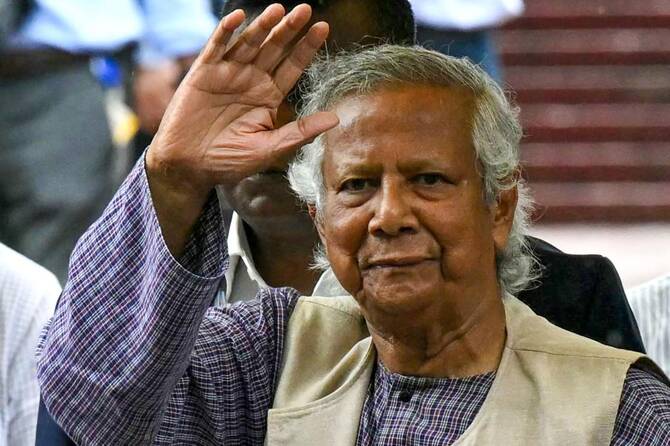
Bangladesh’s Yunus announces resignation, end of interim govt
- Yunus handed over power after congratulating the Bangladesh Nationalist Party and its leader Tarique Rahman
DHAKA: Bangladesh’s interim leader Muhammad Yunus stepped down on Monday in a farewell broadcast to the nation before handing over to an elected government.
“Today, the interim government is stepping down,” the 85-year-old Nobel Peace Prize winner said.
“But let the practice of democracy, freedom of speech, and fundamental rights that has begun not be halted.”
Yunus returned from self-imposed exile in August 2024, days after the iron-fisted government of Sheikh Hasina was overthrown by a student-led uprising and she fled by helicopter to India.
“That was the day of great liberation,” he said. “What a day of joy it was! Bangladeshis across the world shed tears of happiness. The youth of our country freed it from the grip of a demon.”
He has led Bangladesh as its “chief adviser” since, and now hands over power after congratulating the Bangladesh Nationalist Party (BNP) and its leader Tarique Rahman on a “landslide victory” in elections last week.
“The people, voters, political parties, and stakeholder institutions linked to the election have set a commendable example,” Yunus said.
“This election has set a benchmark for future elections.”
Rahman, 60, chief of the BNP and scion of one of the country’s most powerful political dynasties, will lead the South Asian nation of 170 million.
Rebuilt institutions’
Bangladeshi voters endorsed sweeping democratic reforms in a national referendum, a key pillar of Yunus’s post-uprising transition agenda, on the same day as the elections.
The lengthy document, known as the “July Charter” after the month when the uprising that toppled Hasina began, proposes term limits for prime ministers, the creation of an upper house of parliament, stronger presidential powers and greater judicial independence.
“We did not start from zero — we started from a deficit,” he said.
“Sweeping away the ruins, we rebuilt institutions and set the course for reforms.”
The referendum noted that approval would make the charter “binding on the parties that win” the election, obliging them to endorse it.
However, several parties raised questions before the vote, and the reforms will still require ratification by the new parliament.
The BNP alliance won 212 seats, compared with 77 for the Jamaat-e-Islami-led alliance, according to the Election Commission.
Jamaat chief Shafiqur Rahman conceded on Saturday, saying his Islamist party would “serve as a vigilant, principled, and peaceful opposition.”
Newly elected lawmakers are expected to be sworn in on Tuesday, after which Tarique Rahman is set to become Bangladesh’s next prime minister.
Police records show that political clashes during the campaign period killed five people and injured more than 600.
However, despite weeks of turbulence ahead of the polls, voting day passed without major unrest and the country has responded to the results with relative calm.